

Scientists have long assumed that Venus’ harsh environment would quickly destroy artifacts from probe missions. But a new study convincingly demonstrates the opposite.
By Emma Gomez edited by Lee Billings
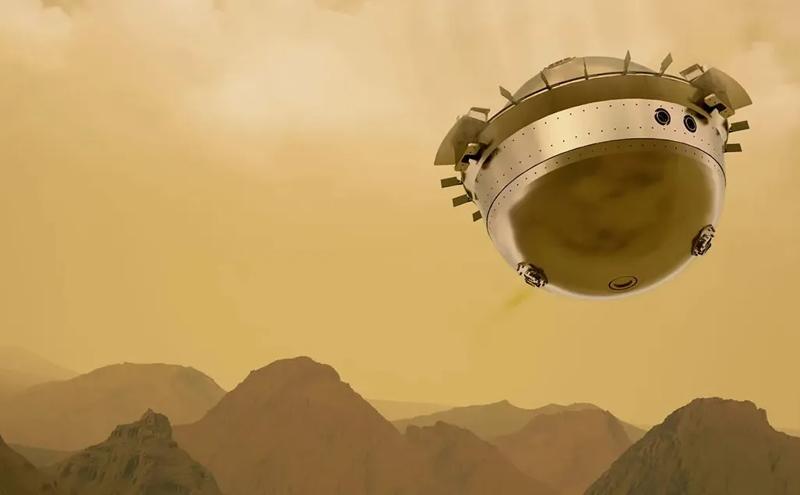
Artist’s impression of NASA’s DAVINCI probe descending toward the surface of Venus.
NASA
When international space agencies send probes into the solar system, many of them are abandoned, expire and deteriorate on alien terrain. But if they are still there, can we learn anything from them?
Space archaeologists have mostly ignored the objects sent to our sister world, Venus. Sometimes called “Earth’s evil twin,” Venus is almost identical to our own planet in simple terms of mass and overall composition, although with quirks that make it extremely inhospitable to humans and machines. Many researchers had assumed that any robotic missions sent there would succumb so completely to Venus’ brutal combination of scorching surface temperature and crushing atmospheric pressure that few would be left for further study. And volcanic eruptions and landslides caused by “Venus quakes” could bury whatever was left in a very short geologic time frame.
But last month, space archaeologists published an article this suggests that the Venusian environment could preserve the probes much better than once thought.
On supporting science journalism
If you enjoy this article, please consider supporting our award-winning journalism by subscribe. By purchasing a subscription, you are helping to ensure the future of impactful stories about the discoveries and ideas shaping our world today.
Of 20 probes, landers and balloons sent by the United States and the Soviet Union that reached the surface of Venus over the past 60 years, the study found that at least seven were likely rugged enough to withstand a hostile environment and ended up in places on the planet where they were not under imminent threat of burial or geological destruction. “That doesn’t mean the others can’t be preserved,” says space archaeologist and independent researcher Luca Forassiepi, one of the study’s co-authors. “But I would say that for those seven…I can’t find any reason not to think they’re still there.”
Reaching this conclusion required somehow replicating the harsh realities of Venus right here on Earth. The planet’s surface is roasting at about 460 degrees Celsius (860 degrees Fahrenheit), about twice the temperature required to melt pure tin. The surface is also under a pressure of 90 bars, nearly 100 times that of sea level on Earth, from a sweltering sky filled with almost pure carbon dioxide and mixed with corrosive rains of sulfuric acid.
The study’s authors used data from NASA’s Glenn Extreme Environments Rig (GEER), which recreated the Venusian environment, to conduct a case study of how the U.S. Pioneer Venus Day Probe may have performed after diving into the clouds of Venus in 1978. The probe was made mostly of titanium, with beryllium shelves and aluminum equipment boxes inside. GEER tests showed that titanium exhibits “excellent resistance” to Venus’ surface conditions, so the probe should have largely retained its shape, the authors wrote. The aluminum parts of the probe showed similar resilience.
The GEER data, however, suggests that the probe’s O-rings, responsible for maintaining its internal pressurization, would likely have failed following prolonged exposure to Venus’ environment. Weakened by a brief but corrosive bath of sulfuric acid droplets during its dive, the probe would inevitably have deformed and broken upon reaching the ground. But that doesn’t mean it would have been completely destroyed, far from it.
“There must be some sort of deformation, of course, and compression as the Venus atmosphere enters and very oxidized and very corroded metal,” says Forassiepi. “I am hopeful that [if we ever] If we have a probe with the imaging capability to image an artifact on the surface, we will see it in the same place we left it.
The Pioneer Venus Day Probe is just one of 20 objects studied, most of which were not American-made. But due to the relative lack of accessible documents from the Soviet era, Forassiepi and his co-authors chose this investigation as a case study.
Their survey also assessed what we currently know about Venus’ surface conditions in the areas where all the probes landed. It took into account estimates of volcanic and seismic activity, radiation levels, meteorite impact rates and even the manner and speed with which sediment accumulates on the ground. Most of the probes, the researchers found, should still be visible, even if not entirely intact on the surface – and the chances of long-term survival appear favorable because Venus’ geological activity is much slower than Earth’s, with much lower levels of volcanism and tremors.
The question of how Venus’ atmosphere affects probes isn’t just about the past: The list of artifacts could soon grow as more probes are expected to land on Venus. NASA’s Deep Atmosphere Venus Investigation of Noble Gases, Chemistry and Imaging (DAVINCI) mission, tentatively scheduled for 2030, aims to release a probe intended to land on the planet’s surface and capture images and data. Furthermore, the Massachusetts Institute of Technology and the company Rocket Lab are considering a launch date in 2026 for the probe of their private mission to Venus.
The paper “expands the scope of space archaeology,” says Beth O’Leary, a space archaeologist and professor emeritus at New Mexico State University, who was not involved in the study but is mentioned in the paper’s acknowledgments. “Forassiepi has expanded this to a place where we [once] said: “Forget it. There will be nothing there.
Space archeology provides insight into past technological innovation and can help us plan future space missions and engineering projects. But it also preserves human history and what scientists call “space heritage.”
“Venus is part of this general effort to study all of our material traces in the solar system,” says Forassiepi. “The fact that it is very difficult to access does not diminish the cultural and historical value.”
It’s time to defend science
If you enjoyed this article, I would like to ask for your support. Scientific American has been defending science and industry for 180 years, and we are currently experiencing perhaps the most critical moment in these two centuries of history.
I was a Scientific American subscriber since the age of 12, and it helped shape the way I see the world. SciAm always educates and delights me, and inspires a sense of respect for our vast and magnificent universe. I hope this is the case for you too.
If you subscribe to Scientific Americanyou help ensure our coverage centers on meaningful research and discoveries; that we have the resources to account for decisions that threaten laboratories across the United States; and that we support budding and working scientists at a time when the value of science itself too often goes unrecognized.
In exchange, you receive essential information, captivating podcastsbrilliant infographics, newsletters not to be missedunmissable videos, stimulating gamesand the best writings and reports from the scientific world. You can even give someone a subscription.
There has never been a more important time for us to stand up and show why science matters. I hope you will support us in this mission.