Forget water features – a tiny pond will bring wildlife to your garden
You might think ponds are complicated things with liners, but you can make one from a washing-up bowl Do you remember the 90s, when everyone was obsessed with “water features”, mostly thanks to Charlie Dimmock? There have been a fair few naturalistic streams (such as A Rewilding Britain Landscape by Lulu Urquhart and Adam Hunt, with beaver-gnawed twigs, which controversially won best in show in 2022), but scant fountains or burbling rocks.
You might think ponds are complicated things with liners, but you can make one from a washing-up bowl
Do you remember the 90s, when everyone was obsessed with “water features”, mostly thanks to Charlie Dimmock? A simpler time. Perhaps I’m hanging out with the wrong garden designers, but I rarely hear much talk of water features now. For years, Chelsea flower show gardens have featured subtle Cor-Ten steel-clad trickles or elegant mirrored ponds. There have been a fair few naturalistic streams (such as A Rewilding Britain Landscape by Lulu Urquhart and Adam Hunt, with beaver-gnawed twigs, which controversially won best in show in 2022), but scant fountains or burbling rocks. Water features are out, I guess. Ponds are in.
My mum built one the other day. Hers is smaller than a piece of A3, lined with rocks and terracotta seedling pots, with two metal ducks stuck around the edge in a boggy bit of her compact urban garden. You might hear “pond” and think complicated things involving liner and algae, but you could make one from a washing-up bowl – and there are plenty of benefits to doing so.
Ponds are brilliant for wildlife. They can play host to insects including dragonflies and damselflies, and lure frogs and newts, which makes them a delicious buffet for birds, bats and those increasingly rare hedgehogs. I made one because I wanted something to eat slugs. It’s just a helpful part of the garden ecosystem to encourage.
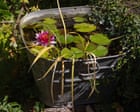
Smaller – or “micro” – ponds are ideal for those with small children and/or small gardens. I’ve had one in an old galvanised bucket for the past five years. You get bonus points for reusing something, and this is where I once again mention plastic storage boxes. Essentially, you just need a container that doesn’t leak water. And if it does leak water, you can use a pond liner.
Whether you sink your pond into the ground or have it sitting on top is up to you. Make sure it gets some light, but if it’s in full sun you’ll end up with a lot of algae. Cover the bottom with large rocks, bits of old brick, upturned plant pots – hard solid things that won’t move for smaller wildlife to perch on, arranged in a way that helps them get in and out of the pond.
Once you’ve filled up your pond with rainwater, you can plant. I’ve been really surprised by the resilience and variety of aquatic plants in my micropond, which has been largely left to its own devices. My receipts suggest I cheated and bought the Container Planting Scheme D for Shade from Waterside Nursery, which delivered four plants in mesh baskets ready to pop in. Five years on and the yerba mansa offers delicate creamy flowers against the slender club rush.
Pond life: easier than you think. Just don’t go calling it a water feature.
- pond
- water
- garden
- feature
- wildlife
- thing
- liner
- washing