‘Swift justice’: Student List supporters focus on cleaning up Serbia’s rotten institutions
After improbable election victory, the unconventional grassroots movement says it will prioritise dismissal of corrupt officials In Belgrade’s Pioneers Park, just across from the national assembly, a small crowd craned their necks to listen. Having spent days bathing in the euphoria of their unexpected triumph, the candidates’ focus was now clear: the cleaning up of the rotten institutions that had increasingly blighted the lives of Serbs over the 14 years of government by the populist leader Aleksandar Vučić and his Serbian Progressive party (SNS).
After improbable election victory, the unconventional grassroots movement says it will prioritise dismissal of corrupt officials
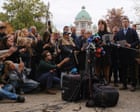
In Belgrade’s Pioneers Park, just across from the national assembly, a small crowd craned their necks to listen. One woman held aloft a placard reading “Love prevailed for the people and Serbia”. With a bouquet of media microphones in front of them, members of the Student List, the direct democracy movement that won an improbable but decisive victory in Sunday’s election, gathered under the trees.
Having spent days bathing in the euphoria of their unexpected triumph, the candidates’ focus was now clear: the cleaning up of the rotten institutions that had increasingly blighted the lives of Serbs over the 14 years of government by the populist leader Aleksandar Vučić and his Serbian Progressive party (SNS). They called for the dismissal of many senior law enforcement officials, among them the chiefs of the criminal police, the paramilitary gendarmerie and an anti-terrorism unit.
Student List candidate Svetlana Stanarević was applauded when she accused the officials of violating the law. She also called for the director of Serbia’s internal intelligence agency to resign, accusing him of running the organisation as “a party security service, not a state security service”.
There was approval, too, for the “reopening or expediting of cases” related to the disaster that sparked the student protest movement. Sunday will mark the second anniversary of the canopy collapse that killed 16 people at a renovated railway station in Serbia’s second city, Novi Sad. There have yet to be any convictions.
The announcements on Thursday were the Student List’s way of stressing they intended to put anti-corruption efforts at the heart of government.
“For years, for decades, people have been really frustrated,” said Iva Marković, a Student List candidate and political ecologist who founded the Right to Water initiative. “We see this as a time where everyone who was honestly and credibly working within [public] institutions can do their jobs. They are no longer under political pressure, and we ask them to do their jobs, which also means for prosecutors to prosecute, and police to investigate.”
Reinforcing the student movement’s key principles is also a way, perhaps, to allay concerns that the Student List might not know how to handle its stunning victory over Vučić and the SNS. The movement is not a traditional party. It does not have a hierarchy or leader – and although the students selected the list of candidates, they will not have any direct control over the people who have been elected, once they have been sworn in as MPs.
Marković said the common commitment the students and their parliamentary candidates had made should not be underestimated.
“The process didn’t start with the elections,” she noted, adding that preventing “individualism” from undermining core goals had been key to the student movement’s success. “When you dream together with some people, it’s very hard to forget this dream, even if you are in parliament.”
Borko Stefanović’s choice of a pizzeria themed around ’Allo ’Allo! as a meeting place reflects Serbia’s enthusiasm for British sitcoms of a certain vintage. Only Fools and Horses is a particular favourite, with its tales of thwarted schemes and broken dreams chiming strongly in a country that has been through turbulent times since the early 1990s.
Stefanović knows this better than most. He was part of the political movement opposed to Slobodan Milošević – and saw the democratic coalition that emerged from the overthrow of Serbia’s notorious former president fritter away its early promise. It is not a film he cares to watch a second time.
“There is this almost legendary saying in Serbia that we won on the 5th of October [2000] over Milošević, but we never had the 6th of October,” he said, adding that the Student List was correct to prioritise the dismissal of corrupt officials.
“Get the right people in the right places, bring swift legal justice, liberate institutions and the media, and allow the prosecutor’s office to arrest criminals. Everyone who wants to contribute to the reforms needs to get on board and to do everything we can to make this excellent example in Europe a lasting one.”
Perched on a sofa in a coffee roastery in Belgrade’s old town, Tara Blagojević was convinced the movement she has been a part of already had the right people in place. With the elections over, she said it was down to the successful candidates to form a government. The student assemblies will take a less active role, acting as “advisers or kind of supervisors”.
“Everything’s going to be fine,” Blagojević insisted, adding that although the Student List was “kind of a political experiment”, the people who will soon be sworn in as MPs “recognise each other’s strengths and are able to project who can be suitable to do certain things within the new government”.
Slobodan Tomić is optimistic about the Student List’s prospects. The Belgrade-born political scientist at the University of York has been following the student movement since its inception. “It is an extraordinary change,” he said of the party’s unconventional structure. “I couldn’t find any example across the world of anything similar happening.
“The MPs had to sign a pledge that they would follow through the programme that the Student List had created. So on paper, there isn’t much space for drift.”
The organisers of the famous Exit music festival are also convinced. They moved the event out of the country this year in protest at the policies of Vučić and the SNS. They confirmed that Exit would return to its home in Novi Sad next year.
The news further energised the crowd at Belgrade’s first big gig since the election, where the euphoria showed no sign of subsiding. Chants of “Victory!” welcomed Fontaines DC on stage among the shipping containers at the port of Belgrade. “Congratulations,” responded the Irish singer Grian Chatten. “This is your moment, not ours.”
A former punk rock bassist himself, Stefanović is sure that assessment is correct. “These wonderful, wonderful people from the Student List and the student movement, they know exactly what needs to be done,” he said. He added just one caveat from experience: “Don’t blow it.”
- student
- list
- serbia
- justice
- institution
- election
- victory
- movement