What the rift within the Tsikhanouski family means for the Belarusian opposition in exile
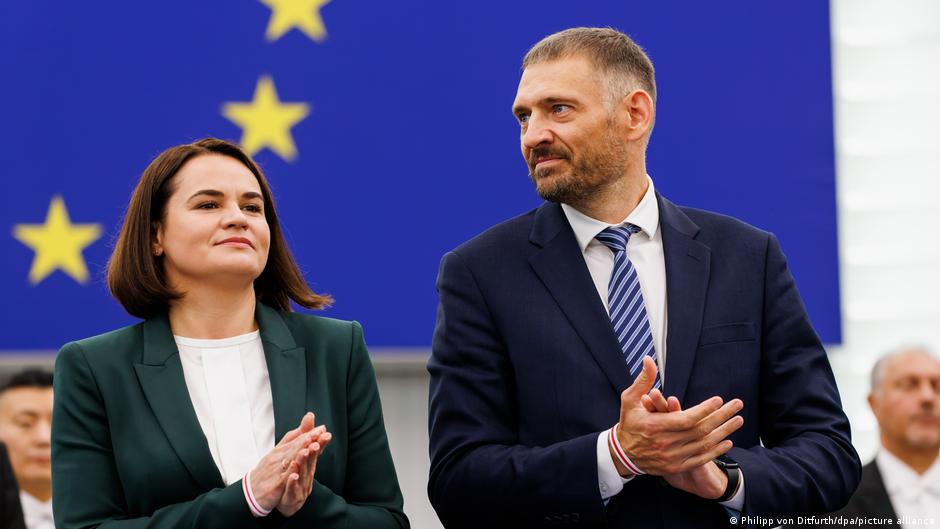
Siarhei Tsikhanouski criticizes the work of his wife, Sviatlana Tsikhanouskaya, and her office. What are the implications for Belarusian political forces in exile?
Blogger and dissident Siarhei Tsikhanouski , 48, was detained in Belarus in May 2020, after he had announced to challenge the country's ruler, Alexander Lukashenko, in the upcoming presidential elections. In December 2021, Tsikhanouski was convicted to 18 years in prison, in part for organizing "mass unrest."
After his arrest his wife, Sviatlana Tsikhanouskaya, took his place and challenged Lukashenko as presidential candidate. Despite allegations of large-scale vote-rigging, Lukashenko was declared the winner of the election in August 2020. This triggered unprecedented mass protests across the country. They were violently suppressed, and thousands of government critics were arrested or fled into exile. Tsikhanouskaya also fled her homeland and became the leading representative of the Belarusian democratic movement.
In June 2025, Siarhei Tsikhanouski was released after nearly five years in prison and was forcibly taken out of the country.
Some 14 months after his release, the blogger has re-activated his YouTube channel, where he not only denounces Alexander Lukashenko's regime, but also Sviatlana Tsikhanouskaya's office, Belarusian media in exile, political analysts and others. Thousands of people follow his streams.
In one of them, Tsikhanouski claims that while Sviatlana Tsikhanouskaya obviously enjoyed "a certain legitimacy from the European Union," the people who were living "quietly and silently" in Belarus today had not granted her any. He said that many of those who had voted for her as joint candidate of Belarus' opposition were regretting this today.
Tsikhanouski has suggested that a supervisory board should be established under the label "United Office of Demoratic Forces." It would be made up of "former presidential candidates, protest leaders and iconic figures of the revolution," including himself and his wife. "There would not be a full legitimacy but one which was at least granted by Belarusians," Tsikhanouski said, adding that such a supervisory board could oversee the distribution of grant funds.
Speaking about his wife, he said: "Sviatlana Tsikhanouskaya was a so-called technical candidate, who received the votes of all those who were against Lukashenko. The percentage of votes she received in the 2020 election was negligible because no one knew who she was. She was allowed to run because she did not pose a threat for the regime, and because she had neither supporters nor political experience."
Asked by DW what his goals were, Siarhei Tsikhanouski refused to comment and referred to his livestreams instead. The former political prisoner is residing in the US and is, by his own account, currently unemployed. At the beginning of summer he said he was living in Los Angeles, learning English, preparing for university studies and writing a book. It is also known that his children — a teenage son and a younger daughter — temporarily stayed with him in the US. Today, however, they attend school in Poland, where Tsikhanouskaya resides.
Neither she nor her office have commented on the family situation or her husband's allegations. Even before the public dispute, the leader of the Belarusian democratic forces avoided commenting on her husband. Asked about his activities, she often suggested to approach him directly.
Speaking to DW in December 2025, Sviatlana Tsikhanouskaya merely said: "What happens in the public sphere and what happens at home, are different things. I understand Siarhei's deep traumatization and also his very strong reactions to certain events. Siarhei was in prison for five years, and I look at it with great understanding. This is why I'm not going public or making any comments. We'll deal with it among ourselves."
During the 32-year-long rule of the Lukashenko regime, the Belarusian opposition has weathered many crises and conflicts. Sviatlana Tsikhanouskaya's leadership role has been called into question more than once. However, she and her team have always managed to work themselves out of difficult situations during the last couple of years. But will she still be able to do that now, with her own husband having turned into her critic?
Siarhei Tsikhanouski had gone back to his own self, said political scientist Yury Drakakhrust: "With all his idiosyncrasies, his style of debate, which is not exactly in line with common practice. This is likely to strike many as odd, including Sviatlana Tsikhanouskaya's international partners."
Tsikhanouski, Drakakhrust pointed out, insisted that he was the key figure of the 2020 events, which is why he was entitled to all the benefits, privileges, recognition and invitations. But there was no way back.
"Even if we assume that Tsikhanouski is right, that he was the central figure, what good would it do today?" he asked. "If, suddenly, hundreds of thousands of Belarusians watched his livestreams, collected funds, formed local groups or associations in Tsikhanouski's name, then perhaps it would be possible to turn back the wheel. But this will hardly be the case."
Drakakhrust described the current situation within the democratic forces as a "crisis." He doubted that Tsikhanouski would be able to reach an agreement with all the members of the supervisory board he has proposed. Furthermore, his wife, in particular, had since established certain assets, resources, and a status for herself through her office.
"Tsikhanouskaya is being received at high levels, if not as an elected president, then as a leader for Belarus and Belarusian democracy. She's not regarded as just one of several democratic leaders from Belarus," the political scientist said.
He pointed out that not only Tsikhanouskaya, but also other actors from the 2020 election campaign are in exile. They, however, had not achieved a similar level of representation or comparable access to resources. "She has surpassed them as a politician, and that's what counts."
Drakakhrust said that the Belarusian government views disputes among the opposition with a touch of irony, occasionally adding fuel to the fire: "Basically, they don't care who wins. The main thing is that there is conflict, bickering and mutual vilification."
- tsikhanouski
- exile
- rift
- family
- opposition
- siarhei
- work
- wife