What to know about California’s midterm elections

Redistricting in California, the most populous US state, could flip control of US House from Republican to Democrat.
As voters across the United States head to the polls for the midterm elections – widely seen as a referendum on President Donald Trump’s second term in office – the state of California is set to play an important role.
Several races across the country’s most populous state could help determine whether the Democratic Party takes control of the US House of Representatives, where Trump’s Republican Party currently holds a slim majority.
California’s ballot initiatives – or policy decisions made by voters – have also received national attention.
Perhaps the biggest difference in this year’s elections, however, is the introduction of new congressional district maps drawn up through a partisan redistricting initiative approved by California voters last year.
That initiative aims to net at least five additional Democratic Party seats in the House, where Republicans have a four-seat majority.
Which California races are competitive, who are the main candidates and how has the state’s redistricting push changed the electoral landscape?
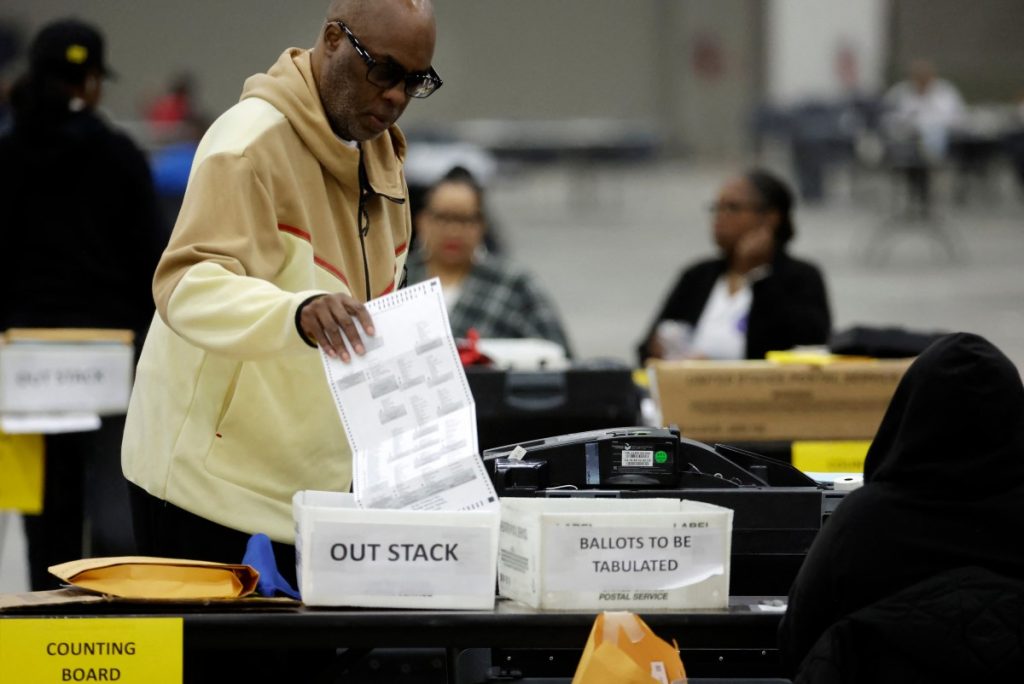
The election will be held on Tuesday, November 3. California polls will be open from 7am (15:00 GMT) to 8pm (04:00 GMT Wednesday). Mail ballots must be postmarked by election day.
The House is divided into 435 districts, each represented by one member of Congress elected by their constituents. While congressional districts are populated equally, their boundaries are set by states and can shift.
Partisan redistricting involves states drawing those district maps in a way that advantages candidates from one party over another.
California Governor Gavin Newsom, a Democrat and Trump critic, first proposed a one-time statewide redistricting effort in response to seven Republican-led states redrawing their maps in an attempt to secure seats for Republicans. Although California had banned partisan redistricting, Newsom pitched the idea as an unfortunate but necessary retaliatory measure.
California voters approved the redistricting plan in a 2025 ballot measure – Proposition 50 – that temporarily suspended the state’s nonpartisan redistricting commission until 2030. California then drew new maps to make several Republican strongholds more competitive for Democratic challengers.
As a result, the handful of districts previously seen as favourable terrain for Republicans have instead become hotly-contested races between the two parties.
California has 52 members in the House of Representatives – the most of any state – with Republicans holding just eight of the seats. There are several closely watched state races in the Democratic Party’s effort to secure a majority in the House, the lower chamber of the US Congress.
One is the 22nd congressional district, located in California’s agriculture-rich Central Valley. The district map was redrawn under Proposition 50, setting up one of the state’s most contentious races in a former Republican stronghold.
Incumbent Republican Representative David Valadao is locked in a tight race with Democratic challenger Randy Villegas. Valadao has portrayed himself as a moderate, while Villegas has hammered him over issues such as the rising cost of living, healthcare and Trump’s immigration crackdowns – a key issue for the area’s immigrant farm-working communities.
California’s 48th district, a traditionally Republican stronghold which includes parts of San Diego County near the border with Mexico, is also considered highly competitive after its boundaries were redrawn. The district’s longtime representative, Republican Darrell Issa, decided to retire after the redistricting, with two local officials – Republican Jim Desmond and Democratic San Diego Councilmember Marni von Wilpert – now vying for the seat.
While California’s redistricting aimed to make historically reliable Republican districts more competitive for Democrats, the process has also had some unexpected impacts: Two Republican members of Congress, Representatives Ken Calvert and Young Kim, have found themselves locked in a bitter race against each other after redrawn maps put them in the same district.
Vying to replace Governor Newsom are Republican political commentator Steve Hilton and Democrat Xavier Becerra. Becerra is a former California attorney general and secretary of health and human services during former President Joe Biden’s administration.
Hilton has blasted Becerra for rising crime and homelessness as well as high fuel prices in California, where a gallon (3.78 litres) of petrol costs $5.95 compared with $4.22 nationally, according to the American Automobile Association. Heavily favoured in the Democratic stronghold state, Becerra has sought to associate Hilton with Trump, who is deeply unpopular among Californians.
Polls show Becerra with a strong lead over the Republican challenger. A recent Emerson poll suggested that he was ahead by 27 points.
California voters will also weigh in on a handful of policy questions, including a tax on billionaires and whether the state should adopt mandatory voter ID.
Perhaps the most contentious is Proposition 40, a one-time tax on billionaires to help fund healthcare and education. The measure is one of three impacting the state’s ultra-wealthy residents, with the referendums dubbed the “billionaire battle”.
The tax would apply to about 200 of the wealthiest people in California, according to the news website CalMatters. The proposition is opposed by powerful industries and tech titans, who have poured more than $152m into fighting the ballot measure compared with $33m raised in support of the tax, a California public radio station KQED reports.
The measure has drawn opposition from figures such as Google cofounder Sergey Brin, who has given more than $102m to defeat the referendum, as well as Hilton, Becerra and Newsom. Despite being supported by the Democratic Party, Proposition 40 is also being fought by some progressive groups opposed to the one-time tax.
Other progressives such as Senator Bernie Sanders of Vermont and Ro Khanna, a wealthy member of Congress from California’s Silicon Valley, support the referendum.
Two other ballot measures, Propositions 41 and 42, would effectively nullify Proposition 40 if approved by voters.
Another measure, Proposition 39, has also been the subject of fierce debate. If passed, it would require Californians to show government-issued IDs in order to vote.
While supporters say mandatory IDs will bolster confidence in elections by countering voter fraud, studies have found that fraudulent voting is nearly nonexistent in the US.
Critics say that voter ID laws add obstacles to voting by requiring government-issued documents, such as a driver’s licence, that not all citizens hold. They argue that strong safeguards ensuring only eligible voters cast ballots are already in place.
- california
- midterm
- election
- redistricting
- state
- control
- house
- republican