Spain train disaster clouds Sánchez chances of re-election

The Spanish PM is hit by a succession of crises just weeks before a snap general election.
The breaking news from Spain this week was shocking but also shockingly familiar: another collision on the high-speed rail line south from Madrid, with reports of dozens killed.
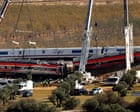
It is just nine months since two trains crashed near Cordoba, killing 46 people. Now 69 bodies have been recovered here in central Spain, from wreckage strewn over the tracks and down an embankment.
For the victims' families it is devastating; a personal tragedy.
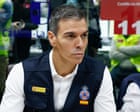
But it is also a national disaster that has shattered confidence in the country's rail network and the Socialist-led government of Pedro Sánchez. It is playing out just weeks before the snap general election he called.
The formal investigation into the Toledo train disaster has only just been launched but the government has been quick to take control of the narrative.
From the first hours after the collision, Transport Minister Oscar Puente began suggesting "human error" was to blame, batting responsibility as far as possible from the cabinet.
On Friday, he appeared before the press for a second time to set out what he called the "objective facts" of the crash and counter a surge of criticism against the government.
The opposition People's Party (PP) is among those calling for his resignation as a "moral" and "ethical" move.
Instead after expressing "huge pain and sadness" for the victims, Puente went on the offensive.
He rejected talk of chronic underinvestment in infrastructure and insisted that Spain's high-speed signalling safety system, the LZB, was neither old nor inadequate: Germany and Austria use the same.
In Spain, it has already failed 170 times so far this year, he revealed, but called that "normal" and around the EU average.
The problem surrounds what happens next - when the system fails and control of the line shifts to manual.
In this case, the minister highlighted a series of human errors that proved catastrophic.
Crucially, at one point a controller instructed a stalled train to restart, clearing it to advance at up to 160km/h (100 mph) even though a second train was stuck on the line up ahead.
The impending collision was clear from audio calls and on big screens in the control centre in Madrid.
"They worked. We checked. They could see what was happening," Puente confirmed. But the advancing train was never ordered to stop.
"I'm no judge... But these are the facts."
So would he take personal and political responsibility anyway, and resign? Puente called it his "duty", rather, to remain as minister.
"I'll face up to things, explain, elucidate," he countered. "I'll think how to improve the system, and give confidence to those who want to travel by train and feel calm and safe."
But Spaniards will take a lot of persuading.
"This is not only a very serious accident, but the second in a very short time," Paco Camas of the pollster Ipsos points out.
An investigation into January's crash in Adamuz, near Cordoba, is still open, with initial reports suggesting there was a crack in the rails - very different to the latest collision.
"It destroys people's confidence not only in the railways but institutions in general," Camas warns. "And in Spain when such things happen, we know that people blame their government."
For Team Sánchez it is the latest in a spiral of crises.
Allegations of corruption against the prime minister's close relatives still persist, all denied.
Then there was a sudden influx of migrants from Morocco this summer to the Spanish exclave of Ceuta. That got right-wing opponents shouting about incompetence and underfunding.
Later, a video of a pensioner being forcibly evicted from her home went viral and sparked street protests.
That's when Sánchez called an early election.
His chances of winning the vote looked slim even before the train crash. Now they have plummeted.
Most recent polls showed the centre-right PP coming first and forming a coalition with the far-right Vox.
"They have this majority in almost 95% of the simulations we have done," Prof Pablo Simon of Madrid's Carlos III University explains.
But Sánchez had been running a positive campaign, trying to lure apathetic voters to the polls to vote socialist.
"They've totally lost control of the agenda and the emotion of this campaign," Simon says. "It's going to be extremely difficult now. There is this general mood of decay, of a country that's not working properly. A depression."
There have already been small protests over the train crash led by far-right groups in Madrid and large numbers of police are on stand-by this weekend ahead of further potential clashes, organised online.
"We all travelled in silence and really sad," Paloma told me at the city station, where she had just pulled in on a half empty train.
She admitted she's scared of the high-speed network now and angry at the government.
"This crash will change all of our votes, completely," Paloma said. "We'll shift from the left wing to the right. Because of everything that's happened."
Lucia takes the high-speed AVE into Madrid each day, and is scared too.
"This was human error. But there's been two accidents now with more than 100 dead," she says. "Things here are really bad. They have to change."
Producer Davide Ghiglione contributed to this report
Audio reveals exchanges between Spain train operators and drivers moments before deadly crash
Spain transport minister says he won't resign over high-speed rail disaster
- spain
- train
- disaster
- election
- cloud
- sánchez
- chance
- succession