‘Plantation tourism’: court victory signals hope in Jamaica’s fight to keep beaches public
A temporary injunction in the coastline battle for beaches to be publicly accessible, not sealed off for private developments, is just a step in fighting what islanders call a tourism model that disadvantages Jamaicans When the Australian human rights lawyer Eva Buzo emerged from the sea on to the shores of One Man Beach in Montego Bay on Sunday after her gruelling, nearly 11-hour-long swim, the thunderous pulse of welcome drums was drowned out by the chants of “free beach” from jubilant supporters. Here in Jamaica’s tourism capital, against a backdrop of jagged mountains and sunset-tinted clo
A temporary injunction in the coastline battle for beaches to be publicly accessible, not sealed off for private developments, is just a step in fighting what islanders call a tourism model that disadvantages Jamaicans
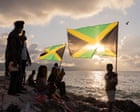
When the Australian human rights lawyer Eva Buzo emerged from the sea on to the shores of One Man Beach in Montego Bay on Sunday after her gruelling, nearly 11-hour-long swim, the thunderous pulse of welcome drums was drowned out by the chants of “free beach” from jubilant supporters.
Here in Jamaica’s tourism capital, against a backdrop of jagged mountains and sunset-tinted clouds, Buzo – a celebrated marathon swimmer – said she was pleased to help support the important work of the Jamaica Beach Birthright Environmental Movement (Jabbem) and others fighting for free public access to Jamaica’s beaches.
“People’s rights are more important these days than ever, and people keep on trying to encroach on our fundamental freedoms,” she said, calling the privatisation of beaches a colonial legacy. But for Jabbem, her swim was not the most significant milestone this month in its fight for public access.
That came earlier in October, when Jabbem celebrated a rare victory in one of several court cases to end the 1956 Beach Control Act that had given the state ownership of the island’s foreshore and seabed. The act has allowed successive administrations to restrict access to beaches and sell off coastlines to wealthy luxury hoteliers.
In October, however, the court issued an injunction preventing the government from continuing to restrict access to Little Dunn’s River in St Ann while the case continues.
“This victory means a lot for the Jamaican people. It means that our case is strong,” said Dr Devon Taylor, an immunologist with a PhD in biochemistry, who founded Jabbem in 2020.
Wilbourn Carr, 73, who is involved in another fight for beach access in Portland parish, in Jamaica, said the temporary injunction offered hope for other cases.
“The matter of beach access is right across Jamaica. And we just had some success at Little Dunn’s River with that injunction. It gives us hope. Because the fact is that one judge now believes that Jamaicans should have access,” he said.
The Jamaican government has said it will appeal. In an interview, the environment minister, Matthew Samuda, said there was no basis for protest. He said the government was safeguarding critical tourism investment and protecting communities from crime, while improving beach access through updated legislation requiring future developments to create access points and investment in community leisure spaces.
In the case of Little Dunn’s River, Samuda said access had been restricted after a murder.
“Because of the cultural sensitivity and the love that certain residents of St Ann and those who travel far and wide to come to the facility have for the space, the government intervened and said it would put up appropriate security structures and would facilitate free access to this area on a weekend basis, Friday, Saturday and Sunday,” he said, describing this as “structured management” that also provided benefits such as lifeguards.
Describing tourism as the “largest foreign exchange earner” and the main source of income for nearly 200,000 Jamaicans, Samuda accused activists of portraying the industry as “the enemy”.
He said: “176,000 people aren’t protesting anything to do with beach access, but 176,000 people are feeding their families because of our tourism product … Let’s not put their needs and their concerns on one side.”
Taylor, however, rejected crime prevention as justification for beach closures, pointing out that “the Beach Control Act of 1956 predates the level of crime seen in Jamaica and was never a tool to control crime”. He referred to the Little Dunn’s River restrictions as an illegal “collective punishment of the Jamaican people” that had nothing to do with solving an alleged murder.
“So you could close it until forever, until you solve this murder, which you have not solved,” he said. “You present no evidence that this place was still under threat … So we refute Little Dunn’s River was closed to solve some murder or to stop more from happening, because four years later you only allow the people to use it on Saturdays and Sundays. We deserve leisure seven days a week.”
Paul Roberts, a British architect living in Jamaica and Jabbem’s St Ann community coordinator, argued that the government is creating a false impression that Jamaicans cannot be trusted.
“It’s a load of rubbish,” he said. “I’ve been coming here for 15 years now and I’ve never had any trouble. I’ve never been robbed, I’ve never been mugged and I’ve never faced any issues.”
Campaigners did not oppose hotels, Taylor said, but rather a “plantation tourism” model that disadvantaged Jamaicans.
“Cheap labour of the Jamaican people, degradation of the environment, exclusion of the Jamaican people from the foreshore, plantation tourism, untenable working conditions. Lock us out using colonial-era law. The industry is guilty of that,” he said.
“We the people do not want to be treated as second-class citizens in our country … we want fairness, equality and equity.”
Buzo described access to shared public spaces as a human rights issue, pointing to countries such as Australia, where she is from, and Barbados in the Caribbean that maintain public beach access alongside thriving tourism industries.
“There’s no reason why hotels can’t have beachfront properties that then front on to a public beach. It’s just this kind of exclusivity and segregation that small amounts of people think they need,” she said.
Samuda argued Jamaica was different because, although the country had “conquered our crime monster”, it had “spent 30 years being in the top three most murderous countries on the planet”.
Much of Jamaica’s coastline was also rocky, he said, with only a fraction considered “beach”. He argued that most of the “beachy” areas remained publicly accessible, although some carried restrictions or charges.
Jabbem is campaigning for full, free and unfettered beach access, arguing that many families are priced out by high entrance fees and forced to buy expensive on-site food and drinks owing to outside-food bans. The group’s western Jamaica community coordinator, Monique Christie, said tourists also lost out when separated from local communities.
“The product that is Jamaica is not the hotel. It’s definitely not the rooms. It’s definitely not the name of the resort. It has always been us, the people. It has always been our warmth and the desire of everyone to just come and meet us.”
Dr Theresa Rodriguez-Moodie, the chief executive of the Jamaica Environment Trust, said questions over what constitutes publicly owned space had become increasingly complex, leaving many Jamaicans feeling disenfranchised.
“I think that we need to be paying attention to what the Jamaican people are asking for, they’re talking about, and find a way to address that through changes to the law, changes to the policies.”
In March, Jamaica’s prime minister, Andrew Holness, proposed a beach access and management policy supposedly intended to modernise legislation and increase access. Campaigners say it still permits unacceptable restrictions.
“The 2026 policy that was published in March was supposed to try and address some of the issues, but it really didn’t,” Rodriguez-Moodie said.
For Taylor, the fight will continue. “The people are crying out. We need a fundamental change. And they must listen to the people because we won’t stop until this law is abolished and we have fundamental rights and workers’ rights in this country. That is what our ancestors fought for,” he said.
- jamaica
- tourism
- beach
- plantation
- court
- victory
- fight
- buzo