The secret behind Lula’s win in Brazil may be an ‘army’ – of social media creators
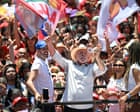
There are many explanations for the incumbent president’s win over Flávio Bolsonaro, but analysts – and he – point to reinvention of his social media use Four days before his stunning electoral comeback, Luiz Inácio Lula da Silva, Brazil’s president, got his first smartphone. Lula, who turned 81 last Tuesday, had long said he wanted to avoid an endless stream of calls during his rare moments off, and he began his presidential campaign by sticking to an old habit: using aides’ phones – only when necessary.
There are many explanations for the incumbent president’s win over Flávio Bolsonaro, but analysts – and he – point to reinvention of his social media use
Four days before his stunning electoral comeback, Luiz Inácio Lula da Silva, Brazil’s president, got his first smartphone.
Lula, who turned 81 last Tuesday, had long said he wanted to avoid an endless stream of calls during his rare moments off, and he began his presidential campaign by sticking to an old habit: using aides’ phones – only when necessary.
Then he suffered an unexpected first-round defeat to the far-right senator Flávio Bolsonaro, who had neither his father Jair Bolsonaro’s charisma nor much of a record as a two–decade legislator – and Lula realised he had lost both in the ballot box and in the digital arena.
The veteran leftist, who contested his first election more than 40 years ago, overhauled his digital strategy, began recording selfie-style videos – and went on to beat Bolsonaro by more than 4.4m votes.
There are many explanations for how he managed to boost turnout and win over other candidates’ voters. Some analysts point to an organic student mobilisation that held mass protests across Brazil, others to a package of government benefits Lula approved at the last minute in a transparent attempt to use government spending to curry favour with the electorate.
But many analysts, and the president himself, point to the incumbent’s reinvention of his social media use as a key reason for his victory.
In the days leading up to the vote, its nearly 11 million followers – up from just 60,000 after the first round – received daily “missions” to try to win over voters and make pro-Lula content perform well on social media.
Leading the “army” was the man Lula praised in his victory speech as “our general”, whose role was “raising the morale of our troops every day”: 42-year-old congressman André Janones.
“I have no doubt that Lula’s army determined the outcome of the election,” Janones said, saying that he is not modest “because modesty sometimes comes very close to hypocrisy. I know how much bigger I came out of this election.”
In his view, the contest had three main fronts. The first was candidate versus candidate, “and on that Lula was winning by a mile because he had much more experience”. The second was mobilisation on the streets, “and we were bringing many more people out to the protests”.
But the third: “You don’t have to be very clever to realise that we were losing on social media.”
Although Lula had more followers, Bolsonaro’s content generated up to five times more engagement.
The incumbent’s campaign also complained to the electoral court of alleged interference by Meta in the senator’s favour, including a 24-hour period in which Lula was unable to boost ads on Instagram, which the company later acknowledged but blamed on a technical error.
Janones said he realised the solution was to boost organic engagement among Lula’s voters.
One of his most successful strategies came a week before the election, when “soldiers” were told to post a photo making an “L” sign for Lula with their thumb and index finger while wearing the yellow Brazil football shirt, a national symbol that had been appropriated by Bolsonaro supporters over the past decade.
Domestic worker Sidneia dos Santos Araujo, 63, took part “because the shirt of Lula supporters is the Brazilian one. Bolsonaro supporters should be wearing the United States shirt,” she said this week, citing the Bolsonaro clan’s “subservience” to US president Donald Trump and noting how the senator fled to Miami.
A day after Lula’s victory, Araujo created a template on Google Drive that allowed followers of the “army” to create their own “certificate”, which would declare that during their “military service” they “maintained excellent performance and exemplary conduct … and are therefore deserving of this distinction as a ‘soldier’”. The certificates, which went viral, came complete with copies of the signatures of “marshal” Lula and “commander” Janones.
Janones said that, above all, he wanted to create a “sense of community: the feeling that we are not alone”.
According to Raquel Recuero, a researcher at the Federal University of Pelotas, this was one of the channel’s biggest achievements: it gave voters “a sense of purpose and the chance to channel their energy into doing something to help Lula”.
Other young, digitally native politicians have also been credited with reshaping Lula’s social media strategy, including 21-year-old Ana Elisa Santos, known as Ana Elisa, who became the youngest congresswoman elected from Minas Gerais in this election.
The night after Lula’s first-round defeat, Elisa recorded a hugely popular video saying the left needed to be more “humble” and to “learn” how to use social media because “there is no longer any separation between social media and the streets … The grassroots are also on Instagram and TikTok.”
She was called to a meeting with Lula and is said to have persuaded the president to record the selfie-style videos he had previously refused to make.
“People think we only say that for the cameras, but it’s real: Lula really didn’t have a mobile phone,” said Janones.
The group hit its target, and when an allied politician gave the president a phone as a gift, Lula finally joined it. “I’m not going to say he’s an expert now, but he’s there, following it, and has been sending some content,” said Janones.
Recuero believes it will be difficult to keep “Lula’s army” engaged now because there is a “social cost” to being so digitally committed – Janones himself suffered a cardiac arrhythmia after the first presidential debate and had to spend 24 hours in hospital. It was the only day the group went silent.
But Janones believes there is a path forward for the group, perhaps not engaged 24/7 as it had been, but focused on special moments, such as trying to secure passage of legislation important to Lula.
“We can’t leave the campaign trail any more,” he said, noting that despite Lula’s election, Bolsonaro’s party secured an unprecedented number of seats in congress. The “army”, he said, is what will “guarantee Lula’s ability to govern”.
- lula
- win
- brazil
- secret
- army
- medium
- president
- creator