‘What’s our crime?’: A Palestinian family’s fight to get care for son injured by Hamas rocket
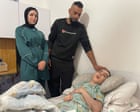
Kinaan Dadou, 10, has been left disabled since 7 October 2023 as his parents struggle to find funding for specialist treatment It was 7.30am on 7 October 2023 when a Hamas rocket exploded next to 7-year-old Kinaan Dadou. The rocket was aimed at the Israeli settlement of Efrat in the occupied West Bank but missed its mark by a few hundred metres, landing in front of Kinaan’s family home instead.
Kinaan Dadou, 10, has been left disabled since 7 October 2023 as his parents struggle to find funding for specialist treatment
It was 7.30am on 7 October 2023 when a Hamas rocket exploded next to 7-year-old Kinaan Dadou. The rocket was aimed at the Israeli settlement of Efrat in the occupied West Bank but missed its mark by a few hundred metres, landing in front of Kinaan’s family home instead.
A piece of shrapnel struck Kinaan in the head. He stood rigid, his hands frozen to his sides, and screamed “Baba!” before collapsing to the ground. An Israeli soldier who passed by promised to call an ambulance. No help ever came. Kinaan’s parents rushed him to the hospital themselves, but it was six hours before a doctor arrived due to the chaos of the day. All the while, Kinaan’s brain was haemorrhaging.
It was the last time that Kinaan’s parents heard his voice.
Now 10 years old, Kinaan lies in a small bed in a persistent vegetative state. His limbs, pale and thin from atrophy, are covered with Mickey Mouse blankets. On the wall above his bed, his parents have taped pictures of Kinaan before the injury. The lively boy climbing trees and beaming into the camera bears little resemblance to the one below, whose one open eye moves listlessly across the bedroom. He is fed through a tube and breathes through a tracheostomy.
“I look at him and I ask him what he wants, what does he need? But he can’t respond, so I begin to cry. I think he’s in pain,” says Alaa Hassan Yakoub Dadou, Kinaan’s 47-year-old father, looking down at his son.
Kinaan’s case is unusual: a Palestinian child wounded by a Hamas rocket on the same day that about 1,200 people were killed in a Hamas-led attack on Israel. Three years on, Kinaan’s parents are still seeking help to pay for his treatment, finding themselves stranded between the Palestinian Authority (PA), which is responsible for healthcare in their area, and the Israeli authorities, who control virtually all facets of their lives.
The Dadou family live in the small village of Um Rukbeh, west of Bethlehem, a part of the occupied West Bank classified as “Area C”, where the Palestinian population lives under Israeli military rule.
The Palestinian Authority, which administers healthcare for Palestinians in Area C, gave some medical support for Kinaan early on – he underwent multiple brain surgeries and had a part of his skull removed – but his parents say it has refused to cover further specialist care and has been inconsistent in providing medication. Under Palestinian law, people with disabilities have the right to have at least 75% of their rehabilitation costs covered, while children also have the right to “obtain the highest possible standard of free healthcare services”.
Officials in the Palestinian ministry of health did not respond to questions.
Meanwhile, Israel, as an occupying power, also has certain obligations under international law to provide medical services, though it’s unclear if that extends specifically to Kinaan’s case. It has told a lawyer representing the family that Kinaan was injured in an area outside its jurisdiction, something the family questioned due to Israel’s de facto control over their daily lives. Israeli authorities control construction permits in Area C, including for bomb shelters, and dictate much of the family’s movement, complicating their efforts to get access to healthcare. Three months ago, they received a warning Israeli authorities would soon demolish their home.
The family has appealed to the Israeli government on humanitarian grounds. If they were Israeli and living in one of the increasing number of illegal settlements surrounding their home, the family says they would have had access to a bomb shelter and medical treatment.
“We’ve knocked on every door. The Arabs and the Israelis, it’s the same response. The Palestinian side says: ‘This isn’t our area.’ What’s our crime? That we happen to live among settlements? Neither side takes responsibility for us,” Alaa says.
Cogat – the Israeli body that oversees the Palestinian territories – did not respond to questions about Kinaan’s case.
Without outside help, the family has been unable to pay for the medical treatment that may improve their son’s condition. A specialist in Turkey said that, with an intensive recovery programme and further surgery, Kinaan’s condition could improve. But the cost of the treatment – about $250,000 (£190,000) – is far beyond what the family can afford.
“I pay 4,000 shekels [£950] per month just for his medication. I borrow from here and there, but it’s too much,” says Alaa. He used to work as a labourer in Israel, but has been out of work since Israel stopped issuing work permits to most Palestinians in the West Bank after the 7 October attack, leaving the family without income.
To save money, Kinaan’s mother, Woroud Dadou, has begun to perform some of the routine medical procedures herself. She changes her son’s breathing tube, saving the family £225 each month.
“I try to keep the tube as clean as possible so it lasts longer, but sometimes if I use the same one too long he begins to cough,” says Woroud, who adds she learned by watching doctors perform the procedures in hospital.
Alaa was told about a former colleague of his in Israel whose child was injured on 7 October. The child was flown to Germany for treatment and has since improved. He is happy for his colleague, but cannot help but wish Kinaan had access to the same treatment.
“If this was an Israeli child, even a settler child, do you think they’d have left him like this? He’d have been taken to the best hospitals. They would have done everything for him,” Alaa says.
“That’s what Israel does for its injured. It takes care of them. But when it comes to us, as a humanitarian case, it’s as though they’re saying: ‘Just give him his medicine until he dies.’”
Memories of Kinaan are scattered around the house. A little blue notebook is filled with his childlike scrawl as he practised letters: “pepper, cabbage, knight”. His parents are proud of his handwriting and said he dreamed of becoming a pilot when he grew up.
Though Kinaan is the middle child, he was the loudest of the three brothers. “Always putting them in order, like a little sergeant,” his father says, smiling. He recalls how, whenever he would come home from work, Kinaan would be waiting at the door, bringing his two siblings along to greet him.
Now only his wife greets him, and the sounds of play have mostly disappeared.
Kinaan appears to wake up, his face seemingly forming a smile as his father speaks. He keeps opening his mouth and pausing, as if about to speak, but no words come out. The room is silent, save for the sucking sound every time Kinaan takes a breath.
“We are realistic – we know he probably will never be the same as he was. But at least we want to relieve his suffering and relieve our guilt,” his father says. “It’s another kind of pain for a mother and a father, not knowing what exactly is hurting your child. That’s an enormous burden for a parent.”
- rocket
- kinaan
- family
- hamas
- crime
- fight
- care
- son