It’s snow time: the best winter activity holidays in Europe for non-skiers
From husky sledding and chasing the northern lights in Lapland to bear-spotting in Transylvania, here’s our pick of wild and magical snowy breaks in Europe At Ruka, the first skiers of the year slalomed down the slopes on 2 October. Just inside the Arctic Circle, Ruka’s long snow-sure season and cosy village atmosphere make it a popular ski resort with Finnish families.
From husky sledding and chasing the northern lights in Lapland to bear-spotting in Transylvania, here’s our pick of wild and magical snowy breaks in Europe
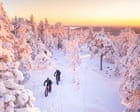
At Ruka, the first skiers of the year slalomed down the slopes on 2 October. Just inside the Arctic Circle, Ruka’s long snow-sure season and cosy village atmosphere make it a popular ski resort with Finnish families. The long polar nights mean there are only a few hours of dim twilight each day, but the slopes here are floodlit, so that never stops play.
The Narnia-like setting offers just as much action off the runs as on them, and in December the resort launches Ruka Guides, guided adventures from a dedicated activity centre. Spend the morning e-fatbiking through snowy forests (from €90) or cutting a hole in a frozen lake to catch fish (from €89), before learning Arctic survival skills (from €85) or snowshoeing in the evening darkness on the hunt for the northern lights (from €89).
Other, more offbeat diversions include floating in a thermal suit down the freezing Kiveskoski river in meditative silence (from €135), whizzing down an alpine coaster at up to 25mph (from €11.88) and practising your sun salutation in the forest surrounded by grazing reindeer (from €45).
Dasher and Dancer are a clue to the other reason Ruka is such a hit with children: the main merry man himself. Father Christmas, Mrs Claus and the elves live at Santa’s Cottage, about 30 minutes’ drive from Ruka, where they test how good little helpers are at gingerbread baking and Christmas card making, before those wannabe elves sing Santa’s favourite carol to him in Finnish, post cards at the post office and sledge down the hillside outside (from €105). All activities at ruka.fi. Rukariutta Superior apartments sleep up to six from €362 a night (rukapalvelu.fi). Lumo Lakeside Lodges sleep up to two adults and two children from €215 (rukasafaris.fi)
In the depths of winter, the sun sets just a shade after 3.30pm in the Cairngorms national park and doesn’t rise again until about 8.50 the following morning. Those long hours of darkness combined with low levels of light pollution (the area around Tomintoul and Glenlivet is an International Dark Sky Park) makes it the perfect place for stargazing.
While it’s easy to be dazzled by the Milky Way without even reaching for a telescope, the Discovery Centre in the village of Tomintoul lends out stargazing kits (pre-booking required) to help visitors delve deeper into the cosmos at one of their recommended viewing sites, such as the nearby Tomintoul Field of Hope, with its purpose-built Skyhide pavilion.
The centre is also the meeting point for astronomy events (there is a close-up look at the moon on 18 November and an evening of meteor spotting when the Geminids shower is at its peak around mid-December (suggested donation £7, cairngormsdarkskypark.org).
A short drive away, just north of Aviemore, storyteller Sarah Hobbs leads monthly Stargazing Storywalks. The 1½-mile after-dark amble weaves in Gaelic and Pictish tales of the night sky from thousands of years ago, from warrior queens to one-eyed giants, and ends with a cup of foraged wild tea (£20pp, Oct-March). For something a little more strenuous, Hillgoers organises regular three-mile night walks with certified star rangers, spotting glowing planets and nocturnal wildlife (£40pp, maximum of eight in a group).
The Lazy Duck continues the dark-sky theme with a clutch of off-grid huts among the pines of the Abernethy Forest with stargazing windows above the beds (from £187 a night in December).
There are plenty of winter activities in daylight hours too, from driving the SnowRoads route, which winds along the highest public roads in Britain, to meeting the country’s only free-roaming reindeer herd (guided hill trips run Feb-Dec from £29.40pp, cairngormreindeer.co.uk).
At the foot of Mont Blanc, Chamonix is famous among skiers for its gnarly off-piste terrain and intense black runs. But that dramatic landscape makes it prime territory for action off the slopes too. One of Responsible Travel’s new trips this season is a four-night self-guided snowshoeing holiday in the Chamonix valley.
Using the traditional mountain spa town of Saint-Gervais-les-Bains as its base, the itinerary ventures deep into the snow-covered Vallorcine valley, hiking through larch meadows and pine forests, heading up the Flégère gondola to walk along a balcony trail facing Mont Blanc, and taking in the views from the summit of Mont d’Arbois at 1,833 metres.
The Mont Blanc massif is one of the most densely glaciated areas in the Alps, and while the ice is receding due to the climate crisis, taking the dinky red Montenvers cog train up to the Mer de Glace is still an impressive experience. This huge river of ice winds some 5 miles between the mountains, and at the top a cable car followed by around 200 steps descends into the Grotte de Glace, a blue tunnel carved into the glacier (€49.70 for the train, gondola and ice cave visit).
A more intrepid ice-spotting option is Les Contamines-Montjoie circular snowshoeing route, which climbs through pine forests to the Plateau du Truc, with its views of the d’Armancette, Miage and Covagnet glaciers.
Back in Chamonix, the Mont-Blanc Museum opened in July, tracing the valley’s history and Alpine exploits from the ice age to today, showcasing objects that include memorabilia from the first Winter Olympic Games (held in Chamonix in 1924) and the walking stick of Jacques Balmat, half of the two-man team that made the first ascent of Mont Blanc in 1786. That climb is only for serious mountaineers, but the cable car from Chamonix town centre is a shortcut to Aiguille du Midi’s almost-as-impressive 3,842-metre peak (€43 round trip) – leaving plenty of energy to hit the nearby La Luge toboggan run (€23 for the pedestrian lift pass and one descent; ski-saintgervais.com). A four-night self-guided snowshoeing trip in Chamonix from £790pp with Responsible Travel, including B&B accommodation, route maps, smartphone navigation app, GPS trackers and 24/7 phone support
Hiking along narrow trails in the Piatra raiului national park, you’re more likely to come across bear or wolf tracks than other walkers’ footprints. The Carpathian mountains are one of Europe’s last bastions for large predators – there are thought to be more than 10,000 brown bears and around 2,500 grey wolves in Romania alone.
A week-long guided trip with Exodus makes tracks into Transylvania’s dramatic karst landscape, and is an atmospheric introduction to snowshoes and crampons. Base camp is the family-run Villa Hermani guesthouse, over 1,000 metres above sea level in the village of Magura, where there’s always a warming glass of homemade pălincă (fruit brandy) waiting.
Hikes climb up to the high ridge of Dealul Măgurice or to the plateau between the Piatra Craiului and Bucegi mountains, where the only thing that might break the silence is the howling of a wolf. One of the most spectacular walks heads along the Zărnești Gorge, its vertical limestone walls rising 200 metres above the icy canyon floor.
When not snowshoeing through Christmas-card scenes, take in medieval churches, the cobbled old town of Brașov and the Libearty bear sanctuary, which has rescued over 120 brown bears from the cruelty of captivity. And while Bram Stoker never set foot in Romania, let alone Bran Castle (often said to be the inspiration for Dracula’s lair), you can. With its frosty turrets and towers set against the Carpathians, it looks more gothic than ever, and even better without the bloodthirsty summer crowds. Exodus’s seven-night Transylvania winter walk and snowshoe trip from £1,459pp, including all accommodation, meals, transport and activities, tour guide, snowshoes and poles
Innsbruck is ringed by the Austrian Alps, meaning wherever you wander in the city – among the medieval alleys of the Altstadt or past the colourful houses along the River Inn – snow-covered mountains are the constant backdrop. Those jagged peaks are home to 12 ski areas within 15 to 75 minutes of the city by public transport, and some are worth the trip for the snow-plough-averse too.
Zaha Hadid’s swooping, modernist Bergisel ski jump is a dominant sight above the town and the vertiginous view is even better from its observation deck. The architect also designed four of the Nordpark Cable Railway stations that feature fluid glass canopies mimicking natural ice formations and glaciers. They take skiers and non-skiers up to the Nordkette mountains for a bird’s eye view of the Tirolean capital.
There’s plenty more to get pulses racing without clipping on a pair of skis, from bobsleighing down the 1,399-metre Olympic track at Igls at speeds of up to 115km/h (from €45 for bobrafting, €119 for piloted race bobsleighing) to night sledding at Rangger Köpfl (€25). For more icy fun, there are igloos to spend the night in at Iglu-Dorf in Kühtai, Austria’s highest ski resort (from €537 for up to three people, including cheese fondue, community sauna and breakfast).
Back down in Innsbruck, Christmas market season kicks off in November, and there are seven dotted around the streets and squares, from the historic old town market to the lofty Hungerburg – be sure to try kiachl, a doughnut-like pastry served either savoury with hot sauerkraut, or sweet topped with wild cranberry jam.
New skating experience Ice Magic also launches this winter, with illuminated ice paths connecting different parts of the city, alongside light installations and projections, ice disco nights and DJs (from €8).
While Scandinavians started using animal bones to make primitive ice skates thousands of years ago, wild, or Nordic, skating as we know it (long-distance skating outdoors on natural ice for sport rather than utility) evolved in Sweden in the 1900s. Stockholm’s Skridskoseglarklubb (“Skate Sailing Club”) was formed in 1901 and today has more than 10,000 members, who share the latest ice information online to find the ideal skating locations.
Nordic skates have long blades attached only at the front of the boot, used to make long, rhythmic glides; other specialist safety kit includes long, pointy poles to assess ice thickness and a backpack that doubles as a flotation device.
Wild is the operative word here, and it is prudent as a beginner to skate with a pro. Stockholm-based Ice Guide runs a number of trips, from one-day introductions to multi-day tours, which head out on to Lake Mälaren or the Baltic Sea in the Stockholm archipelago (from £143 including all gear, transport and lunch). Hellasgården, less than half an hour outside Stockholm, is another popular skate spot with ploughed tracks on Lake Källtorpssjön, and there are holes cut in the ice for the bravest swimmers (and a sauna for after).
While in the city centre, get your frozen kicks at the ice rink at Kungsträdgården (skate rental about £7.50 an hour) or by joining the boisterous crowd at a Djurgården IF ice hockey match at the Hovet stadium. Ruby Frida opened this summer and has doubles from £70 room-only
Hearty Tirolean food is made for winter: Knödel dumplings smothered in melted butter and parmesan, the ricotta- and spinach-filled pasta pockets of Schlutzkrapfen, the cast-iron skillet hash of Bauerngröstl. Hiking through the slopes and valleys of the Dolomites’ Drei Zinnen (Three Peaks) nature park on a week-long trip with self-guided walking holiday specialists Inntravel is a good way to work up an appetite.
From the charmingly traditional Hotel Drei Zinnen in the village of Sesto near the Austrian border, a network of 100km of well-groomed, partially cleared paths (meaning no snowshoes required) branches out through the Fischleintal valley and beyond into the nature park.
Mountain huts (rifugios) are dotted along routes for a warming lunch: Talschlusshütte serves mountain pine and porcini mushroom risotto and classic comforting Gerstensuppe (barley soup) along the Fischleintal valley walk; while the 100-year-old Dreischusterhütte among the fir trees in the nearby Innerfeldtel valley is much loved for its Kaiserschmarrn (shredded pancake) and homemade Apfelkiachl (fried apple rings).
Other routes start with a cable car ride and cut across the snowglobe landscapes of the Kreuzbergpass (stopping for a drink on the terrace at the Klammbach hut, of course) or loop around the banks of the frozen Lake Toblach.
Hotel Drei Zinnen has welcomed a fair few winter explorers through its doors since it opened in 1930. One regular guest – the mountaineer and author of Seven Years in Tibet Heinrich Harrer – inspired the hotel’s original owner Hans Watschinger to transform the establishment and the village of Sesto (Sexten in German) into a winter destination. It’s still run by the Watschinger family, and today there’s daily afternoon cake and a Finnish sauna to ease walk-weary muscles, and four-course nightly feasts of Italian favourites and local South Tirolean specialities to fuel up for another day in the mountains. A seven-night Italian Dolomites Winter Walking trip from £1,076, including half-board accommodation, local bus pass and transfers (inntravel.co.uk)
For as long as the lights of the aurora borealis have danced across the sky, the people living beneath them have told stories explaining the mysterious, spectral glow – are they omens or gods, communication from spirits or threat of war? For some Sámi communities in northern Scandinavia, they were the souls of the dead, souls that were not to be disturbed by looking, talking, waving or pointing at them, in case the ghostly veil snatched you into the sky or cut off your head.
At 217 miles (350km) above the Arctic Circle, Tromsø is the ideal destination for northern lights chasers and learning about the indigenous Sámi people – many of whom still herd reindeer across the vast wilderness.
The Oskal family have lived a way of life shaped by reindeer for generations, and their herd spends winter around the camp near Tromsø and summer roaming free in the mountains. The family now share that traditional way of life through Tromsø Arctic Reindeer, opening up their camp to visitors to sled ride, feed the herd and join the family around the fire in the lavvu (tent), for joik (traditional Sámi song) and perhaps glimpses of the aurora overhead (experiences start at 990 kroner/£75 for reindeer feeding).
At the gateway to Norway’s frozen far north, Tromsø is the launchpad for numerous activities – ice fishing and fjord cruising, husky sledding and snowmobile safaris – and the lively university town is interesting in itself. It was once the departure point for expeditions to the north pole – a history captured at the Polar Museum on the harbour front – and today also draws cultural travellers for concerts in the angular Arctic Cathedral and the international film festival in January. Three-night trip to Tromsø from £767pp, including B&B and an aurora-chasing trip, with Discover the World
- snow
- europe
- time
- winter
- activity
- skier
- ruka
- slope