John Healey says UK apology over historic role in slave trade won’t lead to financial reparations – UK politics live
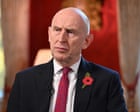
Ahead of a meeting with Commonwealth leaders, Andy Burnham wrote that Britain needed to ‘acknowledge its complicated history’ At the end of his interview with Kuennsberg, Healey was also asked to comment on a potential apology for Britain’s near-250 years of perpetrating the slave trade and why the government should or shouldn’t pay reparations to enslaved people and their countries.
At the end of his interview with Kuennsberg, Healey was also asked to comment on a potential apology for Britain’s near-250 years of perpetrating the slave trade and why the government should or shouldn’t pay reparations to enslaved people and their countries.
Sitting in the grand settings of Number 11 Downing St, Kuenssberg pointed out the lavish interiors:
“So many Commonwealth countries think that this country’s wealth, maybe the wealth in this building, this gilt chandelier, came off the back of slavery. So why is a government not willing to contemplate reparations?”
Healey replied saying the PM was open to “a discussion about an apology”, but “he doesn’t believe that reparations are the right approach”. He makes the same argument as Burnham that the current British people shouldn’t have to pay for past wrongdoings.
Considering a formal apology doesn’t mean accepting that British people now should accept the financial liability for any party and things that happened hundreds of years ago, in which they had no role.
A reminder again of some of the history, which is so key to this reparations discussion.
For almost 250 years (1560s-1807), British ships trafficked more than three million enslaved African men, women and children in a state policy backed by the monarchy and parliament.
Many were taken to British-owned plantations in the Caribbean, which enslaved generations. Children were born into slavery, uprisings were put down with extreme brutality
There were still 800,000 enslaved people on British plantations when enslavement was finally abolished by parliament in 1833
Abolishment was only achieved because the government agreed to “compensate” the enslavers. The government paid an enormous sum, the equivalent of billions of dollars these days, to the “owners” of enslaved people; this came from a huge loan that was only paid off in 2015.
Britain has never paid any compensation or reparations to the people who were enslaved, or their countries.
Over on Sky earlier, the Liberal Democrats leader Sir Ed Davey has also backed the government’s move towards an apology saying “we should have that debate”.
“If you’ve done something wrong, I have no problem for apologising. I think that’s what normal people expect to do,” he tells Sky host Fraser Nelson.
He also ruled out reparations, saying that “wasn’t the right approach”, before advocating the pathway of UK aid and development for poorer countries.
I will point out here that the Whigs, the historical forerunners of the Lib Dems, were heavily involved in and supported enslavement for almost 200 years.
Many Whig MPs (and Tory MPs) were investors in the slave trade and many also owned plantations. When the movement to abolish the slave trade and enslavement grew in the late 18th century, the Whigs generally moved towards supporting abolition, while Tory governments opposed and delayed it for decades.
Just to turn back to the budget for now, and I’ll recap John Healey’s interview on Kuennsberg’s show for the next few posts.
The conversation was the usual tussle, a back and forth, on trying to get the chancellor to commit to specific timing for when the really tough decisions on spending will kick in. Healey, who was defence minister at the start of the year, re-iterated the 3% of GDP commitment on defence spending. But where will that money be found?
In the welfare spending he indicates, which the OBR warned post-budget could cost £100 billion-a-year by the end of the decade.
Healey insists that the “overall bill will come down under Labour” and “we’ll start the changes next year” – but doesn’t specify how and through which measures.
He says that it’s clear the system is not working and “We have to make big changes. We will.”
The Guardian has done extensive reporting on Britain’s centuries-long trafficking of enslaved African people, a policy that was supported by parliament and the monarchy from the 1560s-1807.
Britain’s trafficking operations – which included royal companies led by kings and, later, entrepreneurs in Bristol, Liverpool and other port cities, violently transported more than 3 million enslaved African men, women and children to colonial plantations in the Americas and Caribbean.
My colleague, David Conn, has been reporting on new research documenting the immense scale of these operations.
The Register of British Slave Traders, the product of a three-year project by a team of specialist historians, documents the investors in Britain’s near 250-year transatlantic slave trade.
It shows the relentless involvement of the British monarchy, parliament and financial and business elites; the role of the church in legitimising it; and how the investors’ wealth was woven deep into the country’s fabric and used to fund hospitals, schools, welfare organisations, the arts, science and culture.
A series of British kings and queens were leaders and investors in the trafficking of enslaved African people;
More than 100 MPs were investors in slave-trading companies, including scores in the Tory and Whig parties – the forerunners of today’s Conservatives and Liberal Democrats;
Dozens of directors and original financiers of the Bank of England were investors in the slave trade;
More than 1,000 women invested in slave-trading companies;
Forty-five Church of England clergymen were investors in the slave-trading Royal African Company.
The publication of the register last month will provide further evidence for the growing global movement calling on European governments to acknowledge their perpetration of enslavement, issue a full, formal apology and engage positively with discussions for reparatory justice.
Successive British governments have refused to do so, arguing there is no duty to make reparations because enslavement and the slave trade were not against the law at the time.
On the slave trade apology, Badenoch repeats what she wrote on X yesterday, dismissing the discussion as “naval gazing”.
She also claims that “We have apologised. Tony Blair apologised twice.” I assume she’s referring to Blair’s statements in 2006 and 2007, around the 200th anniversary of the British abolition of the slave trade, where the then PM expressed “deep sorrow and regret”, calling the slave trade trade “profoundly shameful” and a “crime against humanity”.
These statements stop short of an actual apology though. Blair avoided this, just like King Charles did earlier this week, partly due to the concerns that an explicit, formal apology for past wrongdoing could open the door to legal and financial claims.
Badenoch tells Kuennsberg she believes the call is coming now because “many of these [Commonwealth] countries are struggling with the same issues that we’re struggling with. They’re not becoming richer. They don’t know what to do, so they want to ask Britain for more money.”
When Kuennsberg says that the government is just talking about an apology, and has ruled out financial reparations, Badenoch goes:
When will the demands stop? What about if they ask for it next year? How many apologies are needed? Everyone knows the transatlantic slave trade was wrong. Britain played a huge role in stopping it.
The problem with this endless talk about apologies is that it is a distraction. It then means that people start focusing on things that happen hundreds of years ago, instead of solving today’s problems.
Some historical context here – the historical Tory party were directly involved in and supported enslavement for nearly 200 years. It was a state-backed operation that had the full support of parliament’s major parties. Tory MPs were investors in the slave trade; many owned plantations. The Tory governments also opposed and delayed the push for abolition as that campaign grew in the late 18th century.
Badenoch also rejects the idea of rejoining the EU as a potential solution for the UK economy, no matter how popular it’s currently tracking in the polls “I have been very clear, under my leadership, the Conservative Party is not joining the EU,” she says.
“I can’t even believe that we are reopening this debate. This is not something that is needed in order to cut welfare, in order to spend money on defence.
I’m not interested in magical thinking, i do not want to indulge in Andy Burnham’s fantasies about redoing the referendum, because he doesn’t have a plan for what to do today. He keeps talking about things what will happen after the next election. Where is this plan for now? We had a budget that did not do very much last week.
Badenoch is on the BBC’s Sunday with Laura Kuennsberg show now, putting forward the Tory’s alternative budget vision.
She’s defending the Tory policy of scrapping inheritance tax on family homes, and saying that the Conservatives’ main offer to voters is on “fiscal responsibility” and “living within our means”. She says that the Tories have found £70bn in savings – “the bulk of those savings have to come from welfare”.
She also argues that the money would be found in reducing the size of the civil service. “We have talked about reducing budgets in departments like DCMS (Department of Culture, Media and Sports).”
She also suggests cutting out government work duplication, singling out the environment agency and Natural England – the government adviser and public body for protecting and improving the environment.
“We have to start looking at what government actually does. There is a lot of stuff that government does, that it doesn’t need to do.”
Burnham’s consideration of a formal apology has been welcomed by leaders of Caribbean nations, but differences remain on reparations.
Barbados’ prime minister, Mia Mottley, welcomed Burnham’s acknowledgment of the “brutality of the trans-Atlantic slave trade, his openness to a formal apology and his offer of structured dialogue”.
She noted the different approach on reparations – Burnham has ruled this out entirely- but said:
Those differences should not prevent progress on health, education, tackling poverty and inequality, and fairer debt terms for vulnerable states.
Gaston Browne, the prime minister of Antigua and Barbuda called Burnham’s comments a “significant and welcome development”. He reiterated calls for reparation but said this could be addressed.
The Caribbean’s longstanding position on reparatory justice remains unchanged. Differences over financial compensation should be addressed through dialogue, but they need not prevent progress in areas where agreement is possible.
Andy Burnham says the UK will listen to calls to issue a formal apology, but doesn’t believe that reparations is the “right answer”.
He argued yesterday in The Guardian that Britain needs to acknowledge its “complicated history” in order to protect the Commonwealth, the 56 nations that grew out of the British Empire. He’s headed to Antigua and Babuda in coming days. King Charles has been in the Caribbean this week where he’s faced calls for Britain to apologise and pay reparations.
The King, whose forebears directly benefited from trafficking of enslaved people, admitted the “great suffering and injustices of the past” but did not issue an apology. It is UK government policy currently, to not apologise for the country’s role in the slave trade. The British state hugely benefited from the slave trade before it was outlawed in 1807. British enslavement of people on plantations and in colonies like the Caribbean continued until 1833. Burnham, introducing a potential change in his column yesterday, wrote:
The Britain I believe in is confident, decent and brave. We led the world in abolishing slavery – and we can show leadership again today.
For years, those members of the Commonwealth affected by the slave trade have asked for an honest conversation about the legacies of slavery.
By sticking our heads in the sand, we have damaged the ability of the Commonwealth to function.
He said his government is offering to begin a “structured dialogue” with those affected by slavery – but ruled out financial compensation for past wrongs.
But Burnham says that “British people today” cannot be held liable for historic wrongs, “in which they played no personal part”.
Instead he said he would launch a new drive to restructure debt for the poorest Commonwealth countries – that would be led by former PM Gordon Brown – that would help them repay debt under more favourable conditions.
Good morning and welcome to our Sunday UK politics blog.
Budget week conversation has moved on a bit; Tory leader Kemi Badenoch is doing the rounds of the politics shows this morning and she has an op-ed in the Telegraph railing against the delayed defence spending commitment, claiming instead that the Conservatives could find that spend their usual way- cutting welfare spending and lowering taxes.
But she’s also criticised the PM’s announcement yesterday in the Guardian that the government is considering a formal apology for its role in the trans-Atlantic slave trade.
Andy Burnham, who is heading to the Caribbean next week for a Commonwealth leaders meeting, wrote in a column that Britain needed to “acknowledge its complicated history” but rejected the idea of financial reparations.
I do not think that British people today can be held liable for historical wrongs, however heinous, that happened in a different age under different laws and in which they played no personal part.
Cabinet minister Emma Reynolds has repeated to Sky News this morning that an apology is symbolically powerful, but it wouldn’t lead to financial reparations.
Let me be very clear that will not involve financial reparations, because the British people today shouldn’t be held liable for historic wrongs, wrongs that they had no part in.
I’ll have more on that shortly, including the reaction from Commonwealth leaders.
- apology
- people
- healey
- role
- slave
- trade
- reparation
- britain