Life is full of suffering – but leaning into moments of pleasure can allow the nervous system to rest
Buddhism teaches us how to enjoy the small pleasures Making sense of it is a column about spirituality and how it can be used to navigate everyday life There is a particular Buddhist story that reassured me I had found the right path. The story goes that Prince Siddhartha Gautama was deep in spiritual practice – arduous, unforgiving practice.
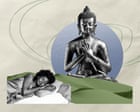
The simplicity of breathing; the sweetness of laughter; the privilege of lying on a bed. Buddhism teaches us how to enjoy the small pleasures
Making sense of it is a column about spirituality and how it can be used to navigate everyday life
There is a particular Buddhist story that reassured me I had found the right path.
The story goes that Prince Siddhartha Gautama was deep in spiritual practice – arduous, unforgiving practice. He had tried everything from breath-holding to extreme fasting. But none of it brought the freedom from suffering he sought.
As is sometimes the case in those moments, he was graced with a memory. He remembered being a child, sitting under the shade of a rose apple tree while his father worked nearby. As he sat there, free from preoccupation, his mind settled and his experience became infused with a deep sense of pleasure and ease.
This memory gestured at what later became a fundamental Buddhist idea: put simply, extreme self-denial is not the path to freedom. More radically, could it be that a certain kind of pleasure – a more refined pleasure – might help point the way?
I’ve always been intrigued by pleasure, its limits but also its invitation. The pleasure Siddhartha remembered was not wily or sneaky, waiting to trick him into attachment, but rather carried him towards freedom of heart.
Admittedly, the Buddha distinguished this kind of pleasure from sensual pleasures, which can become tangled with craving, acquisition and a mistaken belief that happiness lies in getting more.
But the point is not to become sceptical or suspicious of pleasure, but to lean into it when it naturally arises.
As humans, we are strangely adept at trying to elicit and extract pleasure, to plan for it and prolong it, but not so good at receiving it when it is right in front of us.
Stress can diminish our sensitivity to pleasure. Psychologists use the term “anhedonia” to describe the diminished capacity to anticipate or experience pleasure, a phenomenon associated with a range of mental health conditions.
As a teenager, I had a free-spirited friend who wholeheartedly called out, “I love bed!” before she went to sleep. We could hear her down the corridor.
I loved bed too; we all did. But would we admit it?
She noticed the sheets, the relief of placing a tired body down, the privilege of a pillow. Boy, she knew how to receive pleasure when it was being offered.
The Buddha observed that all experience is associated with a tonal quality – pleasant, painful or neutral. In Buddhism, we call this vedanā, or feeling tone. And then there is all the manhandling we do with feeling: judging it, willing it to stay, tweaking it.
When working with mindfulness students who are having a hard time, I often do a pleasure check.
I ask, sometimes provocatively, “What are you doing in your free time?” Then: “Are you able to read a good novel? Could you go for a massage or a meandering walk in the sun?” What I am really asking is: can you be with pleasure intentionally, even in the midst of suffering?
These conversations also make it plain that access to pleasure is not enjoyed equally. The time, safety and space necessary to notice and receive pleasure are impacted by our social and material circumstances. But when pleasure does arise amid turbulence, allowing it to register can offer the nervous system a chance to rest, even for a moment.
We feel this viscerally: a slower breath, a softening, a release. And if we are quiet, we might notice our minds relishing it – “How terrific, I love this.” Or as American novelist Kurt Vonnegut put it, “If this isn’t nice, I don’t know what is.”
Can we let pleasure simply hold our attention without trying to prolong it?
Pleasure arrives with different inflections. Some forms leave us aching for more. Others are more sublime, spiritual even – the kind the Buddha spoke of: the mind that gathers and settles. The simplicity of the breathing body. The sweetness of simply existing.
I once had a teacher who started meditation sessions with, “It feels good to be in the body.” It was a low bar for pleasure, but somehow I felt it.
Then there is the pleasure of living a life of non-harm, of treating ourselves and others with dignity, love and respect. Subtler still is the pleasure of laying down the burden, even for a moment, of having to be and do.
I remember marvelling that in my mother’s final weeks, days in the hospital could still brim with pleasure. Among the many unpleasant experiences, there was the sweetness of laughter, a leg massage, a feeling of togetherness, and a daughter’s recognition of the comfort and familiarity of being with her mum.
Each evening, I would think how strange it was that there was so much pleasure in despair.
And here receptivity was key. I suspect without it, I might have seen only what was painful and missed the pleasure braided through.
Every time I sit to meditate, I consciously luxuriate in the pleasure of breathing.
Of course, pleasure dissipates, and unpleasant and neutral sensations arrive too. Yet in Buddhist practice, these too are met with the same receptive attention: “Oh, this is unpleasant, and it will change.” Sometimes there is even a kind of pleasure in this honesty.
Dr Nadine Levy is a senior lecturer at the Nan Tien Institute. She coordinates its health and social wellbeing program and the graduate certificate in applied mindfulness
- life
- pleasure
- suffering
- system
- story
- practice
- moment
- simplicity