‘We both know how we feel about death and dying’: Rhys Ifans and Laura Linney on their brutally honest Parkinson’s drama
Written by Vicar of Dibley co-creator Paul Mayhew-Archer, who has the disease, Onwards and Sideways sees the actors play a couple who bond over their diagnoses – a devastating subject but laced with humour too, they say Ahead of production on their first job together, Rhys Ifans and Laura Linney didn’t undergo the standard “chemistry read” to make sure they got on. In the Norfolk-set BBC film directed by John Madden (Shakespeare in Love), Ifans would have to nearly throttle Linney while in the grip of night terrors, she’d have to collapse in his arms in a weeping mess having bankrupted…
Written by Vicar of Dibley co-creator Paul Mayhew-Archer, who has the disease, Onwards and Sideways sees the actors play a couple who bond over their diagnoses – a devastating subject but laced with humour too, they say
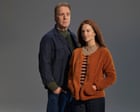
Ahead of production on their first job together, Rhys Ifans and Laura Linney didn’t undergo the standard “chemistry read” to make sure they got on. Which is remarkable, given what their characters would have to do to each other in Onwards and Sideways.
In the Norfolk-set BBC film directed by John Madden (Shakespeare in Love), Ifans would have to nearly throttle Linney while in the grip of night terrors, she’d have to collapse in his arms in a weeping mess having bankrupted herself with a gambling addiction; both situations arising from the neurological condition afflicting their characters: Parkinson’s disease.
But despite being thrown into the deep end in this hugely emotional, often hilarious film, both actors acknowledge an immediate feeling of safety around each other as they embarked on a project that would require them to strip themselves bare. “It’s odd,” says Ifans, “you learn so much about each other so quickly. I couldn’t tell you what kind of car Laura drives. What her home looks like. But we both know how we feel about death and dying.”
Linney, 62, is a triple-Oscar-nominated star with a diverse array of roles on her CV, from her breakthrough in The Truman Show (1998) onwards through Clint Eastwood’s Mystic River and Richard Curtis’s Love Actually (both 2003), then the TV series Ozark and The Big C. Ifans, 59, frankly burst through in 1997’s Twin Town, AKA the “Welsh Trainspotting”, and went on to play Hugh Grant’s scraggly flatmate Spike in Curtis’s Notting Hill (1999), Daniel Craig’s stalker in Enduring Love (2004) and drug smuggler Howard Marks in Mr Nice (2010).
Divergent backgrounds, then. But equally time-served, too. So the actors were able to dive in, no chemistry read required. They did, though, do dance classes. They waltzed together in London, and separately nearer their respective homes, the better to understand one popular form of recreational therapy for people with Parkinson’s. In Brooklyn, Linney was introduced to David Leventhal at the Mark Morris Dance Group. He runs a programme there called Dance for PD.
“That’s the mothership of this wonderful organisation that now has offshoots all over the world, including here,” the New Yorker says when she, Ifans and I meet in the central London offices of the producers behind Onwards and Sideways. Both are dressed casually and low-key, each clearly easy in the other’s company, their conversation frequently erupting into gales of laughter.
“I spoke with David for a long time – and then I learned that Juilliard has classes for this once a week,” Linney says of the acting school that’s her alma mater. “So I just started hanging out there. It’s incredibly moving what the arts will do,” she says – in this case, how dance and music could relax people grappling with a condition that, among its 40-plus symptoms, causes uncontrollable shaking, stiffness of gait and involuntary freezing in doorways and thresholds. “How brave it makes people. How it opens up the imagination, and then the body follows somehow, when it shouldn’t. And the difference between someone moving in a dance class and then, when the music stops, to see what happens to their bodies – it’s shattering in a good and a sad way. So … it gets right to the bone of things.”
Ifans, meanwhile, attended weekly sessions with a group who meet in Pontio, an “arts and innovation centre” in Bangor, north-west Wales. “There was a harpist accompanying the dance,” says the Pembrokeshire native. “Then there was a support dog running around the room who happened to be a sheepdog.”
“It was peak Welshness!” acknowledges Ifans, to hoots all round. Then, quietly again: “They were so inspiring, these classes. And a great leveller. You’d be sitting next to a nuclear scientist and a school cleaner. Both dancing to the same tune and wrestling with the same diagnosis.”
The writer of Onwards and Sideways is Paul Mayhew-Archer. He’s an actor, writer – he co-created The Vicar of Dibley with Richard Curtis – and accidental activist. The 73-year-old is a founder member of the Movers and Shakers podcast, which raises both awareness and laughs, alongside fellow “Parky people”, including journalists Jeremy Paxman and Mark Mardell. He was diagnosed with the disease at 58, with the canary in the coalmine, symptoms-wise, being that “my handwriting was very small and unclear”.
His experiences directly inform the experiences of the fiftysomething characters played by Ifans (Tony, a teacher) and Linney (Emma, a musician). They also, full disclosure, inform my writing of this feature: my dad has Parkinson’s and I’m in the age bracket Mayhew-Archer was when he was diagnosed. My handwriting is appalling.
True to Mayhew-Archer’s mission, Onwards and Sideways is painfully, honestly funny. The scene where Rory Kinnear’s doctor rather cavalierly informs Tony that he has the condition features a joke lifted from Mayhew-Archer’s own diagnosis.
“My neurologist told me one of the symptoms is the difficulty of smiling, and that I seemed to have difficulty smiling,” Mayhew-Archer relates to me when we meet on another day in the same office. “And I said: ‘Well, that could be because you just told me I’ve got Parkinson’s.’ As soon as I said that, I knew I wanted to be funny about Parkinson’s, because I saw no point in being serious.”
Ifans – who’s been staunchly committed to this project for the duration of its lengthy gestation, stretching back pre-Covid – seconds that emotion. “I loved the way Paul’s story about a life-changing diagnosis was handled, funny and devastating all at once. My attraction to it was also that I have friends and family who’ve been impacted by Parkinson’s. That gave me a fast track into the telling of a story like this.”
“You don’t have to scratch very far to find someone somewhere who knows someone who has Parkinson’s,” echoes Linney of a condition that, in the UK, 166,000 people are living with, with one person being diagnosed every 20 minutes according to Parkinson’s UK. “I certainly have friends who do.”
To “act” Parkinson’s, Ifans and Linney were aided by the Neuro Heroes, “remarkable women who do physio for people with Parkinson’s and various related conditions”, says Linney. “They helped us with our basic understanding of Parkinson’s, and then also the physicalisation. [Because there’s] a mercurial element to this condition – it’s bespoke. No one has the same Parkinson’s.” Or even the same side-effects from the drugs prescribed to help manage the incurable condition: they can cause increased libido, appetite, and compulsive spending and gambling.
“Parkinson’s was like a physical dialect for us,” continues Ifans. “We had to learn its physical language. They [the Neuro Heroes] could say what was happening at the muscular level, or the skeletal impact, of Parkinson’s. But we needed poetry to understand what that felt like. Whether it felt like moving through tar or sand. Just to be able to arrive at an image that you could apply to the body, that you could take with you to set each day, to help you achieve the shapes and positions that Parkinson’s puts people in.”
And those people, ultimately, were always in the actors’ minds. Mayhew-Archer knew the film had to honour those with the condition, but that that noble aim did have its bluntly practical limits. “We knew we couldn’t cast people with Parkinson’s in those two central roles,” he says. “Partly because Laura’s character has [a medical procedure] done which means she stops doing certain things. And it would be very hard for people with Parkinson’s to stop doing some things!” he adds with a laugh. “Once you start freezing, you can’t stop!”
“We had the added responsibility in getting Parkinson’s right,” says Ifans. “Not just right, but bang-on. Because there’s a whole demographic watching that deserves to be represented. That was the scary bit, wasn’t it?”
Linney, staring intently at her co-star across the table, nods. It was, she says, fundamentally about “doing it justice”. And then, “the possibility of failing at that?” says Ifans. “Huge responsibility. That brought us closer together. That’s the stuff that woke us up at night.”
When we meet, Linney is about to be unveiled as one of the cast of DC superhero TV series Lanterns. She’s a Guardian of the Universe, “or so I’ve been told”, she says with spoiler-savvy diplomacy. “But a green beam might come down and evaporate me if I utter a word!” She’s also two weeks into filming, alongside Colin Firth and Julianne Moore, Comfort and Joy (formerly The Joy of Sex), a romcom about the north London throuple who helped produce Alex Comfort’s groundbreaking 1972 illustrated sex manual. So, another unconventional midlife drama but lighter, certainly, than Onwards and Sideways.
“There was something about this world of Parkinson’s that forced me to be very present in a way that I normally am not, particularly while working,” she admits. “It forced me to be over my skis a bit. And off-balance, and vulnerable, and experiencing things in very different ways. “This movie rearranged my cellular structure!” she adds, beaming in gratitude. “Most movies don’t do that. I love my work. But very few experiences have literally rearranged my soul. This one certainly did.”
As for Ifans, this year we’ve seen him alongside Anna Maxwell Martin in Apple TV’s cold war-era sci-fi thriller Star City. When I meet him, he’s just been beheaded on House of the Dragon. Onwards and Sideways, in stark contrast, is acting in the raw, with no high-concept narrative or CGI to hide behind. Acting of a different order.
“Yes. You can have spaceships, lunar landscapes, swords and castles, but you ain’t gonna have a co-star like this,” Ifans says, beaming at Linney. “That’s where the money is. Not the coin … That’s why we go to work. As Laura says: all these [roles] are different and thrilling and enjoyable in their own way. But this film is particularly nourishing.”
Having seen Onwards and Sideways in the company of my mum, who cares 24/7 for my dad, I couldn’t agree more. We watched it bathed in both tears and smiles. It’s a beautiful achievement; empowering, educational entertainment, and Ifans and Linney deserve all the credit in the world for how they’ve portrayed the multiverse of Parkinson’s. I would send them a personal note to thank them for what they’ve done for those with, and connected with, the disease. But I’m not sure they’d be able to read my handwriting.
Onwards and Sideways is in UK cinemas from 6 November, and on BBC One and iPlayer later this year.
- ifans
- linney
- rhys
- laura
- parkinson
- death
- drama
- disease