Germany's chancellor called for Korean unity. Does Seoul want that?
Germany's chancellor called for Korean unity. Chancellor Merz called for a reunified Korea during his recent visit — but the prospect seems faint.
The story of South and North Korea — two nations that share history, language and much of their cultural heritage — sounds familiar to Germans.
Their own country spent decades divided by opposing regimes until geopolitical winds shifted and allowed East and West Germany to reunite peacefully in 1991.
Just two years later, German Chancellor Helmut Kohl visited the Demilitarized Zone (DMZ) on the Korean Peninsula and expressed hope that South and North Korea would also be reunited by the end of the decade.
That never materialized. Some 35 years since Germany achieved its dream of reunification, Seoul and Pyongyang are still bitterly divided by political systems, economy, and their geopolitical alliances.
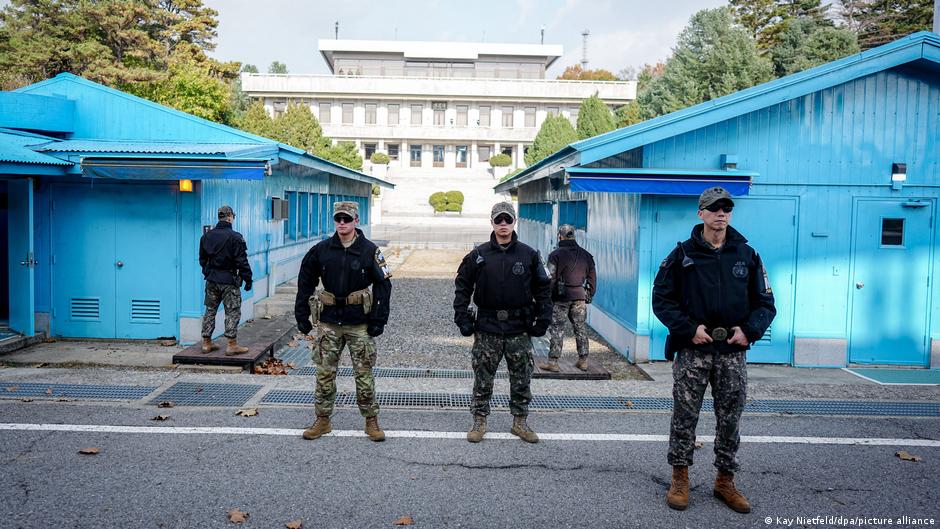
Overlooking the DMZ, which separates the two Koreas, on Friday Chancellor Friedrich Merz could only repeat the hopes stated by Kohl in 1993.
"We Germans know how painful the division of a country is," Merz stated in a message shared on social media. "We also know that whoever stands firm in their values and has the courage for dialogue can tear down walls."
"We wish the people in Korea unity in freedom," Merz said.
To analysts following the day-to-day inter-Korean politics, this sounds like a distant dream.
As the Koreas continue to eye each other warily across the DMZ, their dramatic differences in wealth and political freedom are clearly on display.
But the biggest single issue might be that neither side appears to want reunification.
"The feeling has changed in the last couple of decades," Choo Jae-woo, a professor of foreign policy at Kyung Hee University, told DW. "Younger South Koreans just see the North as another country that happens to be next to us, is poor and threatening, and they have no sentimental attachment to it, like older generations do."
"More and more people are asking why they should bother about reunification," he said.
A study by Seoul National University's Institute for Peace and Unification Studies in September indicated that 39.1% of South Koreans believed reunification was impossible, the highest proportion since the survey was started some two decades ago.
Many were concerned about the vast amounts of money that it would take to build the North's infrastructure, including roads, hospitals, schools and all other requirements for a modern functioning society.
Officially, South Korea's government has not abandoned reunification as a national objective. Its constitution still calls for peaceful union based on freedom and democracy, but Choo points out recent governments are promoting the idea far less frequently than in the past.
North Korea has not been nearly so reticent about where it stands on the matter.
"In December 2023, North Korean leader Kim Jong Un announced that the constitution was being changed and that peaceful reunification was no longer possible," Choo said. "Instead, South Korea would be seen as a hostile rival and that he no longer had any intention of bringing the two together."
The revised North Korean constitution was approved in March 2026 and Kim's regime has moved aggressively to scrub all references to reconciliation and national unity.
"I do not think the North can make it any clearer that it has no intention of getting any closer to South Korea," said Mason Richey, a professor of politics and international relations at Hankuk University of Foreign Studies in Seoul. He added that analysts, officials and ordinary Koreans in the South "roll their eyes" when the issue of Korean reunification crops up.
Beyond the lack of desire on both sides, there are a number of additional challenges that would need to be overcome, he said.
North Korea's regime wishes to protect its own power and prestige, which would inevitably be under threat if a democratic system were introduced for a unified nation.
Bridging the enormous gap in economic development would be a huge undertaking that would put immense pressure on the South, Richey said, even if outside assistance were forthcoming. And while a united Germany has been able to bring its regions to relatively comparable levels, it is worth noting that East Germany in 1990 was still substantially more developed than North Korea is today.
Nominal GDP in North Korea is $31.7 billion a year. In the South, it is $1.85 trillion a year, or 58 times bigger, according to Bank of Korea statistics for 2024. With North Korea having roughly one-half population size of the South, the GDP per capita in the North is just $1,230 (€1,097) against nearly $36,000 in the South.
Professor Choo said reunification would not just be a domestic issue. The two nations have divided strategic and security loyalties, with the South allied to the US and the North tied to China and increasingly, Russia.
"Those superpowers would not want to give up their ally for reunification as it would be a major strategic issue for them, as well," Choo said. "The US would not want a united Korea that leaned towards China, and Beijing would resist reunification if it meant the US could have its military on the Chinese border in what is presently North Korea. That's just impossible for either side to imagine."
Ultimately, he said, the present status quo on the peninsula may be an imperfect solution, but it is the best way of preserving regional stability. A decade into the future, however, the economic, social and security situations may have radically altered — "and that is why we can never say never."
- chancellor
- germany
- unity
- seoul
- korea
- system
- world
- border