Failure to prosecute electoral offenders, threat to free, fair elections, says NHRC

The NHRC head said electoral offences will remain a problem in Nigeria as long as people can commit the crimes and get away without consequences.
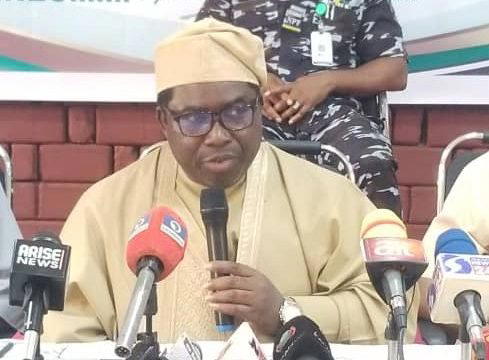
The UNOWAS delegation alongside NHRC's staff
The Executive Secretary of the National Human Rights Commission (NHRC), Tony Ojukwu, identified, on Monday, the non-prosecution of electoral offenders as a challenge to free and fair elections.
Mr Ojukwu, a Senior Advocate of Nigeria (SAN), said electoral offences will remain a problem in Nigeria as long as people can commit the crimes and get away without consequences.
He spoke when he hosted a delegation from the United Nations Office for West Africa and the Sahel (UNOWAS) at the NHRC headquarters in Abuja.
The visiting delegation was led by the Representative of the United Nations Secretary-General for West Africa and the Sahel (SRSG) and Head of UNOWAS, Leonardo Simao.
The visit discussed Nigeria’s political and security developments, particularly preparations for the 2027 general elections, emerging challenges and opportunities, and efforts to promote peaceful elections.
Mr Ojukwu spoke of the commission’s preparedness towards ensuring a smooth conduct of the upcoming elections.
He said the commission had discovered that “people who are committing these election offences are acting on behalf of key politicians.”
This, according to him, makes it difficult for the politicians “to be held accountable for the acts of their agents.”
“And this continues to make the environment very fragile. Because as long as people can commit these election-related offences and go scot-free, then anybody can try anything they like,” the senior advocate said.
He expressed displeasure over the failure to implement a recommendation of the Justice Mohammed Uwais electoral reform report for “the establishment of an election offences framework, which is supposed to deal disproportionately with any election-related offence.” The committee was set up by the then-President Umaru Yar’adua to reform the nation’s electoral system after admitting that the 2007 election that brought him into office was flawed.
Mr Ojukwu noted that the visit was a very good occasion to bring this issue to the limelight, expressing confidence that the delegation would further interface with key government officials.
Mr Ojukwu observed that political campaigns for the 2027 general elections have been marked by controversial remarks from public figures.
Prominent Islamic cleric Sani Jingir controversially described Nigeria as a Muslim-majority country and called for mass support for the Muslim-Muslim presidential ticket of the ruling All Progressives Congress (APC) in 2027 while condemning whoever opposed it.
This generated backlash and even led to the NHRC’s demand for Mr Jingir’s arrest for inciting religious hatred and hate speech.
Similarly, the senator representing Osun East Senatorial District, Francis Fadahunsi, issued death threats to members of the Accord Party found in the Ilesa axis of the state days before the Osun State governorship election in August.
In the same month, the Chairman of Kuje Area Council in the Federal Capital Territory (FCT), Danjuma Shekwolo, was seen in a video asking residents to either vote for the APC or leave the council areas.
Mr Ojukwu noted that all these do not encourage a level playing field for the campaign.
To curb this, Mr Ojukwu disclosed that the commission was preparing an advisory to guide the behaviour of political actors, security operatives and for the government to know its limits in interfering with citizens’ rights.
He also said another advisory to guide the government’s response to civic space is also in place to help address the fear induced by the misuse of the Cybercrime Act.
Mr Simao commended the NHRC for its effort. He noted that campaigns must occur within the limits of the law, the preservation of human life, and particularly the prevention of violence.
He noted that the essence of the visit was to work with different institutions, different stakeholders, and to learn from them how their institution is being prepared for this upcoming period.
“When elections go without violence, there is a lot of work that happens before. Sometimes it is not visible to the general public. Our role as a United Nations, and Nigeria is an important member of the United Nations, is to assist when necessary to reach the objective that the elections take place in a serene, peaceful atmosphere.”
Mr Simao encouraged NHRC to continue with that patriotic attitude and patriotic engagement to conduct peaceful elections.
He noted that the delegation did not come as inspectors to police the activities of the NHRC: “Our objective is that Nigeria continue to be an example of other kinds of support. So you cannot afford to fail. It’s forbidden for Nigeria to fail.
“Our work is continuing to remind you that you can do it and you are going to do it,” he said.
- failure
- threat
- nhrc
- offender
- election
- head
- offence
- problem