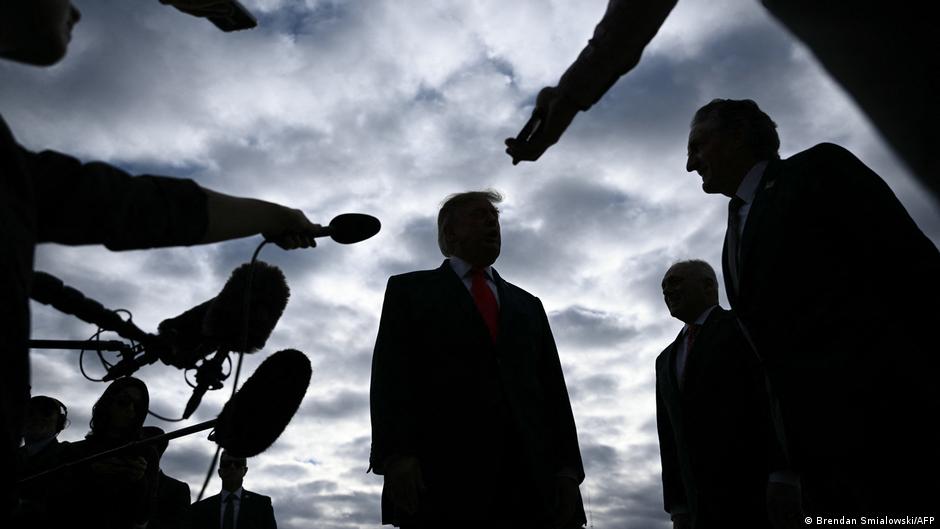
Trump's not on the ballot so what does he have to do with the midterms?
Trump's not on the ballot Voters may treat the midterm elections as a referendum on Donald Trump's presidency and could determine how much power he has for the rest of his term.
Voters across the US are at the precipice of a major date on their electoral calendar — the midterm elections.
Millions of Americans are heading to the polls to elect hundreds of members of Congress in a campaign already marked by threats of interference and even party infighting.
The results will largely be seen as a referendum on Donald Trump's presidency and could determine how much power he wields in the second half of his term.
Let's dive into what's at stake and how the results could shape the 2028 presidential election.
The midterms mark the middle point of a president's four-year term when Americans elect their representatives in Congress.
The Congress is made up of two chambers — the House of Representatives and the Senate.
All 435 seats in the House of Representatives and 35 of the Senate's seats are up for election.
Of the 50 US states, voters in 36 of them will also be electing their next governor to four-year terms.
The Republican Party, also known as the Grand Old Party or GOP, currently holds a slim majority in both the House and the Senate, so we're in for a tight race.
The cardinal rule with the midterms is that the incumbent party, in this case Trump's Republicans, typically lose ground, while the opposition party that isn't in power historically gain seats.
For Democrats these elections therefore offer a chance to take back congressional power.
The results will determine who controls Congress, which passes federal laws that impact the lives of hundreds of millions of Americans.
If Democrats retake the House it will set the stage for two years of clashes and serve as a major roadblock on Trump's agenda.
All 435 seats in the House are up for grabs but only 40 are considered to be competitive races.
Democrats need a net gain of three seats to take the House, which means just a handful of races could dictate who controls the chamber.
The Senate is a different story. It's made up of 100 seats, 35 of which are up for election.
Only about 12 of them are considered competitive with the rest in either reliably Republican or reliably Democratic states.
Republicans currently hold the Senate with 53 seats, while Democrats and independents hold 47 seats.
Democrats need to pick up four Senate seats to reach 51 to take control of the upper chamber.
Republicans can afford to lose a maximum of three seats and still win the Senate with 50 seats. That's because in a 50-50 Senate the vice president, currently Republican JD Vance, can cast a tiebreaker vote.
That makes the Senate race more of an uphill battle for Democrats than the House race.
The short answer is yes. Analysts and prediction markets currently tip the Democrats to win the House.
If Democrats win the House they will make it much harder for Trump to advance his agenda.
A Democratic-controlled House would also bring more aggressive oversight of the Trump administration with more investigations, subpoenas and congressional hearings.
The president could also face another effort to impeach him if the Democrats gain ground in the midterms.
A lot has changed since Americans last voted, including the maps used to decide who represents them in Congress.
Congressional maps have been redrawn in 10 states in a process known as redistricting.
Usually that happens every 10 years, but when Texas redrew its map to favour Republicans it set off a domino effect in other states, sparking fights over political representation and voting power.
The Cook Political Report estimates Republicans have gained a net five additional seats from the redistricting battles, potentially giving them an advantage before a single vote is cast.
There have also been major Federal and Supreme Court rulings that advocates say have weakened the Voting Rights Act — the landmark legislation designed to prevent racial discrimination in voting.
Voting rules have become a major flashpoint, particularly over voter eligibility and access to mail-in ballots.
Presidents are not elected in the midterms and Trump is not on the ballot, but he will dominate the contest.
Despite record low approval ratings in national polls, the president is positioning himself as the Republican party's best asset.
He and his advisers have suggested he's the only person who can mobilise the MAGA faithful and help Republicans avoid steep losses in an election cycle with historically low voter turnout.
In early September, Trump headlined a first of its kind Republican midterm convention which was dubbed "Trump-a-palooza", putting himself dead centre of the party's campaign.
His message to voters is that although his name won't appear on the ballot, his administration, legacy and agenda will be at stake.
The president has also weighed into most congressional races across the country, issuing political endorsements for his preferred candidates, which have overall proved to be influential.
For Democrats, Trump and his policies offer an obvious campaign target. They are framing the midterms as a chance for voters to check his power and push back on his agenda.
A strong midterms result will shape America's political landscape ahead of the 2028 presidential race.
A big win for the Democrats would give the party momentum heading into 2028 and a much stronger platform to challenge Republicans on.
If Republicans retain control of the House and Senate it will strengthen the Trump administration's ability to pursue its agenda and could put the party on the front foot in the lead up to 2028.
Either way, the results will offer an early sign of voter sentiment, and a glimpse at the issues and candidates that could drive the 2028 contest.
Governor races will be also be closely watched for potential presidential contenders, as a strong performance in the midterms would raise their public profile in either party.
- trump
- ballot
- midterm
- voter
- election
- referendum
- donald
- presidency