Americans head to polls in midterm elections seen as referendum on Trump
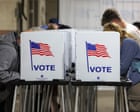
Control of the Senate and House of Representatives, both currently held by the Republicans, is at stake Americans are heading to the polls today in US midterm elections widely seen as a referendum on Donald Trump’s second presidency and a chance for opponents to rein in his untrammeled power. Democrats and Republicans have scrambled in recent days to deliver their final pitches to voters with control of the US Senate and House of Representatives – both currently held by the Republicans – at stake.
Control of the Senate and House of Representatives, both currently held by the Republicans, is at stake
Americans are heading to the polls today in US midterm elections widely seen as a referendum on Donald Trump’s second presidency and a chance for opponents to rein in his untrammeled power.
Democrats and Republicans have scrambled in recent days to deliver their final pitches to voters with control of the US Senate and House of Representatives – both currently held by the Republicans – at stake.
The campaign has been overshadowed by Trump, who has staged several dozen rallies across the country while urging his make America great again (Maga) base to vote for Republican candidates and pretend his name was on the ballot.
The party holding the White House typically loses congressional seats at midterm elections and Democrats are hoping Trump’s nose-diving popularity can be exploited to generate a “blue wave” groundswell of popular opposition that will win them both the Senate and the House.
They are seeking to wrest control over both chambers of Congress to put a brake on Trump’s presidential power, which has gone largely unchecked as he has launched a fierce immigration crackdown involving mass arrests and deportations, waged war on Iran, imposed tariffs on foreign imports , and embarked on vainglorious building projects, including a White House ballroom.
Opinion surveys have suggested the Democrats are well-positioned to win the House. The party faces a tougher task to regain control of the Senate, although it has targeted several Republican-held seats including Ohio, Texas and Maine.
A final set of polls from the New York Times and Siena University, published on Sunday, put Democratic candidates ahead in five of seven key battleground contests – including Texas and Kansas, where voters have not sent a Democrat to the Senate since 1988 and 1932, respectively.
The final stretch of the campaign was not without drama for the Democrats, however. In Michigan – widely seen as a crucial pillar to either party’s ambitions of control in the Senate – Democratic congresswoman Haley Stevens, who lost her party’s senate primary to Abdul El-Sayed, endorsed his Republican rival, Mike Rogers, on Sunday.
Stevens was widely condemned by fellow Democrats over the move, which followed a feud with the El-Sayed campaign over an outside group’s campaign ad that blamed the high cost of living on US support for Israel. Chuck Schumer, the Senate minority leader, described her endorsement of Rogers as “a despicable betrayal”.
“Whatever they’re trying to distract you, it’s because they’re picking your pocket,” El Sayed told hundreds of supporters in Royal Oak, Michigan on Monday.
The extraordinary rupture in Michigan took places days after the party faced damaging headlines in Alaska, where it was reported that the Democratic senate candidate’s campaign was behind an effort to recruit a challenger with almost the same name as her rival, the Republican senator Dan Sullivan. (The Democratic candidate, Mary Peltola, has denied any knowledge of such a scheme on the part of her campaign.)
Before the report of the Peltola campaign’s involvement, the Department of Justice (DoJ) filed a lawsuit to block the certification of Alaska’s Senate results in the event of a Republican defeat, citing potential “voter confusion” over the presence of two Dan Sullivans on the ballot. The lawsuit has since been dismissed by a judge.
Trump has put himself center stage by crisscrossing the country to deliver a succession of speeches for Republican candidate, despite opinion polls showing his approval ratings falling to record lows of between 33 and 37%.
Democrats have sought to reinforce the message that the election is about Trump while trying to highlight the perceived corruption of the US president and his family, along with affordability issues, and the impact of the conflict with Iran, which is seen as having exacerbated the cost of living.
Opinion surveys have shown that voters have become increasingly concerned about corruption in government. A recent Harris poll for the Guardian found that 76% think elected officials care more about enriching themselves than improving the economy for ordinary people.
Disclosures to the US office of government ethics show that Trump has earned about $2.2bn since returning to the White House, including royalties from his own name-branded meme coin.
As the president has grown wealthier, voters have chafed under rising living costs, which Trump vowed to reduce during his 2024 presidential campaign.
The war with Iran – which Trump launched last February in tandem with Israel – has stoked inflation by increasing global oil prices, which has led to higher prices at the pump for American motorists and raised the cost of diesel, a vital fuel for supply chains and farmers.
The US elections also take place under a shadow of uncertainty about whether Trump will accept the results if they do not go the Republicans’ way.
Alaska is just one of the cases pursued by the justice department – under the control of Trump’s close ally, Todd Blanche, the attorney general – that opponents say are designed to cast doubt on the election’s integrity, including through baseless claims of mass voting by non-US citizens.
The justice department plans to deploy a record 1,000 election monitors to polling stations across the US. Critics have denounced the move as voter intimidation.
- americans
- midterm
- referendum
- trump
- republicans
- poll
- election
- control