Yemen: Houthi clashes near Taiz leave residents in a 'state of panic'
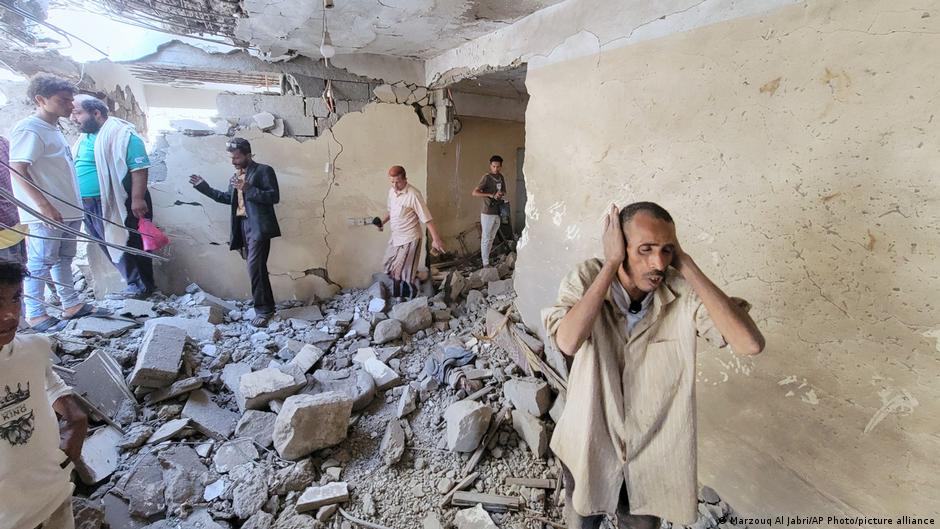
Fighting between Iran-backed Houthi rebels and Yemeni government forces has intensified around the city of Taiz. Residents face growing shortages of food, water and medical supplies as thousands flee their homes.
Four months into the fighting in Yemen between the Iran-backed Houthi movement and the Saudi-backed Yemeni government, clashes are concentrated around Taiz in the country's southwest. Yemeni authorities have warned civilians of sniper fire from surrounding hillsides. Houthi forces have also largely blocked the delivery of goods to Taiz, which is under the control of government forces.
Taiz is Yemen's third-largest city, with a population of around 1 million people. However, fighting has displaced around 134,000 people in the Taiz governorate region, accordingto the International Organization for Migration. The governorate accounts for almost half of the more than 319,000 people displaced across western Yemen, the organization said on November 1, 2026.
"The Houthis have blocked fuel, water and medical supplies, basically all things required for hospitals to function properly," Niku Jafarnia, Yemen researcher at Human Rights Watch, told DW. "Even those who can reach hospitals may not be receiving the care they need," she said, adding that it has had a devastating impact on people's health, particularly those with chronic illnesses.
Ammar, a 45-year-old photographer in Taiz, told DW on Monday that he sees people in a "state of panic" and yet he feels that "the determination not to submit to the Houthis is very strong."
Afnan, the mother of a schoolchild in Taiz, told DW that "neighbors share the little food they have and help each other and many people in Taiz refuse to flee." She and the other residents who spoke to DW asked that their full names not be published, fearing reprisals.
Hanan, a 30-year-old mother of three, said that prices have skyrocketed while there is almost no petrol, cooking gas or drinking water left in the city. "This increases the mental load on people who are already scared by hearing the clashes of the fighting day and night," she said. Despite this, she numbers among those who have decided to stay.
Meanwhile, Nabil Shamsan, the governor of Taiz, told DW that negotiations are underway to bring food, fuel and water back to the city. While it remains to be seen when and under what conditions this might happen, international aid organizations remain extremely concerned.
"Fighting and insecurity around Taiz is making it unsafe for civilians to move freely and also for our staff to deliver aid," said Alison Bottomley, an advocacy adviser with the Norwegian Refugee Council in Yemen. "This is preventing us from reaching the 7,000 people we are supporting with emergency tents, blankets and educational activities for displaced children," she told DW, calling on both factions to allow "civilians and humanitarian workers to move safely."
During the previous Yemen conflict, which began in 2014 and largely ended with a UN-brokered truce in 2022, Ansar Allah, the formal name of the Houthi group, had already laid siege to Taiz in 2015 and 2016. That siege brought the population close to famine and caused a humanitarian crisis, but the Houthis never captured the city.
In turn, Taiz, as a bastion of resistance, represents something the Houthis have struggled to subdue for more than a decade, Hisham Al-Omeisy, a senior Yemeni adviser with UK-based advisory firm Coral Core Consultants, told DW. "The city symbolizes a deeply rooted tradition of political pluralism, civic resistance and rejection of the Houthi model of rule," he said, adding that the city's continued resistance is both a military obstacle and a political challenge to the Houthis' claim that their authority across Yemen is inevitable.
Following the truce in 2022, the Houthis controlled the capital Sanaa, most of northern Yemen and parts of the center, while the internationally recognized government controlled much of the west and the south including the city of Aden. However, fighting reignited in late July and the clashes intensified in September, as the Houthis seized territory from forces loyal to the internationally recognized government.
Control of the strategically important Bab el-Mandeb Strait, which connects the Red Sea with the Gulf of Aden, is contested. The precise territorial situation remains unclear, while the Houthis retain the capacity to threaten maritime traffic. The conflict continues to escalate, alongside an exchange of missile and drone attacks between the Houthis and Saudi Arabia.
Data on the number of people injured or killed in Yemen varies because of the ongoing fighting and separate statistics given by the Houthi movement and the government's health authorities. According to the latest WHO Health Cluster situation report, at least 1,677 people had been killed and 7,395 injured as of October 25, 2026.
Meanwhile, seizing Taiz is highlighted as a key strategic step by analysts. "Taiz would give the Houthis a major advantage in consolidating their hold over northern Yemen while opening the way for further expansion toward the south and the Red Sea coast," Al-Omeisy said, adding that controlling Taiz would give them stronger cards in any future negotiations.
"Taiz is far more than simply another military front for the Houthis," he noted.
"However, the Houthis may not actually need to capture Taiz to achieve many of their objectives," Hisham Al-Omeisy said. "If they can isolate the city, sever its remaining supply lines and neutralize it as a military threat, they could consolidate their positions along the western coast while tying down significant government forces," he added.
"My greater concern is that the Houthis could use gains around Taiz to progressively weaken and fragment the anti-Houthi camp, rather than immediately launch a full-scale offensive against Aden," Al-Omeisy told DW, adding that the Houthis have repeatedly demonstrated an ability to exploit divisions among their opponents, and those divisions remain one of the government's greatest vulnerabilities.
- taiz
- yemen
- resident
- state
- clash
- panic
- iran
- rebel