King Charles addresses summit as campaigners intensify demands for apology for slavery
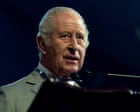
King Charles has said that deepening his understanding of the horrors of slavery has made him more determined to address the wrongs of the past, as Caribbean leaders and campaigners intensified demands for an apology and reparations from Britain. “We cannot change the actions of those who came before us,” Charles told leaders at the opening of the Commonwealth summit in Antigua and Barbuda on Tuesday.
The king did not give explicit support for reparations but says he is committed to ‘addressing past wrongs’
King Charles has said that deepening his understanding of the horrors of slavery has made him more determined to address the wrongs of the past, as Caribbean leaders and campaigners intensified demands for an apology and reparations from Britain.
“We cannot change the actions of those who came before us,” Charles told leaders at the opening of the Commonwealth summit in Antigua and Barbuda on Tuesday. “We can, however, learn from the past.
“The transatlantic trade in enslaved persons still casts a shadow over these islands and other members of our Commonwealth,” he said. “That shameful chapter of history is one that fills my heart with horror and my soul with the most profound personal sorrow.”
Charles said the more he had furthered his understanding “through listening, learning and looking”, the more committed he had become to building modern partnerships capable of addressing past wrongs.
But the king stopped short of an apology or explicit support for reparations, instead pointing to education, employment, intra-Commonwealth trade and climate resilience as ways of tackling continuing hardship and disadvantage.
“For, as any sailor navigating the seas knows, we cannot command the winds, least of all where the winds of yesterday have delivered us, but we can choose how we set our sail,” he said.
Though speaking as head of the Commonwealth, and this speech would have been drafted by Charles personally along with his advisers, palace aides have indicated there would be “no surprises” in it for the UK government.
Reparations are not formally on the agenda of the Commonwealth heads of government meeting (Chogm), where trade, climate resilience and finance, sustainable debt, democracy and opportunities for young people were among the stated priorities of the 56-member bloc.
But sustained campaigning by Caribbean governments and a growing international reparations movement have propelled the issue to the centre of political debate surrounding the gathering.
Opening the summit in St John’s, the capital of Anitgua and Barbuda, the country’s prime minister, Gaston Browne, said “fairness” required an “honest engagement with our shared history” and called for meaningful and respectful dialogue on reparatory justice and the enduring consequences of slavery and colonialism.
The UK’s prime minister, Andy Burnham, has said he was open to Britain apologising for slavery, with officials holding talks with national leaders in Antigua about what that could entail. He has also proposed discussions on debt resets for smaller Commonwealth nations and announced £40m ($54m) for critical infrastructure in the Caribbean over the next three years.
But Caribbean leaders have stressed that dialogue must extend beyond an apology. Philip J Pierre, the chair of the Caribbean Community (Caricom), described an apology as an “essential first step” but said an “apology without repair is incomplete”.
He said any structured dialogue must allow consideration of the entirety of Caricom’s 10-point reparations plan, including public health, education, cultural restitution, psychological rehabilitation, debt cancellation and monetary compensation.
Britain’s royal family benefited from the trade, but Charles is politically neutral and is not expected to offer an apology. A palace spokesperson said it would “not be appropriate” for the king to announce a change in government policy.
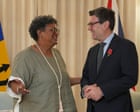
According to the AFP news agency, Burnham discussed slavery with the Barbados prime minister, Mia Mottley, during a meeting on Monday, one of several bilateral meetings the prime minister is expected to have at the summit.
They discussed how Britain was “offering a structured dialogue for communities impacted by the transatlantic slave trade”, including the “next steps”, Downing Street said.
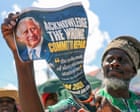
Outside the heavily secured summit venue, protesters gathered with placards declaring: “We know what you did and we can see you”, and “You say appalling atrocity, yet you refuse to apologise”.
One protester, Lenworth Johnson, said that if the king’s constitutional position prevented him from apologising, the British government should authorise him to do so. “We feel an apology is necessary,” he said.
Another, Radcliffe Robins, said the wealth enjoyed by Britain and other western powers was built in part on enslavement. “It is absolutely necessary that his majesty the king and the royal family apologise for the brutality and the injustice that they have imposed on us,” he said. “And with that, we ask for reparations.”
Another protester said the demonstration was intended to ensure those entering the summit knew campaigners were “watching them and listening to what they’re saying and what they’re doing”.
Dorbrene O’Marde, chair of the Antigua and Barbuda Reparations Support Commission and one of the organisers, said: “One whose heart is filled with horror and whose soul bears the most profound personal sorrow must surely be moved beyond words – beyond repeated emotional expression without acceptance of responsibility. Genuine moral consciousness demands apologies – the acknowledgement of wrong, the acceptance of responsibility and the commitment to pursue reparations. Unfortunately King Charles III does nothing of the sort. He has again failed the people who recognise him as king.”
The demonstrations followed a reparations event on Monday hosted by the House of Commons’ all-party parliamentary group for Afrikan Reparations alongside campaign organisations. Its chair, the Labour MP Bell Ribeiro-Addy, welcomed debt relief but warned against presenting it as reparations.
“Reparations was never about personal guilt. It is about the responsibility of states and institutions that still stand,” she said. “Aid is not reparations, because aid leaves the power with the giver. Agency was the crime. Agency has to be the remedy.”
The meeting was followed by a candlelight vigil on an Antiguan beach commemorating enslaved Africans brought to the island. The Rev Bonnie Smith, president of the Antigua Christian Council, asked those gathered to remember people torn from their homes, separated from their families and forced across the Atlantic into enslavement.
“Their names may be absent from our records, but they are not absent from your love,” she said. “Their voices may have been silenced, but their lives have never ceased to matter.”
Prof Sir Hilary Beckles, chair of the Caricom Reparations Commission, meanwhile framed the campaign as part of a wider struggle for peace and justice.
“We are concerned about the unleashing of terror and violence upon innocent people,” he said. “We believe that reparatory justice that calls for human decency, equality and justice for all is the philosophy that will hold us together as humanity going into this 21st century.”
- king
- charles
- summit
- apology
- slavery
- campaigner
- demand
- reparation