The next global pandemic could be brewing on a mink farm in Utah – and little is being done to stop it
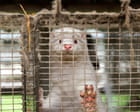
A report by the investigative news service ProPublica reveals that bird flu has been raging in a mink farm in Utah since August, and it appears next to nothing has been done by public officials. George Monbiot is a Guardian columnist Continue reading...
Mink farms are the perfect petri dishes for deadly flu strains to emerge. Yet officials appear to be protecting business interests over human lives
Could this be ground zero? Could it be the spot where the next pandemic begins? It’s certainly a candidate, not least because the chain of events that could trigger a plague far worse than Covid-19 looks like the opening sequence of a disaster movie. A really bad disaster movie, in which the levels of carelessness and turpitude defy belief.
A report by the investigative news service ProPublica reveals that bird flu has been raging in a mink farm in Utah since August, and it appears next to nothing has been done by public officials. In 2023, I warned in the Guardian that mink farms could scarcely be better designed to generate lethal plagues. This is for three reasons: mink are fed on the offcuts of chickens, cows and other farm animals, in which new viral variants often develop; mink readily host both avian and human flu viruses, which can then exchange genetic material, turning a bird disease into a human one; and mink possess extremely high “zoonotic potential” – the ability to infect animals of other species, including human beings.
I pointed out that bird flus that jump into the human population can be extremely dangerous: of those known to have contracted the H5N1 variant since 1997, 48% have died. The first death in the US from avian flu this year has just been announced: the victim caught it from an infected dairy herd. While it is devastating to wild bird populations and some mammals, fortunately its transmissibility between humans is so far extremely low. If the perfect mixing vessel of a mink farm were to generate a variant that was both highly lethal and more transmissible, you would do well to get on with writing your will. Both for this reason and because of the pointless cruelty of the fur business, I called for a global treaty to ban mink farming.
I didn’t expect governments to leap into action, however compelling the case might have been. But nor did I expect them to act as if their aim were to assist a deadly virus. This is how officials in the US appear to have behaved.
ProPublica discovered that, instead of trying to contain the virus by shutting down the farm and slaughtering the mink, Utah departments have sought to contain the story. Public health officials have failed to test workers on the farm for symptoms, or track their contacts, despite the fact that they’re in touch with the infected mink every day, and are often bitten or scratched. Why? Because of complaints from the state agriculture department that “farmers were annoyed” by testing.
Utah’s state veterinarian, Amanda Price, said that the outbreak was “devastating”. But she wasn’t talking about public health. She was talking about the effect on the farmer. “This is his life’s work that he’s seeing be destroyed. I really hope that you understand the humanity behind this situation.” Yes, we do: 8 billion people could be at risk if something isn’t done. Culling the mink could kill the farmer’s business, and he should be compensated for it. Not culling could kill much more than that. Could there be a clearer case of giving the impression of putting special interests above the general interest?
She also remarked: “There’s just not a lot of options out there other than kind of sitting and waiting and seeing what happens … If we started seeing people actively dying from this, obviously that would change how we respond to this.” By which time it would be too late.
The primary effort appears to have been to protect the farm’s interests. The state has not declared an emergency because, officials reason, that might “alert animal rights groups”. It might also alert public health groups, or anyone who cares about human life. Now we’re into flu season. The longer it goes on, the greater the chances that a highly transmissible variant will develop in the mink farm.
These people make the scientists in the first episode of Pluribus look like responsible citizens. The officials here are not following the signals sent by extraterrestrials. Instead, they appear to be following the signals sent by commercial interests. If there’s one thing we’ve learned from the influence of the tobacco and sugar industries, it’s that corporate lobbyists should have nothing to do with public health decisions. Yet they are embedded in every form of decision-making. This, regardless of the issue that strikes the killer blow, could be our downfall.
While mink farms are especially dangerous, all forms of livestock farming present a high risk of generating and propagating pandemics. Indeed, it’s the combination of mink farming with chicken, pig and dairy farming that creates such a high potential for disaster. The edible livestock industries can be seen as disease amplifiers, creating the conditions in which a low-pathogenic strain can easily mutate into a more pathogenic variety. Feed the animals’ innards to mink, to mix this virus with human flu, and off we go.
Here, too, the level of neglect seems psychopathic. The US “health” secretary, Robert F Kennedy Jr, has argued that chicken farmers “should consider maybe the possibility of letting [bird flu] run through the flock so that we can identify the birds, and preserve the birds, that are immune to it”. The US agriculture secretary voiced support for the idea. Not only would this be phenomenally dangerous; it would also be fruitless, as genetic variation has been reduced to an absolute minimum, to produce almost identical chickens. It’s similar to the “let the virus rip” attitudes of the Donald Trump and Boris Johnson governments during the first wave of Covid-19. Kennedy has also claimed that the H5N1 variant “doesn’t appear to hurt wild birds – they have some kind of immunity”. This is completely false.
Though we are more alert than we once were to the machinations of the tobacco, sugar, alcohol, junk food, gambling and fossil fuel industries, most people remain unaware of the levels of threat posed by the livestock industry. It’s not only among the greatest causes of greenhouse gas emissions, habitat destruction, wildlife depletion and extinction, and river and marine pollution. But it is also the greatest risk factor in the development of new pandemics, both directly and through its transformation of ecosystems into farmland. It might also now be the leading cause of the spread of antimicrobial resistance. All from the folks who brought you meat, eggs and milk.
We’ve often been warned that the things we should fear most are those we’re not thinking about. It’s time we started thinking about this.
- mink
- farm
- utah
- flu
- pandemic
- official
- plague
- disaster