Germany news: Wadephul says 'threat of famine' due to ongoing wars
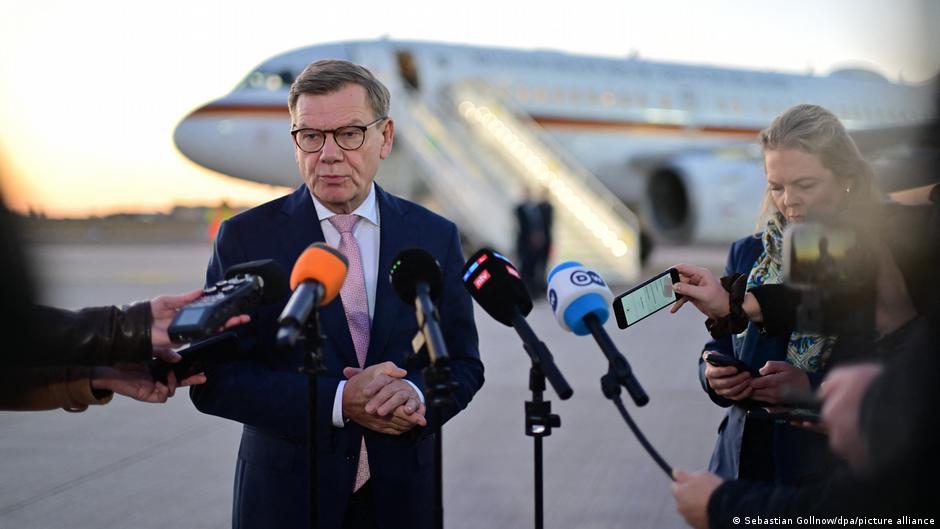
German Foreign Minister Johann Wadephul is joining counterparts in Turkey for discussions on a range of interlinked geopolitical crises. Back in Germany, the Bavarian CSU party begins its two-day conference in Munich.
Welcome to DW's coverage of what Germany is talking about on Friday, 23 October, 2026. Catch up on yesterday's news here.
The Christian Social Union (CSU), the Bavarian sister party of Chancellor Friedrich Merz's conservative Christian Democratic Union (CDU), begins its two-day party conference in Munich on Friday.
Together, the CDU and CSU form Germany's center-right "Union" and, despite plunging ratings for Merz and the CDU nationally, backing for the CSU in Bavaria remains relatively strong, with two recent polls putting support at between 36% and 37%.
Nevertheless, there is still concern in Munich that the Union's struggles in the coalition government in Berlin and growing support for the far-right Alternative for Germany (AfD), including in Bavaria, could threaten the CSU's status as a "big tent party" or Volkspartei.
Chancellor Merz will address delegates on Saturday but few in Munich are hopeful of a positive change of course. And all the while, CSU leader and Bavarian State Premier Markus Söder remains waiting in the wings as a potential challenger to Merz at the national level.
The charismatic, self-confident 59-year-old dominates Bavarian politics and, according to sources who spoke to the DPA news agency, would be ready to step up if called upon.
But a leadership challenge is not expected to be a serious proposition until April 2027 when another senior Union figure and potential chancellor candidate, Hendrik Wüst (CDU), runs in local elections in the western state of North Rhine-Westphalia (NRW), where he is currently serving as state premier.
For this weekend, however, the conservatives' focus is on Bavaria.
German Foreign Minister Johann Wadephul has warned that continuing disruptions to shipping in the Strait of Hormuz and the Red Sea could potentially lead to famine in the global south.
"We're all feeling the effects of the attacks on shipping lanes, whether at the gas station or in the supermarket," he said ahead of a meeting with fellow foreign ministers in Istanbul on Friday. "But elsewhere, there is a threat of famine when fertilizers don't arrive in the places where they are essential for basic production."
Wadephul was referring not only to the Iranian closure of the Strait of Hormuz and the Houthi threats to the Bab al-Mandab strait, but also to Russian attacks on shipping in the Black Sea as part of Moscow's ongoing war against Ukraine, one of the world's leading producers of wheat.
"This effects the poorest people in the world whose basic provisions are especially dependent on wheat, as well as our partners such as Turkey, the biggest wheat processing country in the world," he said.
"Together, we want to send a signal: we will not accept Iran and the Houthi militias [in Yemen] holding global trade hostage," Wadephul continued.
"The indiscriminatory attacks on free shipping and on neighboring countries must stop. For people across the region who are suffering from hunger, who no longer feel safe in their own homes, the continuing insecurity is not acceptable."
German Foreign Minister Johann Wadephul (CDU) was expected in Istanbul, Turkey, on Friday ahead of a meeting with his Turkish, Saudi Arabian, Pakistani, Egyptian, French and British counterparts.
The foreign ministers are set to discuss a range of geopolitical issues including, according to a spokesperson for the Turkish foreign ministry, "the Palestine question, the situation in the Strait of Hormuz, developments in Yemen and the search for an end to the war in Ukraine."
For the seven ministers, the event marks a first such meeting in the so-called "R4+E3" format. The E3, consisting of Germany, France and the United Kingdom, was established in the early 2000s amid nuclear negotiations with Iran, while Turkey, Saudi Arabia, Pakistan and Egypt formed the R4 earlier this year to coordinate a joint regional response to the US-Israeli war on Iran.
"At our first meeting in this format, we Europeans and the four regional powers want to discuss together how we can inject fresh impetus into the conflicts in the Strait of Hormuz, around [the] Bab al-Mandab [strait] and in the Black Sea," said Wadephul ahead of his departure.
"We can only deal with these massive challenges if we work together beyond established formats," he continued, adding that "these gridlocked conflicts" which have "significant economic and security consequences for our countries" have also created a fresh "desire to look for new solutions."
Guten Morgen! Welcome to DW's coverage of what Germany is talking about on Friday, 23 October.
German Foreign Minister Johann Wadephul is set to meet with European and Middle Eastern counterparts in Turkey for discussions on a series of regional geopolitical crises including developments in the Straits of Hormuz and Bab al-Mandab, the situation in Israel and the Palestinian territories and Russia's ongoing war in Ukraine.
Back in Germany, the Christian Social Union (CSU), the Bavarian sister party of the conservative Christian Democratic Union (CDU), is launching its two-day party conference in Munich.
In Berlin, a new survey suggests a lack of support for a potential left-wing Senate coalition between the Left Party, the Social Democrats (SPD) and the Greens.
And while Foreign Minister Wadehul meets the Pakistani foreign minister in Istanbul, Pakistan's President, Ali Zardari, is expected to be welcomed to Berlin.
- germany
- wadephul
- news
- threat
- famine
- war
- foreign
- minister