US midterms: Democrats win House and Senate from Republicans

The Democratic Party gained control of the House and Senate, delivering a stinging rebuke to US President Donald Trump and his Republican Party. Follow DW's live updates.
Follow the latest developments from the US midterm elections:
While most foreign policy decisions ultimately rest with the executive branch, the outcome of the US midterms will have major repercussions for adversaries like Iran as well as countries like Ukraine, which rely on support from Washington.
Read our full report of how Tuesday's elections in the US will likely affect other nations here.
German right-wing populist AfD party co-leader Alice Weidel told the "t-online" news website that while midterm losses for parties in power were the norm in the US, "the extent of the Republican defeat is notable and can be best explained with the considerable consequences of the Iran war."
She said one frequent and loud campaign promise from 2016, 2020 and 2024 had come back home to roost in 2026.
"Trump promised his voters not to conduct and interventionist foreign policy," she said. "This broken promise has now come back to haunt the Republicans."
Weidel said it was in both Europe's and Germany's interests to bring the war in Iran — but also the war in Ukraine — to an end as quickly as possible.
The politician, whose party tends to be quite closely aligned with Trump's MAGA movement and some of its core backers like Elon Musk, has made no public social media comments on the vote. Instead, her comments to "t-online" focused mainly on public protests over the weekend in some cities, which she linked to "militant left-wing extremists, migrant mobs, and organized crime families."
The speaker of Iran's parliament, Mohammad Qalibaf, who is also the country's chief negotiator in the stalled talks with the US and intermediaries, has celebrated the result online — saying that whatever the main motivator, US voters had ultimately spoken out against the war in the Middle East.
"Conscience or the cost of living, Americans said NO TO WAR, and we endorse this message," he wrote on social media. "If the US [government] betrays their public will to serve international paymasters and blackmailers, it will learn our NO comes with a Nightmare."
He did not elaborate on this vague threat, after several tense months of relative inactivity in the military and diplomatic standoff.
Meanwhile, a written statement was published on the website of Iranian supreme leader Mojtaba Khamenei saying that anybody expecting a shift in US policy after the vote was "seriously mistaken."
"Those who still harbor even the slightest hope that the behavior of the hegemonic system might change through partisan or factional shifts, or who imagine that making concessions to the United States can dissuade it from hostility towards the Iranian nation, are seriously mistaken," the statement said.
Khamenei was severely wounded in the US strikes at the start of the war that killed his father and much of his family. He has not been seen or heard in public since amid conflicting reports about his medical and physical status, but written statements attributed to him appear periodically.
Chinese Foreign Ministry spokeswoman Mao Ning told reporters the midterm elections were an "internal matter" for the US.
She said Beijing remained willing to work with the US to implement agreements reached between the two countries' leaders, strengthen communication and manage differences appropriately.
Chinese President Xi Jinping made a high-profile state visit to the US to meet with Donald Trump amid this year's UN General Assembly, which he did not attend. While the pair tried to put on an amicable show, very little of substance emerged from the visit beyond an agreement to extend a temporary tariff truce in their trade spat for a few more weeks.
There has also been speculation about a possible trialteral meeting between Trump, Xi, and Russian President Vladimir Putin, but for now nothing has been formally arranged or announced.
In Moscow, meanwhile, state news agency RIA cited Deputy Foreign Minister Sergei Ryabkov as saying he planned to wait for the final results.
"The Democratic Party leadership's approach to relations with Russia is sharply negative. There is nothing new about that," Ryabkov said. He said it would not impact Russia's position regarding its invasion of Ukraine, as the Trump administration continues to push for peace talks, albeit only arranging working-level negotiations between Moscow and Kyiv as yet.
"Our principled and consistent line regarding Ukraine — as well as our foreign policy in general — is not based on short-term considerations, and, naturally, does not depend on the fluctuations of the political barometer in other countries," Ryabkov said.
Tuesday night not only ushered in a series of changes in the US Congress, but it also saw a number of historic firsts in elections across the country.
Abdul El-Sayed will become the first Muslim US senator when he is sworn in next January after winning in Michigan. His win came nearly 20 years after the election of Keith Ellison to the House of Representatives. Ellison was the first Muslim elected to that body.
After defeating Trump ally Vivek Ramaswamy, Amy Acton is set to become the first female governor of Ohio.
In Georgia, Keisha Lance Bottoms became the first Black female governor of any state, as well as Georgia's first black governor, by beating billionaire Rick Jackson.
Another historic gubernatorial race took place in New Mexico, where Deb Haaland became the first Indigenous American elected to that state's highest office. Haaland is a member of the Laguna Pueblo tribe and was US secretary of the interior under former President Joe Biden.
At the same time, Ojibwe lawmaker Peggy Flanagan became the first Indigenous woman elected to the US Senate. After years in public service at the state level, she wil now represent Minnesota in Washington.
And in New Hampshire, Chris Pappas was also elected to the Senate, where he will be the first openly gay man to serve. In Alabama, Allison Montgomery became the first transperson elected to the state legislature, beating a Republican who repeatedly verbally attacked her for being trans.
More history is likely to be made in January if Hakeem Jeffries, considered the current frontrunner as minority leader, becomes speaker of the House of Representatives, as he would be the first Black man to hold that position.
Left-leaning Spanish Prime Minister Pedro Sanchez, who has repeatedly clashed with Donald Trump in the past year and who faces snap elections himself at the end of the month, said that American society "voted against the policies that only impoverish," such as hate, machismo, climate denialism and the privileges of the elites.
He drew parallels to Brazil's presidential election and the early vote he called, facing a legislative deadlock with his minority government, in Spain.
"It happened in Brazil. It just happened in the US. And it will happen soon in Spain," Sanchez wrote. "The ultra wave that [Alberto Nunez] Feijoo and [Santiago] Abascal are trying to ride is no longer growing: it is crumbling."
French Finance Minister Roland Lescure reminded BFM TV that even after losing control of Congress, Trump would remain in charge on the vast majority of US foreign policy issues, and seemed to warn that the president might not prove the type to favor compromise and collaboration.
Lescure said, "Either he decides to rise above the fray, acknowledging that changes are necessary," particularly on issues like gasoline prices and his foreign policy, "or he does not." Lescure said this would be something "we will need to keep an eye on in the coming days."
Norwegian Prime Minister Jonas Gahr Store told Reuters news agency it was a "powerful political signal about a change of course among American voters." He said voices were emerging in US politics that "are closer to us than the president and the administration have stood for, for example on climate and environment, and in foreign policy and development aid policy."
The co-leader of Germany's Green Party, Franziska Brantner, said the result was a "stop sign towards Trump and his billionaires." She said that while this pointed to "hope" for the US democratic system "hopefully getting back on its feet," it was too soon to breathe a sigh of relief in the European Union.
"On the contrary, we must really bet on Europe and on our own strengths," Brantner said. She said Trump had made it clear that he did not respect the EU and wanted to divide it, and that he wanted less and less to do with supporting Ukraine. "That means, we have our own responsibility for ourselves, no matter what the final result."
Christel Schaldemose, a European Parliament vice president from Denmark, said she was "cautiously optimistic" on Europe's behalf.
"Not because everything will now change for the better, but because it could benefit support for Ukraine, the green transition, and relations with the rest of the world," she said. But she also added that the EU must continue its course of standing on its own two feet, saying "that's not up for debate."
South African President Cyril Ramaphosa said the Democratic sweep of Congress could usher in a "new era in world relations" after voters dealt President Donald Trump a major electoral setback.
"The Democrats have taken control of the Senate and of the House, and the people of America have spoken," Ramaphosa told reporters. "I do think that this is going to introduce a new era in world relations."
Relations between the US and South Africa have deteriorated under Trump. During a televised Oval Office meeting in May 2025, he confronted Ramaphosa with misleading footage and news clippings promoting false claims of a genocide against white South Africans. Ramaphosa repeatedly sought to rebut the allegations.
The Trump administration has also cut aid, expelled South Africa's ambassador and, this week, moved to end its duty-free access to the US market under the African Growth and Opportunity Act from January.
Ramaphosa said South Africa would continue trading with the US while seeking new export markets.
"Diversification has now become the order of the day," he said.
On Wednesday, South Africa is holding local elections of its own.
Democrats have scored stunning victories in states long considered Republican strongholds, flipping key Senate seats.
Brandon Bohrn, a US political analyst with the Bertelsmann Stiftung, analyzes the election results for DW.
Welcome to our coverage of the US midterm elections, particularly if you're outside US time zones and were tucked up in bed as the poll-closing drama unfolded overnight. Here's the lay of the land stateside in what's now the early hours of the morning-after the vote which many saw as a referendum on President Donald Trump.
The Democrats have fared better than polls predicted, at least based on what should now be reliable projections. They have comfortably taken control of the House of Representatives and claimed a majority in the upper chamber of Congress, the Senate.
In a major blow for the Donald Trump administration, they have swung at least seven of the 35 Senate seats up for grabs — in North Carolina, South Carolina, Iowa, Kansas, Ohio, Texas and Maine. Some of those states were Republican-held for decades; Kansas' two Senate seats had been reliably Republican since before World War II.
Counting in the House races is slower, with all 435 seats up for grabs, but the Democrats have already passed the post to win the majority of the chamber with the better part of 100 seats yet to be called.
These results should markedly strengthen the Democrats' hand in Congress, giving them the power to block legislation (if perhaps not executive orders directly from President Donald Trump) and launch investigations into Trump's administration. In the Senate, they will be able to block his appointees as judges or for senior roles in government.
Trump himself praised the Democrats in an interview on Fox News on election night, saying he thought they did a "good job" and "fought hard."
"I don't view it as a hit on me," he said, despite having urged voters to act as if his name was on the midterm ballots during the campaign.
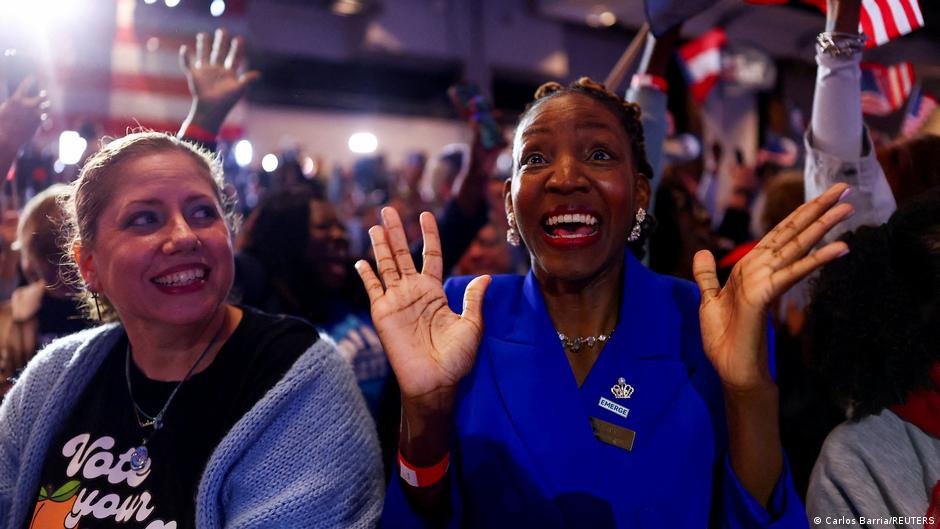
Democrats have won a majority of US governorships for the first time in two decades, capturing offices long held by Republicans in Texas, Ohio, Iowa and Georgia.
The gains give the party more power at the state level to challenge President Donald Trump's policies on immigration, voting rules and the deployment of National Guard troops.
Several victories have also made history:
In Ohio, Democrat Amy Acton defeated biotech billionaire Vivek Ramaswamy, describing it as "the honor of my lifetime." The victory came after a bitter campaign in which Ramaswamy's use of Acton's estranged mother in an attack ad drew widespread criticism.
In Iowa, state auditor Rob Sand thanked voters for his victory over Republican Zach Lahn. Preliminary results put Sand around 12 percentage points ahead in a state Trump won by roughly 13 points in 2024.
Republicans have held Florida, where Congressman Byron Donalds defeated David Jolly, a former Republican who ran as a Democrat.
The results could also shape the next presidential election. Governors influence election administration, while three Democrats considered potential presidential contenders in 2028 — Pennsylvania's Josh Shapiro, Illinois' JB Pritzker and Maryland's Wes Moore — have won reelection.
The midterm election results are "more than a setback" for Republicans and President Donald Trump, DW's Washington bureau chief Ines Pohl said.
The results represent "a dramatic loss of political power" for Trump's Republican Party, she said.
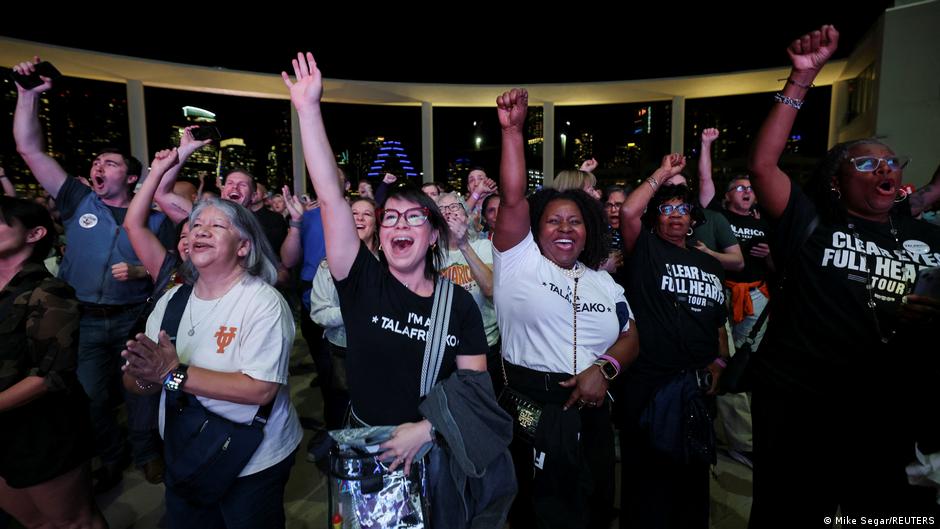
DW spoke to Republican supporters at an election watch party in Austin, Texas, after Democrat James Talarico won the Senate race in the state, breaking a 38-year drought for his party in the Republican stronghold.
Metin Hakverdi, who serves as German Chancellor Friedrich Merz's coordinator of transatlantic cooperation, said he expects the US midterm results to significantly impact the political situation between Berlin and Washington.
"America has chosen change," he told news agency DPA, while stressing that Trump remains largely in charge of foreign policy and that Germany will continue to reach out to both parties.
"We must especially not limit our contacts to individual political camps," he added, while also highlighting the historic significance of the first Indigenous woman being elected governor of New Mexico and the first black woman as governor of Georgia.
Hakverdi, a Social Democrat, has extended family in the United States and attended high school there.
Defense Minister Boris Pistorius congratulated Democrats on what he called their "historic victory." He also emphasized that the White House will remain the same and Berlin will continue to cooperate with it.
Here you can catch DW's live video coverage of the results and reactions to Democrats flipping both houses of the US Congress, as well as several governors' seats:
- house
- senate
- democrats
- republicans
- party
- midterm
- democratic
- control