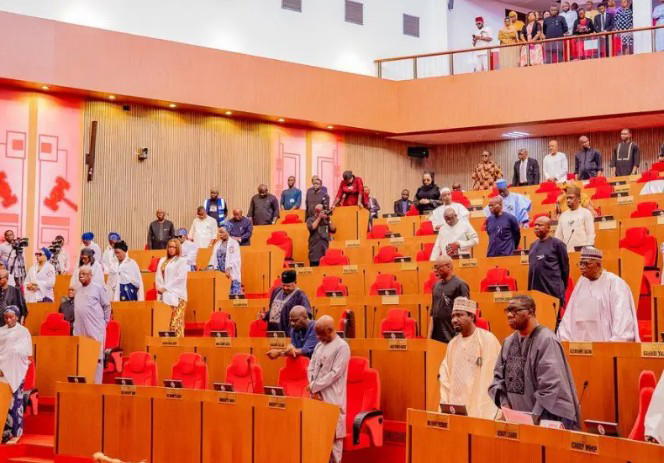
Senate advances Agricultural Revolution Bill
By Henry Umoru ABUJA — A bill seeking to establish a comprehensive legal framework for the transformation and modernisation of Nigeria’s agricultural sector has scaled second reading in the Senate. Contributing, the Senate Whip, Senator Mohammed Monguno (APC, Borno North), said the bill would translate Nigeria’s economic diversification policy from oil dependence to agriculture into practical reality.
By Henry Umoru ABUJA — A bill seeking to establish a comprehensive legal framework for the transformation and modernisation of Nigeria’s agricultural sector has scaled second reading in the Senate. The bill, sponsored by the Deputy President of the Senate, Senator Jibrin Barau (APC, Kano North), seeks to promote food security, agricultural productivity, mechanisation, irrigation, agricultural financing, agro-industrialisation, rural development and climate-resilient farming.
Following its passage at second reading, the President of the Senate, Senator Godswill Akpabio, referred the proposed legislation to the Senate Committees on Agricultural Production, Services and Rural Development, and Agricultural Colleges and Institutions for further legislative consideration. Akpabio directed the committees to report back to the Senate within four weeks.
The bill, titled, A Bill for an Act to Provide a Comprehensive Legal Framework for the Transformation and Modernisation of Agriculture in Nigeria, is also designed to promote sustainable agricultural development and address longstanding challenges in the sector. Leading the debate on its general principles, Barau lamented that agriculture, which was once the mainstay of Nigeria’s economy, was no longer performing optimally.
He recalled that between the 1950s and early 1980s, agricultural production supported numerous industries, including textile and processing companies in Lagos, Kano and Port Harcourt. He regretted that several industries, particularly those in Kano’s Sharada and Bompai industrial areas, which once supported vibrant economic activities, had become largely dormant.
Barau also recalled that the Second Republic government introduced the Green Revolution Programme but noted that its implementation lacked an enabling legal framework. According to him, the absence of legislation made it difficult to sustain the programme beyond the administration that introduced it. He said Nigeria had the human and natural resources required to transform agriculture but lacked effective mechanisms to harness the sector’s enormous potential.
“The bill is to provoke conversation, bring in our expertise to look at the entire scenario and see how we can change the trajectory,” he said. Barau urged senators to consider the proposed legislation from the perspective of patriotism rather than partisan politics, stressing the need for collective action to reposition the agricultural sector. Contributing, the Senate Whip, Senator Mohammed Monguno (APC, Borno North), said the bill would translate Nigeria’s economic diversification policy from oil dependence to agriculture into practical reality.
He said agriculture contributed about 40 per cent of Nigeria’s Gross Domestic Product and provided approximately 70 per cent of employment. Monguno, however, lamented that Nigeria had consistently fallen short of agricultural budgetary allocation targets, with its highest allocation in recent years standing at approximately five per cent. He said the proposed legislation would address challenges relating to mechanisation, agricultural financing, rural infrastructure and post-harvest losses through a comprehensive legal framework.
Also contributing, Senator Babangida Hussaini (APC, Jigawa North-West) commended the bill’s sponsor, noting that his contribution was informed by his experience as a practising farmer. Hussaini recalled that despite the introduction of the Agricultural Credit Guarantee Scheme in 1976, Nigeria had yet to establish sustainable agricultural financing mechanisms.
He said the bill would harmonise agricultural policies and programmes while addressing challenges across production, financing, marketing, storage and processing. The senator cited Jigawa’s production of hibiscus and sesame seeds, lamenting that inadequate storage, marketing and processing facilities had prevented farmers from maximising the economic potential of the commodities.
He also urged the Senate to pay adequate attention to livestock production, describing it as a significant economic opportunity. In his contribution, Senator Anthony Ani (APC, Ebonyi South) described the bill as comprehensive, saying it addressed virtually every aspect of agricultural production. He identified mechanisation, irrigation, research, innovation, extension services, financing and support for women, youths and small-scale farmers as key provisions of the proposed legislation.
Ani said the bill would help address challenges confronting farmers, including climate change, inadequate farming equipment and poor agricultural infrastructure. Similarly, Senator Adeniyi Adegbonmire (APC, Ondo Central) supported the bill, describing the proposed legal framework as necessary to ensure continuity in Nigeria’s agricultural development policies.
He said the legislation would establish a National Agricultural Revolution Programme with clearly defined national targets and implementation strategies. According to him, the framework would pl
- bill
- senate
- agricultural
- nigeria
- senator
- agriculture
- revolution
- framework