‘Turner prize for dance’ winner Christos Papadopoulos: failure, friction and my forgotten youthquake
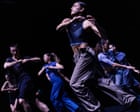
He explains how asking the near-impossible of dancers brings a shared joy Christos Papadopoulos is talking about how to spend £40,000. The Greek choreographer came out top of four finalists, picked by a judging panel including Arlene Phillips and PJ Harvey, for his piece Larsen C, a shadowy, trance-like and glacially paced crescendo of a dance named after an Antarctic ice shelf.
Amid galloping global crises, the Greek choreographer has returned to his revolutionary ideals. He explains how asking the near-impossible of dancers brings a shared joy
Christos Papadopoulos is talking about how to spend £40,000. Specifically the winnings he scooped from the first ever Rose international prize for choreography in 2025 – the dance world’s equivalent of the Turner and the Booker. The Greek choreographer came out top of four finalists, picked by a judging panel including Arlene Phillips and PJ Harvey, for his piece Larsen C, a shadowy, trance-like and glacially paced crescendo of a dance named after an Antarctic ice shelf.
Forty grand is not a bad bounty. Did he blow it on designer gear and exotic holidays? He did not. A big chunk went to his dancers, “because they are very hardworking and not so well paid – that’s the Greek reality”. The rest he invested in his new production: “I had some holes to fill, you know, in the budget.” The win may not have made Papadopoulos a household name (this is contemporary dance we’re talking about), but his work is touring worldwide. We speak over video call from Shanghai, where he is performing My Fierce Ignorant Step before its UK premiere.
The title, he admits, is a bit weird. It came to him before he’d started making the dance and refers to Papadopoulos’s younger self, full of naive optimism, youthful hope and revolutionary zeal to change the world. Growing up in a small town in the Peloponnese, Papadopoulos spent much of his time in nature. In the summer, he would be out all day “just wandering the mountains and playing”. When everyone else was sheltering from the sun, Papadopoulos would roam the forest on his own: “these quiet moments stimulated my awareness”.
Young life was full of freedom and possibility. Today, in middle age, he is “frustrated by the future” and the daily bombardment of doom about world events. “I felt that I was losing hope, and I was getting drier and drier inside,” he says. “I started thinking about my teenage years, when I had this fierce, almost arrogant certainty that we would create a great world ahead. We were naive and we were very romantic. Now that I’m more mature and I can think of the political situation in a more three-dimensional way, I can easily be discouraged.” That can lead to inaction so My Fierce Ignorant Step isn’t a nostalgic look back to a lost time, but an attempt to “restimulate our lives to really do something about it”.
Papadopoulos’s first attempt at making the show was disastrous. “The first month it was a complete failure,” he says. “A dead end.” He was trying to recreate that energy and positive force he remembered, and have the dancers express it, but “you cannot create a ‘happy’ piece, or an ‘optimistic’ piece”. Instead, he had to create the conditions to generate that feeling for real among the dancers. That meant causing friction, in the shape of long, technically and rhythmically difficult phrases that the dancers struggled with. They had to help each other, “their antennae of awareness would go out”, they’d be signalling to each other, supporting each other. You attempt something “so epically difficult that we need each other in order to do it”, Papadopoulos says, then when you actually achieve it together, a sense of joy floods in – and with it the sense that anything is possible.
Further inspiration came from the Axion Esti, a poem by Greek Nobel laureate Odysseus Elytis from 1959. It speaks of the best and worst of humankind, and has vivid descriptions of the natural world, which connected with Papadopoulos when he read it as a teenager. “It was also the period when my political consciousness was forged,” he says. “Elytis was proposing a world, a political world, but also a world where through morals and through love you can achieve beauty. He was suggesting that beauty is not an aesthetic choice; it is a consequence of a way of being.” A version of the poem set to music by composer Mikis Theodorakis became a symbol of Greek resistance to military dictatorship in the 60s and 70s. The music and poem don’t actually appear in Papadopoulos’s show, but the spirit is there, just as he hopes the spirit of resistance is simmering in society.
“You see it in Paris, in all these demonstrations, the realisation that we need to go out there and be radical,” says Papadopoulos. “It’s possible to change things – I still believe if we did something radical to protect the environment, the environment would bounce back – but unfortunately we are always very late to realise it.” Is Papadopoulos stirring us up to change the world? “It’s an invitation, for sure,” he says. “My friends, they were all going out of the theatre afterwards saying: ‘This is a revolution!’”
My Fierce Ignorant Step is at Sadler’s Wells East, London, 13-14 November
- dance
- papadopoulos
- turner
- prize
- christos
- winner
- failure
- friction