2027 Politics Watch: From Atiku’s Sokoto rally to Obi’s convoy attack

Atiku Abubakar launched his presidential campaign in Sokoto after days of controversy over access and security, while police arrested a suspect following an attack on Peter Obi’s convoy in Calabar.
A day after Atiku Abubakar accused security authorities of plotting to disrupt his presidential campaign launch in Sokoto, he addressed supporters at the event on Wednesday. In Calabar, the convoy of another opposition presidential candidate, Peter Obi, came under attack, with a suspect arrested.
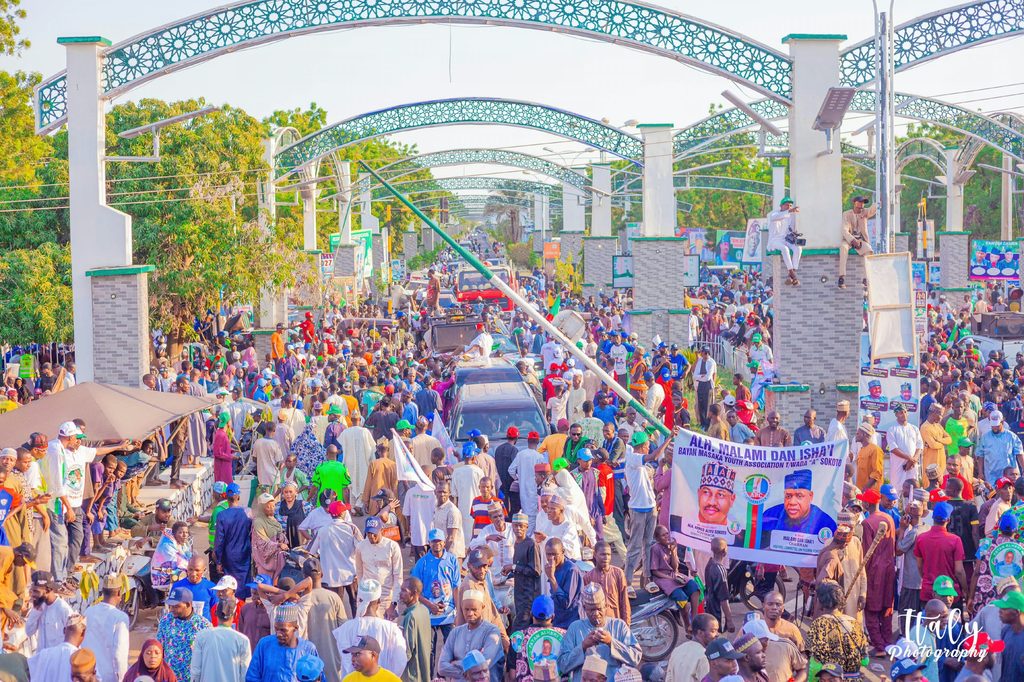
The ADC portrayed the turnout in Sokoto as an endorsement of Atiku’s affordability message. In Calabar, police were investigating an attack that Mr Obi blamed on APC supporters, although investigators had not established the attackers’ political affiliations.
President Bola Tinubu withdrew an earlier external borrowing request and submitted a $7.7 billion replacement, drawing criticism from Atiku, who was simultaneously renewing his promise to make fuel and other essentials more affordable.
Seyi Makinde unveiled his presidential manifesto, the Independent National Electoral Commission (INEC) sought international assistance against election-related disinformation, and court rulings affected leadership and nomination arrangements in two opposition parties.
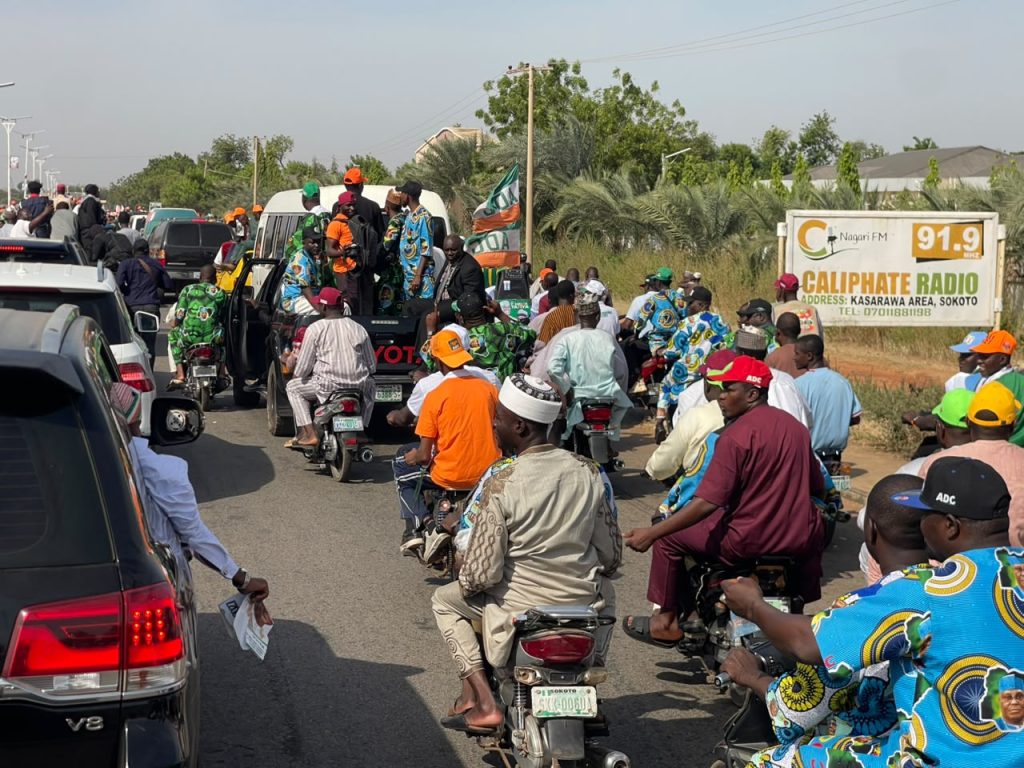
Atiku addressed supporters at the ADC presidential campaign launch at the party’s state secretariat on Ilorin Road, Sokoto, accompanied by senior party figures, including his running mate, Rotimi Amaechi, former Sokoto governor Aminu Tambuwal and former Attorney-General of the Federation Abubakar Malami.
He promised to tackle insecurity and reopen land borders for legitimate trade, while renewing his argument that government intervention could reduce the cost of living.
The Ilorin Road venue differs from the premises on Ahmadu Bello Way that the Sokoto State Government ordered sealed. Officials cited Savannah Bank’s ownership of the property and security concerns, while the ADC accused the government of political intimidation.
On Tuesday, Atiku alleged that the State Security Service (SSS) was recruiting protesters to disrupt the launch and create grounds for a curfew. The agency denied the allegation and announced an investigation.
The launch went ahead, although the allegations surrounding its preparations remained unresolved.
In a subsequent statement published on Mr Atiku’s verified X account, the campaign said the motorcade took three and a half hours to reach the venue because of the crowds.
Mr Shaibu portrayed the reception as a rejection of the Tinubu administration’s economic policies and support for the ADC’s affordability programme.
The campaign’s economic message centred on a targeted, production-based subsidy for qualifying petroleum products refined in Nigeria.
The proposal predates Wednesday’s rally, but earlier written answers from Mr Shaibu to PREMIUM TIMES provide some indication of how the campaign intends to implement it.
Mr Shaibu said domestic refineries, including modular plants, could qualify for support. One proposed mechanism would supply crude oil below market prices, with the difference treated as a production subsidy.
He described a budgeted programme with spending limits and independent audits, adding that lower consumer prices would be a condition for receiving support.
The explanation did not specify the crude discount, eligible volumes, annual spending ceiling or formula for passing savings to consumers. Wednesday’s statement supplied no additional figures.
Supplying crude below market prices would entail a fiscal cost or forgone revenue, depending on how the arrangement is structured. The discount, eligible volumes and pricing rules would determine the programme’s cost and how much of the benefit reaches consumers.
While the ADC celebrated its Sokoto outing, the Nigeria Democratic Congress (NDC) faced a security incident during its presidential campaign activities in Cross River State.
The convoy of its presidential candidate, Peter Obi, was attacked near Watt Market Roundabout in Calabar at approximately 2.20 p.m., according to the police.
The convoy was returning from the palace of the Obong of Calabar towards the Metropolitan Hotel, where the party was holding a presidential town hall meeting.
In a statement reported by TheCable, police spokesperson Eitokpah Sunday Akata said suspected attackers armed with machetes and sticks emerged from the Calabar Road and Clerks Alley area and damaged vehicle windscreens.
Officers arrested a 27-year-old suspect, Victor Edet Yellow Duke, while other suspected participants escaped.
The police said the number of damaged vehicles was still being established. Commissioner of Police Ajo Ordue ordered an investigation, and the command cautioned that the arrest did not establish the suspect’s guilt.
PUNCH reported that stones, bottles and other objects were thrown at the convoy and that some NDC supporters sustained injuries. The reported injuries were not independently confirmed in the police statement.
Mr Obi accused APC supporters of involvement, but police have not established the attackers’ party affiliations or any political sponsorship.
Earlier on Wednesday, security personnel had intervened during a separate confrontation involving NDC participants and APC supporters near the Metropolitan Hotel on Murtala Mohammed Highway.
Police described the earlier incident as an encounter between two groups whose routes converged. At the time, reports placed Mr Obi and his running mate, Rabiu Kwankwaso, away from the hotel.
The confrontation and the convoy attack occurred at different locations. Police have not established whether they were connected.
The incidents coincided with a separate directive from Inspector-General of Police Olatunji Disu, ordering commissioners nationwide to prevent and investigate the destruction of political posters and billboards and pursue suspected sponsors where evidence supports their involvement.
There is no established connection between that directive and the Calabar attack.
The immediate question in Calabar is whether investigators can identify the remaining suspected attackers and establish whether evidence supports the political allegations that followed the incident.
President Tinubu withdrew an earlier external borrowing request and submitted a replacement proposal for $7,707,404,882.49 to help finance the 2026 budget.
The withdrawn request involved approximately $20.52 billion and €1.05 billion under a supplementary external borrowing plan for 2026–2027.
The replacement is not an additional amount to be combined with the withdrawn request. It is presented as financing for the 2026 budget.
In a letter read by Senate President Godswill Akpabio during Wednesday’s plenary, Mr Tinubu said the borrowing would support programmes in infrastructure, defence, agriculture, healthcare, power and education.
He proposed pursuing several financing options simultaneously, emphasising Eurobonds because of their speed and capacity to raise larger sums.
The president explained that interest rates, repayment periods and other final conditions would be determined when the borrowing was priced.
However, Atiku urged the Senate to reject the request without fuller disclosure of the projects to be financed, their allocations, borrowing terms and repayment arrangements.
His statement, issued through Mr Shaibu, also urged international lenders to withhold further financing pending those disclosures.
The president explained why final market terms were unavailable, but the published sector list does not identify individual projects or allocations. Senate committees will therefore have to examine what the proposed borrowing would finance and the conditions under which it would be raised.
Mr Akpabio referred the request to the Senate committees on local and foreign debts and appropriations.
The dispute also places Atiku’s own economic proposals under scrutiny. His proposed support for domestic petroleum refining would require public resources, even if delivered through discounted crude rather than a direct cash payment.
The policies concern different forms of government intervention, but each requires an explanation of costs, implementation and expected benefits.
Allied Peoples Movement (APM) presidential candidate and Oyo State Governor Seyi Makinde unveiled his Reset Agenda manifesto in Abuja alongside his running mate, Lawal Musa Daura.
The published programme sets out proposals on economic management, security, education and governance, including reducing structural living costs, strengthening intelligence coordination and devolving greater responsibilities to states.
Separately from the proposals contained in the published manifesto, Mr Makinde advocated changing the threshold for winning presidential elections during his remarks at the launch.
PUNCH reported that he proposed requiring candidates to secure at least 51 per cent of votes, although another account described the threshold as 50 per cent plus one vote. The precise formulation requires confirmation from his original remarks.
Under Section 134 of the Constitution, a candidate in a contest involving more than two candidates must secure the highest number of votes and satisfy geographical spread requirements. A mandatory national majority would change that test and require constitutional amendment.
Mr Makinde also reiterated his earlier proposal for a transitional government of national unity and called for a national conference. He did not explain how the proposed transitional arrangement would operate within Nigeria’s existing constitutional framework.
The APC’s presidential campaign council directed ministers, political appointees and council members to concentrate their rally attendance and mobilisation activities in their home states.
A circular reported by PREMIUM TIMES, signed by campaign director-general Abdulaziz Yari, also called for mobilisation at polling-unit, ward and local government levels and greater visibility for legislative candidates.
The directive assigned responsibilities to national party officers, with exceptions for specified offices.
In Cross River, the ADC inaugurated a 63-member campaign organisation as it expanded its state-level preparations alongside Mr Atiku’s national campaign launch in Sokoto.
Separately, Inspector-General of Police Olatunji Disu directed police commissioners nationwide to prevent and investigate the destruction of political posters and billboards. Suspected sponsors could also face prosecution where evidence established their involvement.
African Action Congress (AAC) presidential candidate Omoyele Sowore also demanded an independent investigation into the 30 October incident in Ekiti State. He called for the preservation of CCTV footage and other electronic evidence, questioning the scope of the police investigation despite the announcement of 11 arrests.
Meanwhile, Independent National Electoral Commission (INEC) Chairman Joash Amupitan sought assistance from the United Kingdom and the United Nations to counter foreign disinformation and artificial intelligence manipulation ahead of the 2027 elections.
He also sought support for public awareness programmes, cybersecurity and mock electoral exercises.
The commission said its North-Central readiness assessment would begin on Thursday, following the completion of its South-South tour.
In Abuja, the Court of Appeal dismissed an appeal by former Senate President Adolphus Wabara and seven others seeking to compel INEC to recognise the interim National Working Committee of the Peoples Democratic Party (PDP) led by Kabiru Tanimu Turaki.
The appellate court upheld the Federal High Court’s refusal to grant the recognition sought.
The faction’s spokesperson, Ini Ememobong, said its lawyers had been instructed to approach the Supreme Court. The announcement did not establish that an appeal had already been filed.
In Nasarawa State, a Federal High Court ruling set aside the nomination of retired Major General Nuhu Angbazo as the ADC governorship candidate.
Reports of the judgment said the primary was inconclusive because voting had not taken place in Karu Local Government Area.
The court ordered the outstanding exercise in Karu’s 11 wards and reportedly restrained INEC from recognising Mr Angbazo under the disputed nomination.
The case was brought by former Environment Minister Mohammed Abdullahi, who contested the primary against Mr Angbazo and Senator Mohammed Onawo.
Mr Angbazo urged calm while his lawyers studied the judgment.
- atiku
- sokoto
- obi
- convoy
- attack
- politics
- watch
- rally