‘It was so magical’: the 33-year-old who made history swimming the length of California
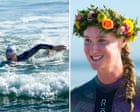
Ultra-endurance swimmer Catherine Breed navigated waves, wildlife and pollution to become the first person to swim from state’s northern-most tip to Mexico border Nearly four months ago, Catherine Breed, a 33-year-old from the San Francisco Bay Area, set out to become the first person to swim the entire coastline of California – from its northern-most tip to the border with Mexico. But after dodging hurricanes, wildlife and 8ft waves in an unusually volatile Pacific Ocean, Breed finally celebrated the end of her journey on a beach in San Diego on Monday.
Ultra-endurance swimmer Catherine Breed navigated waves, wildlife and pollution to become the first person to swim from state’s northern-most tip to Mexico border
Nearly four months ago, Catherine Breed, a 33-year-old from the San Francisco Bay Area, set out to become the first person to swim the entire coastline of California – from its northern-most tip to the border with Mexico. She and her support team prepared for encounters with sharks and storms. They hadn’t anticipated completing the marathon swim during a year of historic super El Niño weather.
But after dodging hurricanes, wildlife and 8ft waves in an unusually volatile Pacific Ocean, Breed finally celebrated the end of her journey on a beach in San Diego on Monday.
Breed joins a group of elite ultra-endurance swimmers who continue to set new records for long-distance swims, including swimming the entire coastlines of Ireland and Iceland and one side of New Zealand’s North Island – all journeys of close to 1,000 miles (1,600km).
Breed spoke to the Guardian this week about living onboard the Catalyst, the sailboat that accompanied her, her physical and mental preparations for her 111-day swim, and what she thought about while spending more than 15 weeks in the water. The conversation has been edited for length and clarity.
On your website, you talk about the desire to be part of “an elite group of humans who have been the first to accomplish a monumental feat”. What does that feel like now that you’ve done it?
It is a little bit of an out-of-body experience. Like, I know I’m the one who did it, but there are parts of me where I feel like I’m along with the audience, watching this thing happen. I think I’m still trying to grasp what I’ve done.
How did you get the idea to swim the full length of California, which no one has ever done before?
Other people showed me that the model was possible. Ross Edgley swam around Great Britain. Sean Conway and Jasmine Harrison swam the length of Britain. [In 2022] I did a swim down the California coast from the Golden Gate Bridge to Half Moon Bay, and it made me realize how much fun I had during that, and I was like: I want to try to do this with the coast.
What did you think about while you were swimming four to five hours a day?
In college, my coach used to say you only get so many energy units per day. Overthinking or excessive thinking or negative thinking – that can take some of that energy you have. During these marathon swims, I try to keep my thoughts very focused on the task at hand. Coaching myself to get to the next 30 minutes, coaching myself to do the next 2 miles, and kind of like celebrating those little moments. When the conditions were really rough, there was a lot of thought around my technique, because I really had to adjust how I was swimming to not wreck my shoulders in the big waves.
What could you hear as you were swimming?
I had earplugs on, so I couldn’t hear the crew. But one thing I could hear very clearly was dolphins. And so there were many occasions where I would hear the dolphins before the crew could see them. And I would look up and I’d be like, you guys, incoming, there’s dolphins.
At points, you were swimming through 6-8ft waves, which you have described as feeling like you were in a washing machine. What is it like to swim in those conditions?
If I’m swimming into the swell, it feels like you’re swimming up a hill. But if it’s behind me, then it’s actually very fun because it feels like I’m surfing. So it really depended on the conditions. When you’ve got a lot of wind and a lot of swell, the waves can crash on you from the back or the side or the front. And it does take a lot of effort to keep my body in the right position. One day a wave picked me up, and I landed on my butt.
How do you train for swimming in those kinds of waves?
I’ve been marathon swimming for 10 years. I grew up swimming, I grew up sailing. So my whole life has been in the ocean. So those moments, they’re difficult, but I’m comfortable. I surf a lot. And so I think surfers are comfortable with waves and they understand kind of just wave mechanics and moving with the ocean.
I think the challenging part of the swell was not so much as swimming, but that there’s no chance of recovery [with living on a boat]. Getting ready to swim is really hard – like you’re trying to make breakfast and you’re falling over, your coffee’s spilling. Even putting my wetsuit on is a challenge in itself.
Were there days when you woke up and did not want to get in the water?
Yes. Many days. [She laughs.] But for myself, I committed to this goal, and my team committed to being part of it. And so, the days I didn’t want to get in it, it didn’t matter what my emotions were, because this project is bigger than just me.
You swam the English Channel in 2018 and the North Channel crossing between north Ireland and Scotland in 2019. How was preparing for this California challenge different from preparing for those classic marathon swims?
For my other swims, I did follow English Channel rules: it was just one cap, bathing suit, goggles. So that preparation required a lot of cold adaptation, and spending hours in the San Francisco Bay being comfortable to be in those conditions for a long time. In California, I’m wearing a wetsuit, so I didn’t have to focus so much on the cold training. I focused more on putting on muscle, and ensuring my body composition was going to benefit me for the swim. So the training was a little less swimming than my other marathon swims, and more time in the gym.
What were some of the hardest moments of the past four months?
Swimming down in San Diego by the Imperial Beach and Tijuana River and knowing about the sewage pollution crisis [where billions of gallons of raw sewage and toxic chemicals flow from the river into the ocean] – that was probably the most nerve-wracking, because, though we were 3 miles offshore and I was taking prophylactic antibiotics, I still was so scared about my health. And then, you know, any moments that the team spotted a shark fin.
What did you do when your crew saw a shark in the distance?
The team just says: “Shark!” And within five seconds – definitely less than 10 seconds – I’m out of the water. Then we observe the situation. And if we see the shark again, then we were just done for the day. That only happened once in four months. So it really was the most insignificant part of the trip.
Our biggest shark deterrent is the fact that I was swimming right next to a 52ft sailboat. And on the other side of me, I had a tender in the water. Ultimately, the sharks just really weren’t interested in me.
You’ve spoken out on your social media accounts about the assumption that sharks are the biggest threats to your swim. Why do you think that’s the wrong focus?
The pollution definitely made me more uncomfortable than any shark sightings ever did. It’s so interesting how people focus so much on sharks when sharks have been in the water with humans for a really long time. We’re so concerned about them, but we should be more concerned about what damage we’re causing to our planet and our home.
Outside populated cities like San Diego and Los Angeles, we saw trash and plastic pollution every day, all day. It was astounding. I think we picked up over 10 Mylar balloons in one day. I had no idea there were that many in the ocean.
You did not plan to do this swim during a year of extreme super El Niño weather, but that’s what happened. How did that change your experience?
The California coastal current historically goes north to south. That’s why we picked the direction. But with the super El Niño, all of the tropical storms and hurricanes that happened this year, instead we were fighting this insane current that is pushing against us. We had to do a lot of problem-solving and pivoting to make forward progress: some of our sections, we did the opposite way. [Breed swam some daily segments of the journey backwards, south to north, allowing her to go with the current, rather than against it.]
You were swimming down the coast during a summer of massive tropical storms in the Pacific, with giant waves that have wrecked havoc on southern California’s beaches. How did you handle that?
We had some days where we knew there was going to be really bad weather, and so we just didn’t even go out that day. I can think of four or five days where we started to swim – for example, during Hurricane Rachel, we were supposed to be able to swim until 2.30pm. But then the wind went from about 10 knots to 25 knots (11mph to 29mph) in about seven minutes. And so the team was like: we’ve got to get out. We need to get to harbor.
What were some of your most memorable animal encounters?
I’ve had manta rays swim around me. In Morro Bay, a humpback whale and her calf swam right next to me. I could see them diving. It was so magical. In Santa Barbara, a pod of bottlenose dolphins came and played with us for about 10 minutes. It really felt like the ocean was welcoming us.
From Humboldt [county] all the way to Point Concepción, we probably saw anywhere from five to 10 whales a day. I think the most we saw on a day maybe was like 50. We would have whales come swim right under the boat.
Is it lonely doing these long-distance swims?
No, it’s not lonely. It’s absolutely the opposite of a solo expedition. It requires a huge team and it requires a team that I literally trust with my life. Yes, I was in the water for four to five hours a day by myself. But when I got out, I was surrounded by just this incredible team of women. And through the difficult, through the tough, we still found moments to connect with laughter and just bring some lightness to the whole swim.
Yeah. It feels very weird to wake up this morning and just get to relax.
- california
- breed
- history
- length
- catherine
- wave
- wildlife
- person