Flashbulbs, lies and victim blaming: how Russell Brand’s trial unfolded
Level of interest in comedian’s case resulted in examination of affairs inside and outside the courtroom Russell Brand’s trial at Southwark crown court, which ended with him being found guilty of raping one woman and sexually assaulting three others, was one of the most obsessively watched criminal cases in recent history. As well as Brand’s own conduct, the case became an examination of his victims’ evidence, the legal strategy his team used to defend him, and the culture within which he committed his crimes.
Level of interest in comedian’s case resulted in examination of affairs inside and outside the courtroom
Russell Brand’s trial at Southwark crown court, which ended with him being found guilty of raping one woman and sexually assaulting three others, was one of the most obsessively watched criminal cases in recent history. As well as Brand’s own conduct, the case became an examination of his victims’ evidence, the legal strategy his team used to defend him, and the culture within which he committed his crimes.
Brand’s victims told how he “snapped” from charming to nasty as he raped and sexually assaulted them before gaslighting them into believing nothing was wrong.
The comedian’s youngest victim, who was 21 when he targeted her at the height of his fame in 2009, was left traumatised by their encounter.
Brand had stored her name in his phone alongside a series of letters and symbols. The court heard the letter “T” stood for “tart”, while “AP” denoted anal play, and two asterisks meant: “Never, ever forget this individual, this is a memorable encounter.”
It was, indeed, an encounter the woman would never forget, she spent years torturing and blaming herself for what happened.
The woman was starstruck when she met Brand after one of his standup performances at the Hammersmith Apollo in early 2009. Brand, who was more than a decade her senior, picked the woman from the crowd and invited her to his dressing room. There, she performed oral sex on him and engaged in a threesome with another young fan.
Days later, Brand sent a chauffeur to drive the woman to his three-storey Victorian townhouse in Hampstead, north-west London, where he forced her to shower and brush her teeth before they had consensual sex.
Then, without warning, Brand flipped her over and anally raped her so violently that she struggled to breathe. She begged him to stop but he refused, telling her: “I want you to feel my come.”
He later chastised her for getting blood on his sheets and ordered her to clean up the mess before casually turning on the TV and instructing an assistant to escort her out.
Two dozen witnesses gave evidence in support of the woman’s account. “The way I would describe that event to people after was that it was traumatic and that he hurt me and harmed me. And when I asked him to stop, he didn’t,” she told the court.
The lasting trauma of her experience was far from unique.
Brand met his earliest accuser at a cabaret event during the Labour party conference in Bournemouth in 1999. The court heard the woman was not attracted to the then unknown performer, whom she assumed was gay. But she found him intelligent and believed they were passionate about the same causes.
She invited him back to her hotel to continue their conversation, but “froze” when she returned from the toilet to find Brand partly naked. She told police he then raped her but on the evidence presented in court, the jury found him not guilty of that offence. “I remember him on me, very heavy. I know I said no. I kind of drifted out of my head. I couldn’t get out of the situation – ‘Do I shout, do I scream?’” she told the court.
After the incident, Brand left his email address. An act, the prosecutor said, which was designed to characterise the encounter as normal. “Today that might be called gaslighting, a technique that defendant used with good effect on some of his other victims,” said the prosecutor Riel Karmy-Jones KC.
Among them was an MTV worker who met Brand in 2004 at a birthday party held at a bar in Soho, London. Here, Brand sexually assaulted her by grabbing her breasts. The woman claimed he also orally raped her in the toilets, but he was cleared by the jury on that allegation.
Brand also faced claims that he preyed on women while they were at work. The second complainant on the indictment was also an MTV worker, who said Brand transformed into a “wild-eyed maniac” when he tried to drag her into a men’s toilets in 2001. At the conclusion of the trial Brand was cleared of attempting to indecently assault the woman.
Another woman claimed Brand laughed after “mauling” her by squeezing her breasts and kissing her sloppily while she was at work at the radio station Choice FM in 2004 or 2005. She said Brand “overpowered her” during the “violent” and “frenzied” sexual assault, which took place in front of his entourage. He was found guilty of sexually assaulting her.
Brand’s final victim said she was “repulsed” when Brand lunged at her crotch and put his head so deep into her lap that she could feel his breath on her vagina during a recording session at Channel 4 in 2009.
She said two members of Brand’s entourage had told her Brand would not continue filming unless she gave him a massage. “I thought they were joking because I wouldn’t expect anybody to say that and then I saw by their faces they weren’t,” she recalled. Brand was again found guilty of sexual assault.
In the dock, Brand barely flinched as his accusers recounted harrowing ordeals through tears from behind a screen. In scenes captured by court artists, he sat bolt upright and stared straight ahead, as the women described his “disgusting” serpent-like body, threatening eyes, and how he “wasn’t very well endowed”.
But his composure appeared to falter on 28 October when he was in the witness box for more than four hours. The case had been a “deeply traumatic episode” in his life and he was “innocent” of all the charges, he told the four women and eight men on the jury.
“Consent is fundamental, essential, necessary and, indeed, in many ways more important than sex itself,” he said. He denied setting a “goal” to sleep with 5,000 women, but said he had misused his fame and success “very selfishly”.
“As I became more successful and famous, I was very comfortable allowing that to facilitate sexual access, which I agree with you was wrong,” he told the prosecutor.
“With women, of course, which is the subject of my trial, I’ve been persuasive, seductive, begging and flirting, and dedicated a lot of my life to what seems now beyond reckless philandering, and idiocy.”
He blamed his public fall from grace on 2023 media reporting about his alleged sexual misconduct. He had achieved “staggering fame” after his marriage to the singer Katy Perry, but now nobody would touch him “with a bargepole”.
However, the prosecutor noted the Hollywood actor turned influencer still had millions of followers online. “This is not the case of poor Mr Brand being taken apart by the media,” she told jurors.
Karmy-Jones accused Brand of tailoring his recollections to the prosecution evidence, telling jurors his evidence amounted to “a lot of half truths, but spun into lies”.
Brand’s cross-examination was punctuated by long spells of silence and awkward staring at the prosecutor. But he became more animated while his wife, Laura, 39, gave evidence. He appeared to smile, nod and mouth words at her as she talked about his 2024 baptism and said he was a “wonderful father” and an “amazingly attentive husband”.
Brand’s barrister, Ian Winter KC, ripped into the complainants with a steely determination. The judge, Mr Justice Bennathan, had to interrupt him during one uncomfortable exchange about consent, saying: “Shush please. I’m the judge, you have to let me talk.”
In another, the judge objected to Winter questioning a woman about why she had not reported that Brand had raped her during the #MeToo movement when “every woman in the world was examining whether she had been sexually assaulted by a famous person”. “I think that’s a bit of a generalisation,” the judge said.
Described online as a “leading white-collar crime silk” specialising in fraud and financial crime, Winter repeatedly questioned why his client’s accusers had not fought back when they were being raped. “Not one of them resisted or screamed or even tried to leave,” he told jurors.
Referring to Brand’s youngest victim, Winter said: “She didn’t just roll over and kick out.” He went on to claim that Brand’s earliest accuser was not a “naive and wilting flower”, declaring: “She was plainly attracted to him.”
He also questioned why an MTV worker, whom he claimed was “perfectly capable of looking after herself”, did not slap Brand, who is 6ft 2in tall, in the face when he grabbed her breasts before he allegedly orally raped her. He suggested she had not “sufficiently” resisted.
Karmy-Jones criticised Winter’s “skilful but quite aggressive” cross-examination of one victim in her closing speech. “Might you have thought she was being blamed for what happened?” she asked jurors.
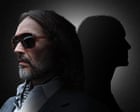
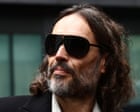
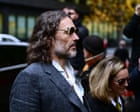
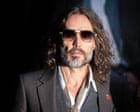
Brand arrived at court each day with his entourage to a flurry of camera flashes and questions from journalists as the case attracted unprecedented media coverage.
Well-known for his dishevelled fashion choices, Brand had smartened up his appearance for the trial. The unbuttoned animal-print shirt and monogrammed fedora hat combo he wore to a pre-trial hearing was replaced by a series of dark suits and long scarves.
His bright blue Bible, packed with colourful Post-it notes, was also nowhere to be seen as he sat in the dock, but he, or his entourage, carried it into court in the early days of the trial. Occasionally, Brand was spotted clutching prayer beads.
Brand’s wife was by his side on most days, as was his bodyguard Joe McCann, said to be a former sparring partner of the boxer Tyson Fury. Other members of his daily entourage included his manager and producer, Jake Smith, and the American podcaster David Fields. Newspapers have noted that Smith – who bears a passing resemblance to Brand – was abused and praised by members of the public who mistook him for the comedian outside court.
Five daily podcasts tracked the ins and outs of the trial for audiences in Britain and the US, where Brand now lives with his wife and three children. Content creators crossed legal lines as they live-blogged every twist and turn in the case. In a moment of courtroom drama, the judge demanded one blogger be arrested for publishing identifying information about one of the victims, all of whom are entitled to lifelong anonymity. The man was arrested and cautioned.
In another legal blunder, People magazine in the US risked contempt of court by publishing a pre-trial ruling that could have prejudiced the trial. It can now be reported that Brand’s legal team had tried to get the case dropped, arguing that he could not receive a fair trial due to the 2023 media reports.
They said a Channel 4 Dispatches documentary and articles in the Times and the Sunday Times had “destroyed” Brand and “turned the world against him”.
At the end of the trial, Winter launched into an extraordinary tirade against a Sunday Times journalist, Rosamund Urwin, who worked on an investigation of allegations against Brand.
Outside the courtroom, he said: “I hope you are pleased with yourself.” Urwin responded: “I’m pleased justice has been done,” before Winter replied: “Well, it wasn’t. You fucked it.”
The prosecution successfully argued that Brand had generated extensive publicity himself in high-profile interviews with Tucker Carlson, Megyn Kelly, and Piers Morgan.
Brand continued to offer competing narratives during the trial in two episodes of his Sunday Service podcast in which he and his wife discussed being in the “eye of the storm” and the “aquarium dock” of court 3.
“If you follow empire media you will be aware that, of course, we as a family, and me in particular, are in a situation that requires the authenticity and authority of true justice, and for that reason we will be extremely cautious in any way we refer to the trial,” the former Big Brother’s Big Mouth presenter told his followers after the first week of his trial.
Wearing a loosely tied leopard-print dressing gown and stroking his cat, Jericho, he added: “The worst of all the things I have had said to me or about me this week was do your shirt up.”
Brand’s victims said they did not report his predatory behaviour at the time because he was an A-list star and they feared they would not be believed. “It was a toxic environment,” the Choice FM worker said of the media industry. If she had reported Brand’s assault to a line manager, she said, “they would have said something along the lines of: ‘Oh you’re lucky.’”
But the court heard that two of the victims who worked in the media did raise concerns about Brand’s behaviour. The MTV worker who was sexually assaulted at a Soho bar said she told a colleague that Brand was a “sexual predator” and asked another in 2006 why Brand had been rehired by the music channel.
The Channel 4 worker told two managers about the incident. One recalled how the woman told her two associates of Brand “watched and laughed” as he sexually assaulted her.
“They were turning a blind eye, as others had done,” the prosecutor said.
Brand’s former personal assistant told the court that his bad behaviour was indeed “normalised and dismissed” by those around him.
“Though I’d worked with celebrities before and seen a lot of people normalising bad behaviour, this was on another level,” she said in a witness statement. “I do however remember numerous instances where I knew his behaviour was wrong and would turn to someone and say: ‘This is really fucked up’, but would get told: ‘That’s Russell.’”
- brand
- victim
- russell
- trial
- case
- flashbulbs
- examination
- lie