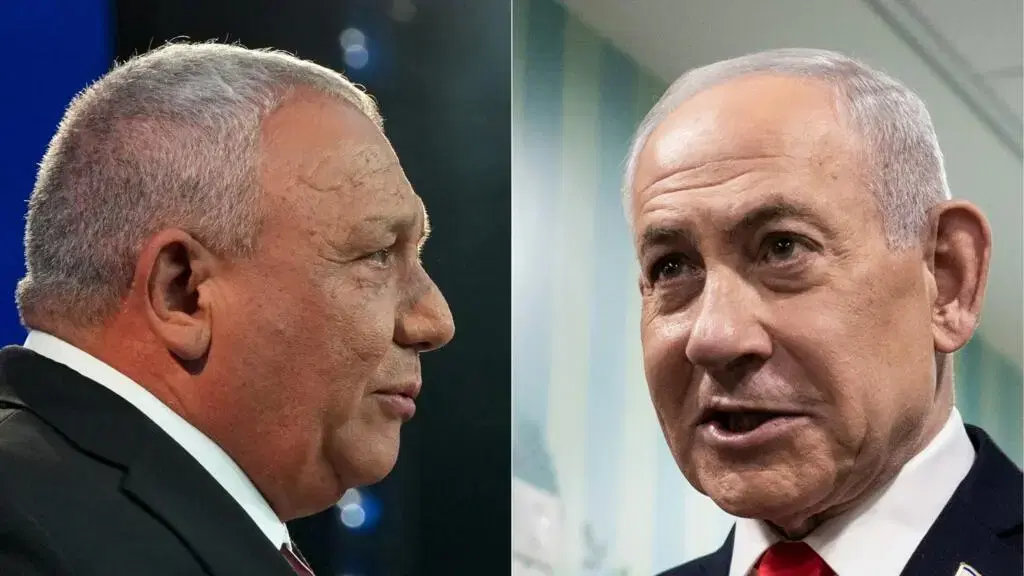
Israel's president set to hand Netanyahu rival first chance to form government
Neither Mr Netanyahu's Likud-led bloc nor the opposition, led by former military chief Gadi Eisenkot, secured enough seats for a parliamentary majority in last week's election.
Israel's President Isaac Herzog is poised to give Benjamin Netanyahu's main rival Gadi Eisenkot the first chance to lead coalition talks.
Neither Mr Netanyahu's Likud-led bloc nor the opposition secured enough seats for a parliamentary majority in last week's election.
Mr Eisenkot faces an uphill struggle amid a divided political landscape, and Israel could be facing weeks of delays.
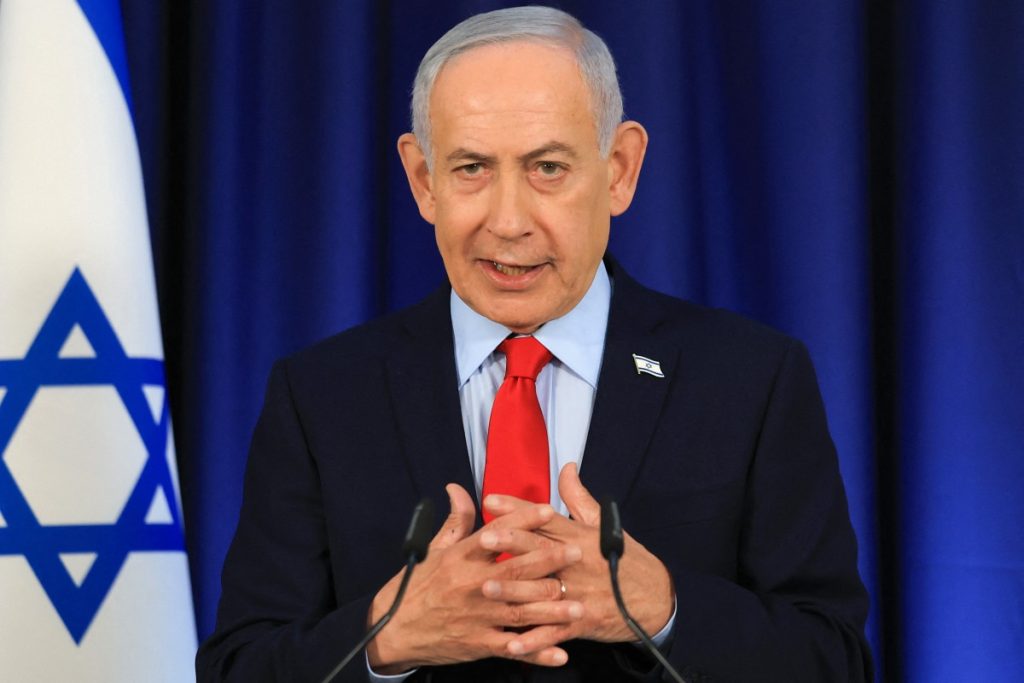
Israel's President Isaac Herzog will wait until Sunday to announce whether he will tap Benjamin Netanyahu's main rival to begin the process of forming a new coalition government, amid ongoing accusations from the prime minister and other right-wing politicians the election was "stolen."
Last week's ballot delivered an unsurprisingly inconclusive result, with neither Mr Netanyahu and his ruling right-wing coalition or the band of challengers led by former Israeli military chief Gadi Eisenkot receiving enough support to govern in majority.
Coalition governments are the norm in Israel, and after being presented with the official results of the election the president has had the task of meeting representatives from each party to seek advice on who they believe is best placed to begin negotiations.
While the meetings were underway on Thursday night, two competing groups of protesters gathered outside the president's residence in central Jerusalem — one group calling for a "unity government" comprising Mr Netanyahu and Mr Eisenkot's parties, and a larger group demanding a Jewish-Arab coalition to stabilise the country.
Mr Eisenkot's own Yashar party, along with fellow "change" camp parties Together, Yisrael Beiteinu and the Democrats all recommended the former general be given the first shot at forming government.
Mr Netanyahu’s Likud, the far-right Otzma Yehudit and Religious Zionism parties led by internationally sanctioned ministers Itamar Ben-Gvir and Bezalel Smotrich, and the ultra-Orthodox Shas all backed the incumbent to begin the negotiations.
The other ultra-Orthodox party, United Torah Judaism, did not recommend either leader.
It defended the approach by arguing there had been "wild incitement and fierce persecution" of their community during the debate over whether Haredi men should be forced to complete compulsory military service.
The two Arab-Israeli or Palestinian-Israeli parties, the Joint List and the United Arab List, also recommended Mr Eisenkot.
"We believe that it is possible to establish a new government that will serve all the citizens of the State of Israel, and it will certainly be infinitely better than the current government, which is defined as the government of failures," leader of the United Arab List Mansour Abbas told President Herzog during a meeting on Thursday.
Mr Herzog said he would take the weekend to consider the issues.
"The results of the consultations may appear clear, but the authority vested in me by law is to determine who has the ability to form a government, and that is not entirely clear, given the mutual vetoes between the blocs and within the blocs themselves," he said.
"I will try to determine this directly and quickly, in personal talks with some of the party leaders."
The Arab-Israeli parties have record representation in the next Knesset, with 19 seats between them. But that surge in support is fuelling ongoing allegations of the election being stolen.
David Zini, the head of Israel's intelligence agency the Shin Bet, has claimed 100 million shekels, $45.1 million AUD, was poured into Arab-majority communities in a foreign interference operation aimed at encouraging voter turnout.
Israeli media has reported Mr Zini, who was handpicked by Mr Netanyahu, sought to question three senior Arab-Israeli politicians. The move was blocked by Israel's attorney-general, who said there was insufficient evidence.
"This is an earthquake, an unprecedented event that undermines the very foundations of the democratic regime in Israel," Otzma Yehudit member Yitzhak Wasserlauf told President Herzog.
"We want an in-depth investigation so that they don't play with our Israeli democracy, so they won't play with this important country that we have prayed for over two thousand years, not to let terrorist elements to take over our system."
Likud member, and Netanyahu government transport minister, Miri Regev told President Herzog there should be no government relying on the support of the Arab-Israeli parties, labelling them as "terror supports" who were a "danger to the State of Israel".
The anti-Netanyahu parties have accused the prime minister of weaponising the nation’s security agencies to undermine the democratic process.
Israel’s elections committee, chaired by a Supreme Court justice, ratified the results of the election on Wednesday despite the ongoing allegations.
That triggered President Herzog to begin consultations, which wrapped up Thursday night local time.
The recommendations from political parties to begin negotiations do not guarantee a government can be formed, but kickstart a 28-day window for wrangling to occur.
Within the anti-Netanyahu camp, Yisrael Beiteinu’s leader Avigdor Liberman has insisted he will not work with the Arab-Israeli parties in any coalition or partnership.
If Mr Eisenkot was to try to form a coalition with the so-far unaligned United Torah Judaism, it may mean walking back from his commitment to force most Haredi men to complete compulsory military service.
If a government cannot be formed within the initial 28 days, the president can extend the negotiating period for another 14 days.
After that is over, another politician can be given a shot.
If a deadlock remains after all of that, fresh elections can be ordered.
Even without a government being formed, power plays in the Knesset will begin as early as next week when members are sworn in.
There is enough support for the anti-Netanyahu camp to start making changes, with the support of the Arab-Israeli parties, including installing a new speaker.
That is widely tipped to be former prime minister Yair Lapid, who ran on the Together joint ticket with fellow former prime minister Naftali Bennett.
While Likud is going to be the largest party in the Knesset, with 27 seats compared to Yashar's 21, the "change" camp parties, along with the Arab-Israeli lists, make up a combined 67 seats in the 120-vote parliament.
- netanyahu
- president
- rival
- chance
- government
- israel
- likud
- bloc