Hardship: Northerners turn to cargo trucks for cheaper journeys despite risks
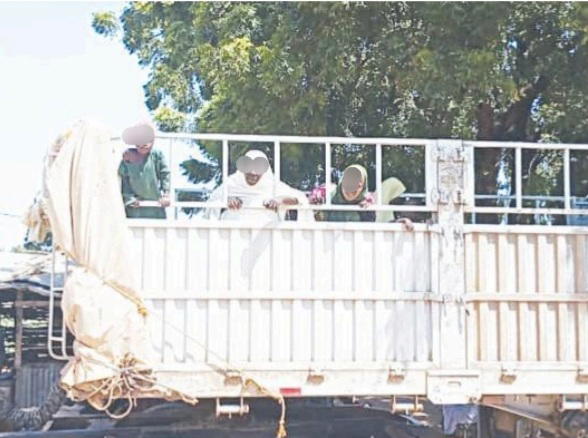
By Maryam Abdul-Aziz Usman, Damaturu POTISKUM — Despite Dangote’s ban on unauthorised passengers, Northerners still board its trucks to escape rising transport fares. Lagos fare A transport union worker known as agbero (name withheld), was interviewed at the ‘Tashan Na Tsira’ Motor Park in Potiskum, and he told the Arewa Voice correspondent that a bus journey from Potiskum to Lagos, which previously cost about N15,000, now costs approximately N35,000.
By Maryam Abdul-Aziz Usman, Damaturu POTISKUM — Despite Dangote’s ban on unauthorised passengers, Northerners still board its trucks to escape rising transport fares. In July 2026, Dangote Industries Limited offered N500,000 for credible information on illegal haulage, including unauthorised passenger transport, but travellers in Potiskum say rising fares leave them with few affordable options.
Baba Iyatu, a middle-aged woman, was perched atop a Dangote compressed natural gas (CNG)-powered truck, among dozens of other passengers preparing to leave Potiskum, Yobe State. Her destination was Niger State, where her daughter had just given birth. For her, the journey was about family. But with the cost of conventional transport increasingly difficult to afford, reaching her daughter meant accepting the uncertainties of travelling on a truck designed to carry goods, not passengers.
Baba Iyatu and the others knew the company prohibited unauthorised passengers on its trucks. Yet they argued that those enforcing the restrictions did not understand their economic circumstances. To them, the arrangement offered cheaper travel while giving drivers and their assistants opportunities to earn extra money. Their predicament captures a troubling reality in Nigeria: when the price of moving from one place to another becomes prohibitive, some people are willing to sacrifice comfort and safety to reach their destinations.
The difference in cost is stark. Lagos fare A transport union worker known as agbero (name withheld), was interviewed at the ‘Tashan Na Tsira’ Motor Park in Potiskum, and he told the Arewa Voice correspondent that a bus journey from Potiskum to Lagos, which previously cost about N15,000, now costs approximately N35,000. By comparison, passengers can negotiate rides on heavy-duty trucks for between N5,000 and N10,000, depending on the driver’s mood.
The difference can amount to as much as N30,000 on a single journey. For people already struggling with the cost of food, accommodation and other necessities, that saving can determine whether a journey is possible at all. Fuel prices have compounded the problem. In September 2026, petrol prices reached around N1,400 per litre in parts of Nigeria and N1,500 in some northern locations, while diesel exceeded N2,000 per litre, according to Reuters.
Rising fuel costs add to the expenses facing transport operators, who must also contend with maintenance, spare parts and other running costs. But the passengers negotiating rides at Potiskum’s ‘Baban Tasha Park’ are not all travelling for the same reasons. Their stories reveal how the informal use of cargo trucks intersects with family obligations, unemployment and commercial activity. ‘I’ll think about job when I ge to Lagos’ Among those preparing to travel to Lagos was Adamu Hamisu, 24, who had secured a place on a privately owned truck transporting beans to the commercial city.
It was his first trip to Lagos. He had arranged to stay with a friend but had no definite business plan. Asked what business he intended to start, Adamu said he would think about it once he arrived. For the young man, reaching Lagos came before deciding what to do there. He was travelling in search of greener pastures, hoping that being in the city would bring opportunities he could not readily access at home.
His journey illustrates the uncertainty facing young people who leave their communities to seek work or start businesses without substantial resources. Spending less on transportation could leave them with more money for food, accommodation and the first steps towards earning a living. Hassan Idris, 34, was travelling for a different reason. The livestock trader was taking 14 rams to Lagos to sell.
He had arranged with the truck driver to collect a few more animals in Azare, Bauchi State. Having traded livestock for five years, he already had accommodation arrangements in Lagos and middlemen who bought his animals for resale. Unlike Adamu, who was heading towards an uncertain future, Hassan was moving within an established commercial network connecting livestock traders in northern Nigeria with buyers in southern markets.
Their journeys demonstrate how the use of cargo trucks extends beyond people simply trying to save money. The vehicles also form part of the wider movement of goods, traders and economic activity between communities. For the drivers and their assistants, however, the economics of the practice are different. Iliya, a truck driver’s assistant, explained that truck owners receive payment for delivering goods, while drivers and their assistants are settled for food and ‘calculated fuel expenses’.
The assistants help deliver the cargo but do not necessarily receive the main payment for the job. Carrying passengers therefore offers another possible source of income. Sama’ila Ado, a truck driver who drove into ‘Tashan Yawale’, explained that drivers and their assistants also make money from selling used engine oil. According to h
- truck
- passenger
- lagos
- journey
- transport
- potiskum
- cost
- cargo