Germany news: Emergency at Leipzig airport sparked by novice driver
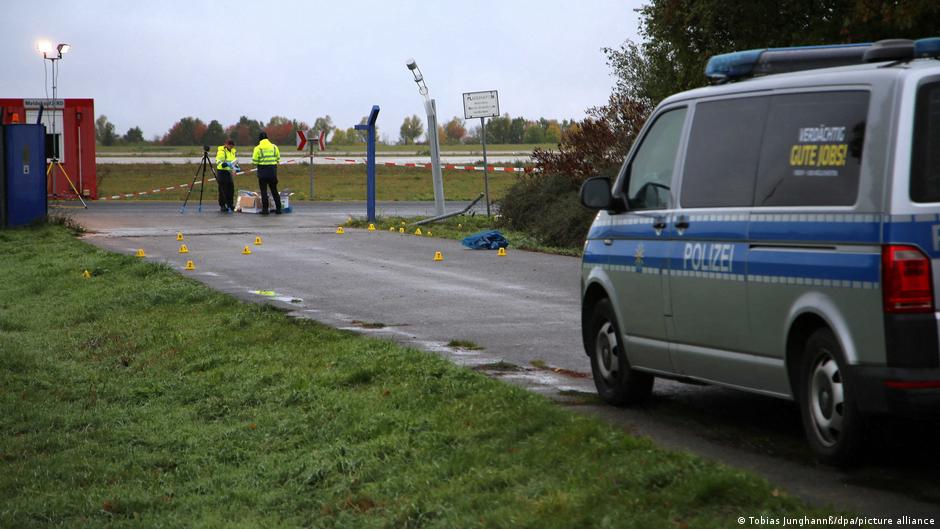
Emergency at Leipzig airport sparked by novice driver. Two men breached a fence at the Leipzig/Halle airport while practicing for a driving test.
This blog is now closed. Below is a roundup of the stories from and about Germany on Monday, October 19, 2026.
Berlin's Left Party, the Greens and the Social Democrats are set to move ahead on talks to form the next coalition government in the capital city.
The SPD's state leadership approved the motion with a wide majority in an online session, and the Greens voted overwhelmingly in favor of talks at a small party convention.
The Left Party has not scheduled a conference until October 31 because members of the party may be away because of school holidays.
The Left Party is hoping to have Elif Eralp lead the state government.
The coalition talks are set to open after weeks of tense negotiations and a dispute over alleged antisemitism within the ranks of the Left Party.
German Chancellor Friedrich Merz and Nvidia chief executive Jensen Huang unveiled a new artificial intelligence (AI) cooperation at a glitzy investment summit in Berlin on Monday evening.
"Germany is open for business," said Merz at the Invest in Germany event, adding that the combination of German engineering and cutting-edge AI technology would help strengthen the country's economy in the long term.
"Germany is open for investment and Germany is ready to grow at a faster pace," the chancellor continued, before joking: "If I were Jensen Huang, I would put on my leather jacket, take a flight to Berlin, meet the German Chancellor, and tell him, 'I'm ready to invest.'"
The partnership with Nvidia is intended to speed up the digital transformation of German industry and secure the country's technological sovereignty.
According to the company, Nvidia invested nearly $1 billion in Germany last year and holds stakes in numerous start-ups and established companies.
But Europe's largest economy has nevertheless struggled to attract foreign investment after years of weak growth, with high energy prices and labor costs continuing to deter businesses.
German officials were hoping that Monday's summit, which was attended by more than 200 domestic and international investment executives, would showcase Germany as an attractive investment destination, highlighting its sound public finances, status as the only G7 country with a triple-A credit rating, its universities, skilled workforce and tariff-free trade within the EU single market.
Further behind-closed-door talks are set to take place on Tuesday.
Do you remember those arrests in Germany last week, connected to an arson attempt at a Starlink control center in Poland?
The government in Warsaw called it a hybrid attack and accused Russia of recruiting organized crime elements for the alleged crime.
It's much too early to say for sure, but Bulgaria has now issued a pair of European arrest warrants against German citizens in a case that seems rather reminiscent in several regards.
The two 19-year-olds are accused of driving in from Serbia claiming to be tourists, setting fire to a series of antennae south of Sofia, and leaving the country again within a matter of hours.
Hermann Höllenreiner, a Sinti German raised in Bavaria who survived the Nazis' Auschwitz concentration camp as a child, has died aged 92.
Munich's Hanser Verlag publisher and the International Auschwitz Committee said that he had passed away last Friday, October 16, in Mettenheim in Bavaria, surrounded by his family.
Höllenreiner, known as "Mano" to his large Bavarian Sinti family, spent time at the Auschwitz-Birkenau, Ravensbrück and Sachsenhausen camps as a child.
"Only later in his life did he start to tell his story and became a major witness of the era, who hauntingly reported on the horrors of Auschwitz, the perpetrators and the victims, and above all of the still-persistnent discrimination of Sinti and Roma in Europe," Christioph Heubner, executive vice president of the International Auschwitz Committee, said.
"Mano Höllenreiner's biography and tales of suffering were enough for more than one life. What he saw with his own eyes as a child in Auschwitz and what was done to him — for many decades he didn't know how to speak out about it," Heubner said, thanking Höllenreiner for his "courage and humanity" in ultimately telling his story.
Höllenriener managed to flee one of the so-called "death marches" fleeing extermination camps in as Allied armies approached.
Author Anja Tuckermann told his story in a book whose title roughly translates as: "Mano. The boy who didn't know where he was."
He was initially found on a roadside and rescued by liberated French prisoners, who took him home with them. In 1946, he was reunited with surviving relatives in Germany.
Two men have admitted to breaking through a fence at Leipzig/Halle airport while one of them was practicing for a driving test, an incident that triggered a major security operation, police said on Monday.
The two, aged 20 and 32, handed themselves in to the police on Sunday evening, following the incident. The broken fence was first discovered by airport staff late on Saturday.
Police said the 20-year-old had been at the wheel despite not having a valid license.
An investigation was opened into the learner driver for fleeing the scene after breaking through the fence.
The mass-circulation Bild newspaper reported that the car involved, of which fragments were found at the site, was an Audi.
The airport was the site of a security scare in August, when an explosives-laden drone was found there near Ukrainian cargo planes.
German officials accused Russia of having planned an attack, something Moscow denied.
Germany's Rheinmetall defense group on Monday announced that it had acquired Romania's Mangalia shipyard at auction in partnership with Swiss shipping giant MSC.
Rheinmetall said it had paid approximately €138 million ($154 million) for the facility. Acquisition is expected to be finalized within a few weeks. Rheinmetall and MSC plan to develop the Black Sea shipyard near Constanța into a dual-use site for civilian and military shipbuilding for both domestic and international markets.
Rheinmetall says its Naval Systems division will use the facility to build four vessels commissioned by the Romanian government, including two 96-meter (305 foot) offshore patrol vessels and two 43-meter diving support vessels. The company also intends to modernize the shipyard's infrastructure and expand its capacity.
"In doing so," said the company, "Rheinmetall is creating a scalable foundation for future projects in southeastern Europe and strengthens its position in a strategically important market."
The Foreign Ministry has summoned Iran's ambassador after two men were convicted of preparing attacks on Jewish figures and pro-Israel targets in Germany at the behest of Tehran.
"We vehemently condemn Iran's activities. We will not allow Iran to threaten our liberal society," the ministry wrote on X.
"We do not tolerate attacks on Jewish life and those who defend it anywhere, and particularly not in Germany," it wrote.
A Hamburg court on Thursday sentenced a 54-year-old man and a 43-year old man respectively to 8 1/2 and 4 1/2 years in prison for having spied on the president of the Central Council of Jews in Germany, Josef Schuster, and Volker Beck, the president of the German-Israeli Society (DIG).
In the court's opinion, their actions were carried out in preparation for terrorist attacks, including the planned murders of Schuster and Beck.
The court said the 54-year-old, who was said to have also done the groundwork for an arson attack on a kosher food store in Berlin, received his orders directly from officers in the Quds Force.
The Quds Force is the branch of Iran's Islamic Revolutionary Guard Corps (IRGC) that is in charge of extraterritorial operations.
German industrial businesses employed some 496,000 fewer people at the end of 2025 compared to the start of 2019, according to a survey conducted by the Ifo Institute economic think tank.
Worst-hit has been the automotive industry, a key sector of the German economy, where 123,500 jobs were cut both at carmakers and suppliers, a decline of 13%.
But the metals sector also saw a marked decline in the number of jobs available, dropping 115,600 workers in the period, while the machinery sector bled 64,500 positions.
At the same time, more than 2.2 million additional jobs were created in the service sector, according to Ifo.
It said 391,000 new jobs had been established in the health sector and another 357,000 in social services, including care homes.
Joachim Ragnitz, managing director at Ifo Dresden, said the figures showed an "accelerated structural shift" in Germany.
"Ironically, the very sectors that have sustained our prosperity up to now are shrinking," he said.
"The new jobs are for the most part not being created where Germany is especially productive and innovative. That may slow down our growth potential in the future."
A German woman has died in a climbing accident in the Italian Alps, mountain rescuers said on Monday.
The 32-year-old woman, who was an experienced mountaineer, fell more than 50 meters (164 feet) to her death while on the Cengia dei Camosci, a difficult route on the 2,323-meter Grande Nabois mountain near the Slovenian border.
The rescue service said the accident was caused when a climbing hold gave way under the woman, who was accompanied by an Austrian fellow climber at the time.
Investigations are underway to clarify the exact circumstances of her death.
Carmaker Volkswagen intends to freeze the salaries of some 660,000 employees worldwide until 2030 as the company, along with the entire car industry, faces a range of challenges that have impacted its profits.
Trade union IG Metall confirmed earlier media reports of the plans, citing information given to employees by the works council.
The works council described the plans as unrealistic and said there would be considerable resistance to them.
If the company does implement them, employees could lose an estimated 10% of their purchasing power by the end of the decade.
The news comes after VW decided in September to cut 50,000 jobs worldwide in the coming years in addition to the reduction of 50,000 positions that had already been agreed.
Four plants in Germany are also at risk of being closed between 2031 and 2034.
Less than a third of leadership positions in Germany are held by women, a lower level than the EU average, statistics released on Monday showed.
According to the Federal Statistical Office (Destatis), citing figures from the EU statistics authority Eurostat, women held just 30.3% of leadership positions in Germany, compared with 35.9% in the whole of the EU.
Only Cyprus, Italy and the Netherlands have lower rates than Germany in the bloc, while Sweden has the highest, at 44.4%, followed by Latvia, Estonia and Poland.
"The low proportion of women in leadership positions in Germany is particularly striking, as almost as many women as men are employed here," Destatis said, comparing the situation with Italy, which has almost the same level of female leadership but a much lower rate of female employment overall.
Destatis defines leadership positions as those involving the management of small companies, the management of large companies or departments within them and high administrative posts.
A two-day conference entitled "Invest in Germany Summit" is to begin on Monday evening in Berlin as the government seeks to shore up public-sector spending with private money.
Chancellor Friedrich Merz will deliver the opening speech at the conference, which will be attended by an expected 200 representatives from large German and international companies.
The CEO of the US chip manufacturer Nvidia, Jensen Huang, is to be one of the key guests at the conference.
The German government is looking to cooperate strongly with the company, whose products are central to the boom in artificial intelligence, in a bid to help Germany catch up in the sector.
The German Economic Institute (IW) has, however, warned against any too high expectations from the summit, saying that high costs for labor, energy and bureaucracy in Germany were a deterrent to investment in the country.
"It would be naive to believe that the summit will change that in the short term. Companies don't choose Germany because of a promotional event. What matters is whether they can make money here," IW director Michael Hüther told the DPA news agency.
He said it would be more effective if the government were to swiftly implement its reform agenda.
A study by Allianz Research has shown that investment in Germany fell by 6.4% between 2019 and 2025, while it grew by 6.7% in the rest of the eurozone and a whole 20.2% in the US.
The DW newsroom in Bonn bids guten Tag to all its faithful readers at the start of a new week!
Today, we will be looking at a conference in Berlin that will seek to attract private investment in Germany to help make the country fit for the future, with the field of artificial intelligence a key focus.
New statistics are also to be released on Monday on women in leadership and government positions in Germany and the EU in 2025.
And the Leipzig/Halle airport has resumed normal operations after a security incident involving a breached fence triggered a large-scale police operation.
This occurred just weeks after an explosives-laden drone that German officials believe was intended to carry out an attack on behalf of Russia was found at the airport.
Read on for more on these and other stories connected with all things German.
- leipzig
- airport
- germany
- news
- emergency
- novice
- driver
- man