If Dune is this generation’s Star Wars, we are all in big trouble
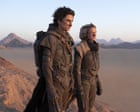
According to Florence Pugh, Denis Villeneuve’s stunningly strange and breathtaking universe is the equivalent to George Lucas’ heroic space opera. It is worth remembering this when considering Florence Pugh’s recent declaration, ahead of next month’s Dune: Part Three, that Dune is her generation’s Star Wars.
According to Florence Pugh, Denis Villeneuve’s stunningly strange and breathtaking universe is the equivalent to George Lucas’ heroic space opera. Let’s hope not
A long time ago, far far away, in a galaxy called the 1970s, kids dreamed of joining the rebellion, rescuing a princess and blowing up the Death Star. Peer into the cosmic tea leaves and it would become immediately clear that no amount of evildoing could withstand a neurotic gold butler, a dustbin with ideas above its station and a walking seven-foot tall shagpile carpet with a very low tolerance for disagreement.
It is worth remembering this when considering Florence Pugh’s recent declaration, ahead of next month’s Dune: Part Three, that Dune is her generation’s Star Wars. And then wondering how much trouble we might be in if she’s actually right. “I think they brought back movie-going. What an event the second [Dune] was,” Pugh cheerfully told the New York Times. “It was just so lovely to be a part of something that we know is our generational kind of Star Wars.”
Ponder this for a moment. George Lucas’s space opera boasted a hero who wanted to rescue his friends and free the galaxy from tyranny. Denis Villeneuve’s Dune gives us a young aristocrat who arrives in somebody else’s desert and ends up with a personal army so fanatically devoted to his greatness that his girlfriend appears to be the only person still bothering to check whether he has gone completely mad. Star Wars had a vaguely Buddhist mystical order who wanted you to trust your feelings. Dune has one that would prefer you to stop having feelings for anyone whose genetic profile hasn’t already been approved by their committee of sinister space nuns. What does it say about us if this is the defining cosmic fantasy of the modern era?
Pugh’s analogy becomes stranger the more you think about it. Lucas may have drawn heavily on Frank Herbert’s original 1965 book when he dreamed up the desert planet of Tatooine, but the two sagas offer distinctly different views of the universe. The original Star Wars trilogy asked us to believe that its central villain was ultimately worthy of redemption, despite having been a powerful cog in a regime responsible for billions of deaths. Dune, by contrast, is flowing grimly in exactly the opposite direction.
Next month’s Part Three may well be the point at which we discover that this saga’s chosen one, Timothée Chalamet’s Paul Atreides, is actually Darth Vader with better hair. However this all ends up, and cast members have been hinting that Villeneuve’s finale may not follow Herbert slavishly, it is unlikely to involve a bunch of teddy bears somehow bringing down a galaxy-spanning fascist superpower. We know from having watched the first two films that Paul has already glimpsed the horrors that could follow his rise to power. His ability to see possible futures means part three is a particularly uncomfortable prospect: a ruler who can foresee catastrophe yet may still be unable to prevent it. The boy who seemed destined to save everybody has become the man who could destroy it all.
There is one department in which Dune already has Star Wars beaten: Villeneuve’s films look absolutely astonishing. Lucas gave us twin suns, vast Imperial warships and the Death Star, but he then also gave us CGI space critters wandering across the foreground for no obvious reason, a digital Jabba you could almost see buffering and a Sarlacc pit given a face only its programmer could love. Villeneuve’s universe feels heavier, stranger and more genuinely alien: huge ships hanging over deserts, armies reduced to specks beneath impossible architecture, sandworms arriving with the rumble of ancient, inexorable doom. Even when Dune is telling us something dreadful, it looks better than almost anything else in modern blockbuster cinema.
And perhaps this is where Pugh’s comparison begins to make a bleak sort of sense. In a world where powerful men keep promising to save us from disasters they helped create, the closest thing to escapism is a dictator who can see the future he is ruining, but is unable to stop himself because the whole damn thing looks so utterly glorious in Imax.
- dune
- star
- wars
- generation
- trouble
- pugh
- florence
- denis