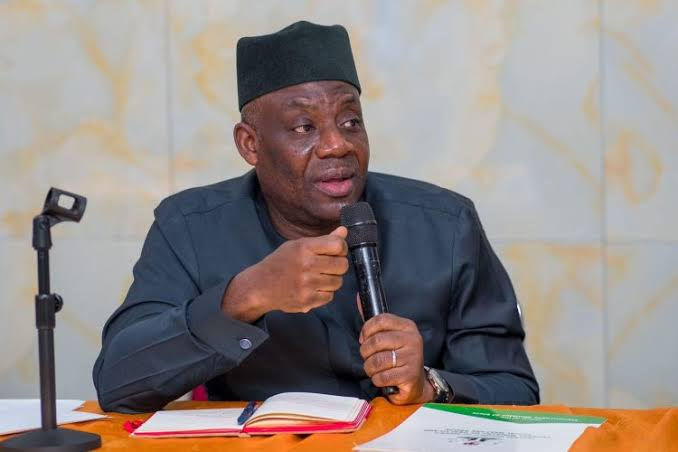
Mutfwang: Educated Nigerians masterminding corruption, institutional decay
…says professionals behind major governance failures …challenges graduates to choose integrity over wealth By Joseph Erunke, Abuja Plateau State Governor, Caleb Mutfwang, has accused educated Nigerians of masterminding some of the country’s most damaging corruption scandals, financial fraud and institutional abuses, saying the nation’s governance crisis is not a result of a shortage of intellectual capacity but a failure of conscience. Describing the situation as an uncomfortable reality the country must confront, Mutfwang said some of Nigeria’s most entrenched governance failures were…
…says professionals behind major governance failures …challenges graduates to choose integrity over wealth By Joseph Erunke, Abuja Plateau State Governor, Caleb Mutfwang, has accused educated Nigerians of masterminding some of the country’s most damaging corruption scandals, financial fraud and institutional abuses, saying the nation’s governance crisis is not a result of a shortage of intellectual capacity but a failure of conscience.
Mutfwang said some of the most sophisticated acts of financial fraud, contract manipulation, money laundering and subversion of public institutions were perpetrated by people whose academic qualifications and professional expertise should ordinarily be deployed for national development. The governor spoke on Friday in Abuja while delivering the convocation lecture at the 15th Convocation Ceremony of Veritas University.
In his lecture titled, “Building the Nigeria We Want: The Role of the Educated Mind,” he warned that education without moral discipline had become a dangerous instrument against the country’s progress. He challenged the graduating students to rethink the purpose of university education, insisting that academic certificates and intellectual brilliance would amount to little if deployed for selfish interests at the expense of society.
According to him, Nigeria’s development challenges cannot be blamed entirely on inadequate manpower or lack of expertise, as many individuals responsible for undermining public institutions are highly educated and professionally trained. Describing the situation as an uncomfortable reality the country must confront, Mutfwang said some of Nigeria’s most entrenched governance failures were products of educated minds.
He said: “Indeed, I make an uncomfortable observation: the afflictions I diagnosed earlier, prebendalism, the privatisation of public office, grand corruption, the capture of institutions, are almost never the work of illiterate minds. They are overwhelmingly executed by educated minds. “The contract, the doctored account, the laundered fund, the ingenious evasion of law.
All these are the signatures of trained minds. This is the paradox we must confront. The educated mind is at once our greatest hope, and when corrupted, it becomes our most sophisticated danger.” The governor also cited internet fraudsters, popularly known as Yahoo boys, as an example of intelligence deployed in the wrong direction, arguing that criminal ingenuity reflected a lack of moral restraint rather than an absence of intelligence.
“The Yahoo boy is certainly not a derelict. He is a work of intelligence, but intelligence wrongly applied,” he said. Mutfwang maintained that Nigeria had no shortage of brilliant citizens, noting the achievements of Nigerians across different professions and on international platforms. However, he lamented that the country had failed to translate its abundant intellectual resources into responsible leadership, accountable governance and sustainable development.
He urged the graduating students not to measure success solely by their earning capacity, professional positions or social standing, but by the extent to which their knowledge improved the lives of others. According to him, intellectual capacity must be matched with conscience, warning that an educated person without moral discipline could inflict greater damage on society than someone without formal education.
“Knowledge tells you what you can do, but conscience tells you what you should do. An educated mind without a formed conscience is not an asset to any nation. It is a very efficient danger,” he declared. The governor identified integrity, responsibility and competence as three critical attributes Nigeria needed from its educated population to overcome its development challenges.
He explained that responsibility required citizens to accept the consequences of their decisions rather than hide behind claims of good intentions. Citing the principles in The Ethics of Responsibility, Mutfwang said national development required individuals willing to take ownership of the outcomes of their actions. He described the Nigeria of his aspiration as a country where hospitals delivered quality healthcare, courts dispensed justice, schools provided meaningful education and public office holders regarded their positions as opportunities to serve rather than avenues for personal enrichment.
“The Nigeria we want is a nation of institutions that work, where the hospital heals, where the courts deliver justice, where the schools teach, and public office serves truly the public. “It is a nation where merit is rewarded and mediocrity is not enthroned, where security is felt in the farm, in the market, at home, where prosperity is shared rather than captured, and where leaders understand office as stewardship and not as a spoil,” he said.
Mutfwang, who reaffirmed his belief in Nigeria’s unity, said the country’s ethnic, linguistic and cultural diversity should be regarded as an
- mutfwang
- mind
- nigerians
- corruption
- nigeria
- educated
- governance
- governor