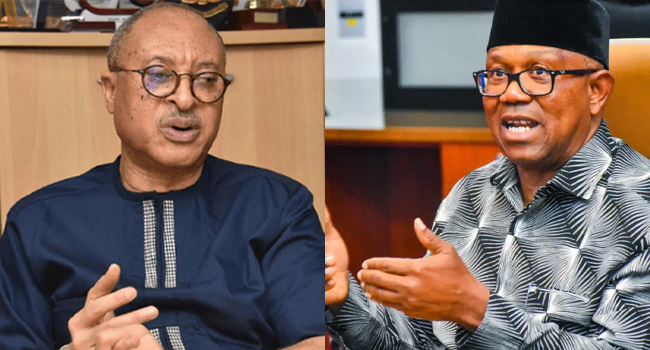
Obienyem faults Tinubu over claim Obi ignored erosion in Anambra

Valentine Obienyem, a media aide to former Anambra State Governor Peter Obi, has faulted President Bola Tinubu over his claim that Obi did nothing to tackle erosion during his tenure as governor. Other locations included Okpuno, Uwani Village, Ebenebe, Inyaba Umudim, Nnewi, Umuchu, Iyiagu floodplain in Awka, St Patrick’s Catholic Church, Awka, New Tarzan Junction, Agulu Avenue, Okpuno-Umuota,
Valentine Obienyem, a media aide to former Anambra State Governor Peter Obi, has faulted President Bola Tinubu over his claim that Obi did nothing to tackle erosion during his tenure as governor. Obienyem, in an opinion article sent to Vanguard on Saturday, described the allegation as unfair and contradicted by historical records, citing several erosion-control projects undertaken by the former governor and his role in securing regional and international support to address the problem.
The reaction followed Tinubu’s visit to Akwa Ibom State, where he reportedly promised to develop the state’s deep seaport and accused Obi of failing to address erosion in Anambra during his administration. Obienyem linked the development to Obi’s recent remarks on the need to develop seaports across Nigeria’s coastal states, including the Calabar Port and Ibom Deep Seaport.
He recalled that Obi had advocated the development of multiple ports across the country’s littoral states, citing Egypt, with about 15 ports, and South Africa, with about eight, as examples of countries that had diversified their maritime infrastructure to promote balanced economic development. On the erosion challenge in Anambra, Obienyem said the state had more than 1,000 active erosion sites, including the devastating Nanka-Agulu erosion complex, but maintained that Obi gave the problem considerable attention while in office.
He cited two incidents to illustrate the former governor’s personal involvement in emergency interventions. According to him, Obi once arrived at Umuchiani, Ekwulobia, as early as 6 a.m. after receiving reports of advancing erosion threatening the Ekwulobia-Oko road and nearby buildings. He said some residents had begun dismantling parts of their houses to salvage their belongings before Obi intervened and directed that work should commence immediately.
Obienyem said the erosion was subsequently arrested and stabilised, saving the road and protecting the threatened buildings from further destruction. He also recalled a similar intervention along the Nkpor-Onitsha dual carriageway, around the Omagba axis, where Obi reportedly responded to a distress call and helped prevent an endangered building from being swallowed by erosion.
Beyond the emergency interventions, Obienyem said Obi, as Chairman of the South-East Governors’ Forum, advocated declaring the region an ecological disaster zone to attract urgent government attention and international assistance. He credited the former governor’s advocacy with helping to advance the Nigeria Erosion and Watershed Management Project (NEWMAP), a World Bank-assisted programme designed to tackle erosion and watershed degradation.
To support the claim, he cited the remarks of former Minister of Environment, John Odey, who reportedly acknowledged Obi’s contribution during the project’s official launch in Abuja. According to Obienyem, Odey recalled that Obi had almost single-handedly pushed for the initiative despite initial reservations among some of his colleagues. He also cited the commendation by the World Bank’s then Country Director, Marie-Françoise Marie-Nelly, who praised Obi for being the first governor to pay the state’s N500 million counterpart contribution to the programme.
The project covered Anambra, Imo, Ebonyi, Enugu, Abia, Edo and Cross River states. Obienyem further claimed that Obi had worked on nearly 40 erosion-control and storm-water management sites across Anambra State before leaving office, with most completed and work continuing on others. Among the locations he listed were Umuchiana, Ekwulobia; Mbaukwu; Mbanabo-Umuogba/Bishop Uzodike Road, Nnewichi, Nnewi; Umunze-Uga; Umudiana, Adazi-Nnukwu; Nsugbe; and Utu/Osumenyi in Nnewi South.
Other locations included Okpuno, Uwani Village, Ebenebe, Inyaba Umudim, Nnewi, Umuchu, Iyiagu floodplain in Awka, St Patrick’s Catholic Church, Awka, New Tarzan Junction, Agulu Avenue, Okpuno-Umuota, Obosi, and New Era Girls’ Secondary School, Onitsha. He also listed drainage and waterway interventions, including the dredging of the Nwangene River in Onitsha, desilting of the Okpoko/Obodouwku road channels and Okpoko Creek, as well as desilting of the Sacamori channels in Fegge and Housing Estate, Onitsha.
According to him, other erosion-control projects were undertaken at several communities, churches, schools and public institutions across the state, including Obosi, Oraifite, Ebenator, Okpuno, Nimo and Agulu. Obienyem argued that the projects demonstrated that erosion control was a major component of Obi’s administration’s development agenda and not an afterthought.
He said the former governor’s interventions went beyond saving roads and buildings to protecting livelihoods, communities and the economic future of residents. The writer urged that governance should be assessed based on problems identified, initiatives undertaken and results achieved rather than political propaganda.
- obi
- erosion
- obienyem
- anambra
- state
- tinubu
- claim
- governor