After victory in the midterms, what next for US Democrats?
Donald Trump's Republican party has lost its majority in both chambers of the US Congress. But the president still has a lot of power — and the Democrats have yet to agree on how best to use theirs.
A "blue wave" has rolled across the United States. Some are even calling it a "blue tsunami." The Democrats scored a decisive victory in the midterm elections on November 3, wresting the majority from President Donald Trump's Republicans in both the US House of Representatives and the Senate. They also won gubernatorial elections in former Republican strongholds such as Texas.
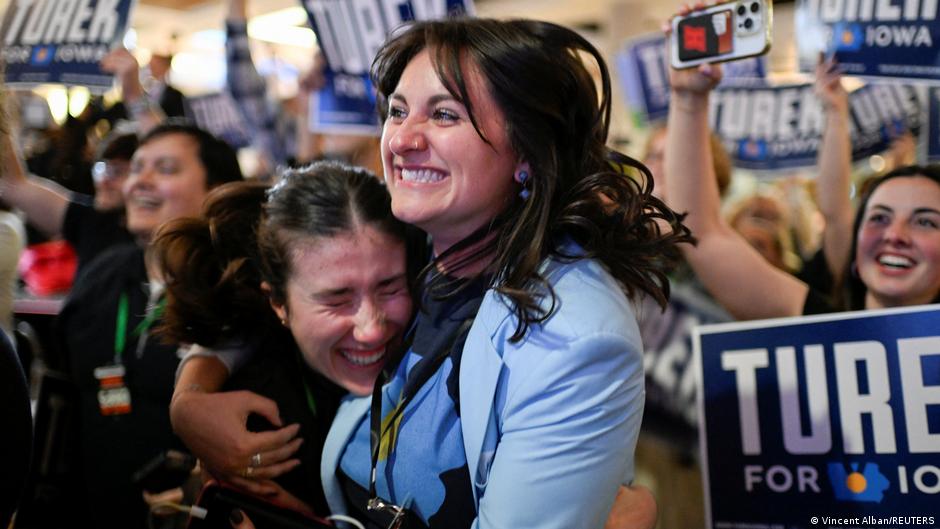
Pictures from Tuesday evening show Democrat politicians and supporters across the country celebrating, hugging, even weeping with joy. However, as the White House reminded Americans in a post on X the day after the elections: "Trump is still your president."
Trump has the power to veto any proposed legislation Congress puts before him, and his veto can only be overruled by a two-thirds majority. Also, in the past he has, on occasion, simply ignored the Congress's decision.
Patrick Malone, professor at the public administration and policy department at American University in Washington DC, told DW that a presidential veto is not necessarily the end of the matter — even though the Democrats don't have a two-thirds majority in either Congressional chamber.
"There are Republicans, especially on the House side, who are not going to want to tie themselves that closely to Trump anymore," says Malone. "The Republicans that survived had a very strong message sent to them. It would be illogical and foolish for them to point to a neighboring district [that turned blue] and say, 'Well, that can't happen here.'"
For that reason, Malone predicts that Republicans and Democrats may come together to overrule a Trump veto. "It could happen very easily."
A question at the front of many people's minds is: Might the Democrats make another attempt at impeachment? One possible basis for this would be that Trump started the war with Iran without congressional approval. The US Constitution says only Congress has the power to declare war. But as commander-in-chief, the president also has a degree of military authority. How far this extends without Congressional approval is legally disputed.
From January 2027, Democrats will have the simple majority required to bring charges against him in the House of Representatives. They will not, however, be able to muster the two-thirds majority in the Senate that would be needed for a conviction and Trump's removal from office. Some Democrats say it is nonetheless imperative that the impeachment process be initiated, as a way of keeping the president in check.
Others remain skeptical. "If we make Donald Trump the center of our focus, we will lose this moment in history," the Democratic senator Cory Booker said. "We need to deal with the American people's problems."
This does not mean that Democrats won't try to launch investigations into Trump, or into members of his family or government. Quite the reverse. Malone believes the Democrats in Congress take their control function very seriously and will definitely initiate investigations. These, he says, serve a purpose beyond the documented outcome: "Another thing about Congressional investigations: They have a much stronger impact on public opinion than on legislation. They catch people's attention."
While Trump will most likely get to keep his job, Pete Hegseth might be about to lose his. Observers assume the Democrats will demand a different secretary of defense. "There's a lot of speculation about what's going to happen to Pete Hegseth," says Brandon Conradis, a former DW journalist who is now an editor at Bloomberg Government in Washington DC. Whether Trump will actually fire Hegseth is a decision for the president. All the Democrats can do is exert political pressure.
From January onward, the Democrats will have a majority in Congress, which is where decisions are made on how government funds are spent. Conradis says one possibility for the Democrats to get their way would be to link the financing of Trump's pet projects to specific conditions. "One thing Democrats might do is say, 'Look, if you want more funding for these conflicts, Pete Hegseth needs to go.'"
As secretary of defense, Hegseth is being held at least partially responsible for the US's relative lack of success in the war with Iran. This could also be a reason for Trump to fire him.
After their success in the midterms, the Democrats have been enjoying a brief moment of unity. But Malone says it won't last. "The Democratic Party was unified for maybe 24, 36 hours. Now they're not really going to unify for a bit."
Unlike Germany, the US does not have governing coalitions at the federal level. There are, however, various political groupings within the Democratic Party itself. On the left wing of the political spectrum there are the progressive Democrats, including, among others, the prominent young representative Alexandria Ocasio-Cortez. "[Progressives] have very aggressive policy ideas, whether it be environment or social programs," comments Malone.
In the middle are the mainstream liberal Democrats, who see themselves as politically pragmatic and good at compromising. But there are also moderates. "This is an important group on the Democratic side," Malone says. "There were a lot of Democrats [in the midterms] who won elections in former red districts or really, really conservative blue districts. They won't be able to go back to their districts and say, 'Look, AOC wants this.'"
It will be no easy task for Democrats in Congress to agree on one clear direction. But many believe that it's vital that they do. "They're going to have to figure out a positive governing agenda that they can all agree on," says Malone. Just opposing Trump won't be enough for the Democrats to sustain their current success, the pundit argues.
This article has been translated from German.
- democrats
- victory
- midterm
- donald
- trump
- party
- majority
- chamber