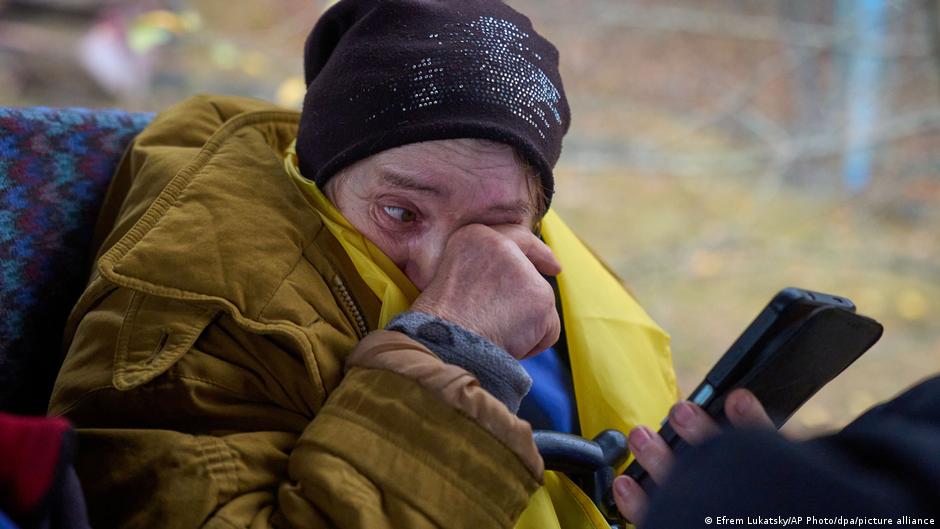
Ukrainians 'suffered forced starvation' in Oleshky before escape
In Russian-controlled Oleshky, Ukrainians say they were forcibly starved and tortured before an evacuation mission allowed them to flee.
In this war-ravaged Ukrainian city, most of the residents who remain are Russian.
Located in a stretch of the heavily contested battlefield known as Ukraine's "kill zone", Oleshky sits in Russian-controlled territory on the bank of the Dnipro River.
In the past week, images from within Oleshky have been broadcast worldwide as part of a six-day ceasefire brokered with help from US first lady Melania Trump.
The truce marked the most significant pause in fighting since Russia's full-scale invasion of Ukraine began more than four years ago, allowing some residents to escape.
Here is what is known about what they were fleeing.
Before the war, it took 15 minutes to travel from Oleshky to the neighbouring city of Kherson.
In Kherson, across the river to the west, sports and cultural events continue underground despite the constant threat of air strikes.
In Oleshky, the conditions are among the worst in Ukraine.
Before the evacuation, residents said food stores had been exhausted, and with no electricity or running water, they faced a gruelling winter.
But with landmines blocking exits, attempting escape was just as life-threatening.
"[This is] the choice that Russia leaves every day to civilian residents: stay and starve to death, leave and risk getting blown on a landmine," Ukraine's human rights ombudsman, Dmytro Lubinets, wrote on Telegram.
Russian forces captured the eastern bank of the Dnipro on February 24, 2022 — the day they invaded Ukraine.
Two months later, they seized full control of Oleshky, blocking evacuation routes and humanitarian corridors that could be used to import food and medicine, according to Ukraine's Armed Forces and the UN Human Rights Monitoring Mission.
Residents said the food supply became unreliable last year, and the situation deteriorated in May.
They said that was when the last food delivery was made.
Tetiana Hasanenko, the head of the Oleshky military administration who is now based in Kherson, told the ABC the mines made it "impossible" for supply vehicles to drive into the city without being destroyed.
She said with so many cars damaged, and power outages causing a lack of refrigeration, maintaining food stocks was extremely difficult.
Since then, residents have survived on home-grown produce and preserves. But as winter approaches, those supplies are rapidly dwindling.
"What on earth could possibly be left in your house when you haven't been to the shop for half a year?" a woman living in the town told Reuters, asking not to be identified for fear of reprisals from Russian forces.
She recently attempted the 20-kilometre trip to neighbouring Radensk and was injured by a mine on the return. She said three people were recently killed on the same route.
Larysa, a woman who fled Oleshky shortly after the invasion, told Reuters her husband was still there, surviving on dwindling rations since May.
"There are no eggs, no dairy, no meat — there's nothing," she said.
She said he was living on vegetables and homemade flatbread made from pre-invasion flour stocks that had gone bad long ago and cooked on an open fire.
He feeds their four cats and a dog with grass mixed with whatever grain is left.
The only way to boil water is on an open fire, because the city has been without electricity or water utilities since 2023, when a nearby hydro-electric power plant dam was destroyed in an apparent Russian attack that also led to severe flooding in the region.
Ms Hasanenko said she has also seen people resorting to eating foods mixed with grass as a last resort and believes it is having a significant impact on residents' health.
"Nutrition is very limited … People are losing a lot of weight — 10, 20, even 30 kilograms each. People are exhausted and because of that they do not have enough strength to leave Oleshky."
Working with the International Committee of the Red Cross (ICRC), Ukraine used heavy-lift drones to deliver almost four metric tonnes of food and medicine to Oleshky at the end of September.
Supply drops of this kind have been sporadic, Ukraine said, because Russia has frequently attacked humanitarian efforts.
Kremlin press secretary Dmitry Peskov confirmed the situation in Oleshky was critical, but said Ukraine was behind the attacks on humanitarian supply drops.
Even when the drops are successful, retrieving the supplies can be complicated for Oleshky's residents.
Ms Hasanenko said Ukrainian authorities suspected residents were often threatened or tortured by Russian forces who thought they may have cooperated with Ukraine's armed forces to distribute food drop supplies.
"Because of that, people get the food products and immediately pour it into another unlabelled container, in some glasses, dishes, home plates, in order to not explain [where it came from].
"Now there are no potatoes and no meat, there is no flour, no cooking oil at all. Because of that, [people] eat twice a day and only a few spoonfuls of some kind of grain each time, if they have it."
Speaking on the conditions in Oleshky at a UN Security Council meeting in September, Ukraine's Foreign Affairs Minister Andrii Sybiha said: "The Kremlin reproduces the crimes of the past."
Soviet policies during the 1930s brought an engineered famine to Ukraine that killed at least 4 million people — roughly four times the death toll of the Irish Potato Famine.
"Hunger was Moscow's weapon then; it is Moscow's weapon now," Mr Sybiha said.
Prior to this month's ceasefire, Ukraine made several attempts to open negotiations for a localised humanitarian truce with the Kremlin, with Mr Lubinets saying he raised the issue via the ICRC in May and July.
"The Kremlin's deliberate non-response reveals a certain logic to Russian occupation policies", according to analysis by the Institute for the Study of War (ISW), a Washington-based think tank.
Russia's strategy of creating deprivation conditions acts "as a means of further consolidating its control over occupied areas", the ISW said, pointing to similar strategies used by Russian forces during their siege of Mariupol from March to May 2022.
In a 2024 submission to the International Criminal Court, Ukrainian lawyers accused Russia of committing a war crime by deliberately starving the people of Mariupol.
"Russia likely views any tangible response to the situation in Oleshky as a display of weakness," the ISW said.
- ukrainians
- oleshky
- escape
- starvation
- russian
- evacuation
- mission