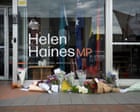
'Shouldn't have to wear a flak jacket': Haines spoke of risks to MPs before attack
Haines spoke of risks to MPs before attack. As the nation recoiled this week at the brutality of the physical attack on Independent MP Helen Haines, a small but terrible poignancy pulsed beyond public view.
As the nation recoiled this week at the brutality of the physical attack on Independent MP Helen Haines, a small but terrible poignancy pulsed beyond public view.
For the past year, Haines has been a key Australian advocate of a groundbreaking project to map the physical and mental health risks to which public representatives are exposed in their line of work.
The study — understood to be the largest ever undertaken into Australian MPs' mental health and apprehensions around physical safety — canvassed the experiences of 288 current and five former representatives from federal, state and local government over the past year.
Conducted by the Berlin-based Better Politics Foundation, the report titled Fit To Lead is still in draft form, due for release next month.
But the sentiment coursing through the survey responses is powerfully encapsulated by a single anonymous MP's quote in the report's introduction, penned by the foundation's Australian-born co-CEO, Kimberly McArthur.
"We don't want to make politics comfortable, but we do want it to be safe," the MP says.
"You shouldn't have to wear a flak jacket, physical or emotional, to do the job."
These words belong to Helen Haines. Her office this week authorised the ABC to attribute them to her, hoping that the critically injured MP's own words could be heard among the tumult this week.
McArthur, who now lives in Berlin, and colleagues were horrified to hear of the attack on Haines. She is a listed "champion" of and key collaborator on the study.
"What happened to Helen is shocking," McArthur says.
"But I am sorry to say that those of us who work with politicians in Australia have feared an attack like this was coming for some time."
McArthur says half of the study's female respondents reported fears for the safety of "self or family or team" had a significant or substantial effect on their wellbeing.
"When the job becomes this dangerous, the harm does not stay with the individual," she says.
"Nearly 40 per cent told us their own wellbeing had at some point stopped them speaking out on issues they believe are important. It drives good people out of public life, and it quietly tells the next generation of leaders not to bother putting up their hand. That is not just unfair to them. It is a problem for all of us."
The Fit To Lead study will be released in Australia next month by Alastair Campbell, the high-profile British podcaster, author and former adviser to Tony Blair who has written extensively on mental health and politics.
On Wednesday, Campbell spoke about Haines on his podcast The Rest Is Politics. Campbell said Australia had always enjoyed a reputation as a safe place to be a public figure, but this was changing.
The Fit To Lead report established Australian politicians now experience "more depression and anxiety than people who work in the emergency services" he said.
The late Bob Hawke, interviewed on the ABC's Kitchen Cabinet in 2014, recalled with delight an occasion when — waiting with a high-level delegation of American visitors outside the MCG for a bus to take them back to their accommodation — he was greeted by a carload of young men who rolled down the windows and yelled: "G'day Hawkie! Hawkie! You're the best!"
"And I sad, 'Well if I'm that good, how about giving me a lift to town?'," the former prime minister recalled.
"And they said 'sure' so I just piled into their car," he said. The journey was unremarkable — Hawke was delivered to the hotel unscathed, having spent the trip chatting with his fans and calling their mums.
"The Americans couldn't believe it," Hawke said.
"It does distinguish our country. I mean, that could never happen — certainly in the United States where you're just surrounded by security and so on. One of the great marks of this country [is] you can do that and people would have a laugh, but it wouldn't be regarded as unsafe."
But life is changing for Australian MPs.
Nearly a decade after that Hawke interview, a six-episode season of Kitchen Cabinet featured two guests who were unable to film in their own homes because of serious threats on their lives.
Both were female. Both were Indigenous — then cabinet minister Linda Burney and the independent senator Lidia Thorpe, who has faced consistent and alarming threats over her time in the parliament and has spent periods being unable to live in her own home.
In the past five years, the annual rate of threats against high office holders and federal MPs recorded by the Australian Federal Police has increased from 300 to more than 1000.
Online and social media threats are a significant driver; one senior Coalition figure estimated this week that she referred a dozen threats a week to the Australian Federal Police.
The shocking attack on Haines, for which police are yet to advance a motive although a man has been charged, has been described variously as a "wake-up call" and as a "turning point" for the Australian polity.
"Helen is a non-combatant," says one parliamentary veteran, a political opponent. "She's Switzerland. For her to be attacked in this way is just unthinkable."
But in the days since Haines sustained her terrible injuries, the threat level for public figures has not markedly dissipated.
Small Business Minister Anne Aly, who earlier this month disclosed that she received 19 death threats in one week after an opposition MP told parliament she and Prime Minister Anthony Albanese should be "stoned in the marketplace", says the temperature of online debate had — if anything — intensified since Haines was attacked.
“Intuitively you’d assume that the terrible thing that happened to Helen would have calmed things down,” she says.
"What's immediately happened is people jumping to conclusions — which is never a sensible thing to do — to lay blame, to identify the perpetrator: is he one of us, or one of them?"
On Thursday, Aly's electorate office received a letter declaring a bullet would be "too good" for her. It was accompanied by a package of Bibles, in what Aly and staff interpreted as a statement about her faith (Aly is the first Muslim woman to serve in federal parliament).
On Wednesday, a man was arrested in Perth for behaving in a threatening manner at the electorate office of state Labor MP Hannah Beazley, while allegedly carrying nunchucks.
In Brisbane on the same day, Communications Minister Anika Wells was obliged to close her electorate office after a woman carrying a replica firearm threatened the woman staffing the reception desk.
Wells is one of the many MPs who have grappled with death threats and online abuse; a Bankstown man was last year charged and fined for stalking the Brisbane MP.
Aly, who was an internationally renowned authority on terrorism and radicalisation before entering parliament, is no stranger to heightened threat environments.
But her experience as a parliamentarian has thrown into sharp relief the research she's done on radicalisation, and the trajectory that can push an individual from seeking information online to "lurking" among extremists to taking active and violent steps.
But she says it's not as simple as blaming social media.
"We're missing pieces of the conversation here," she says. "There's a substantial mental health factor. Particularly with men in their forties and fifties."
Several years ago, Aly was in her office when a man entered, armed with a knife. Aly and a staff member remained in the office to try and talk the man down, directing others to lock the door and summon police.
"That case involved mental health issues," she says.
Another threat — in which a correspondent advised Aly "would be shot" at a specific car park she regularly used — made it to court.
Deputy Nationals leader Darren Chester, who has held the regional Victorian seat of Gippsland for nearly 20 years, suspects the rate of online threats against MPs is under-reported.
"We evaluate them ourselves as to whether they're worth forwarding to the AFP, and of course we're not really qualified to do that," he says.
"It's much easier now for people with a grievance to get in touch with an MP. And you can do it 24 hours — you can fire off an email with three scotches under your belt where once you might have had to wait until morning to write a letter and maybe think again."
Chester is also listed as a champion of the Better Politics study. He cautions against a knee-jerk response to the Haines tragedy.
"You don't formulate drought policy when you're in the middle of a drought, and if you're making decisions about security in the middle of a crisis you run the risk of making bad decisions," he says.
"If you change your behaviour to the point where you're travelling around in motorcades, then you become aloof from your community, and the scumbags have won, and our democracy suffers."
Chester says the face-to-face interactions with his constituents are vastly different from online ones.
"Nobody has ever said to my face the kinds of things that are said on social media," he says.
McArthur agrees social media is a significant driver of fear and apprehension among elected representatives.
"Traditional and social media personalities have an enormous role to play in holding power to account —which democracy needs — and in curbing the kind of pile-on and rhetoric that strips people of their basic safety and dignity," she says.
"The police have a role in taking threats against elected officials seriously, because harassment does not always stay online. And the public, that is all of us, has a role too. Before the next angry message is sent, it is worth remembering that these are human beings doing a frighteningly hard job on our behalf."
The tipping point between online abuse and physical aggression is hard to predict or judge, but ASIO director general Mike Burgess has warned repeatedly over the course of his term that extreme rhetoric and supercharged debate increases the chance of real-world violence.
And while the attack on Haines has widely been described as a “wake-up call”, the terror attack at Bondi last year already stands as a shocking demonstration of the way ideology can burst into violence.
For serving MPs, who are obliged to be visible in their electorates as part of their jobs, protective measures can involve restricting advance notice of where they are planning to appear, posting photographs only after they've left a location.
But for local government candidates, disclosing private contact details can be part of the deal.
In states like NSW, WA and Tasmania, local government candidates are obliged by law to authorise campaign materials with their personal addresses. In other states including Queensland and Victoria, PO boxes can be used as an address, but a recent NSW branch conference of the Australian Local Government Women's Association heard the requirement to publicise a personal street address was a major disincentive for female candidates.
Delegates shared stories of receiving abusive calls late at night, aggrieved constituents coming to their homes and family members experiencing harassment.
A recent study of NSW women in local government, titled Not On My Council and authored by academic and Cumberland City councillor Diane Colman, found 61 per cent of women councillors experienced bullying, harassment or intimidation.
Despite the grim statistics at every government level, McArthur says the representatives surveyed are far from giving up.
"The overwhelming majority told us they would still encourage others to run for office," she says.
"The least we can do is make it a job worth standing for."
- attack
- flak
- mps
- haines
- jacket
- haine
- risk
- nation