Manchester’s soulless content machine football clubs sum up post-imperial Britain
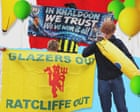
In Manchester this weekend it was possible to bookend your Thursday‑to‑Sunday entertainment with two cultural events. And three days later, three miles down the road, Manchester United versus Aston Villa at Old Trafford.
United and City dominate the news cycle with stories so strange and vast they threaten to consume the rest of the league
In Manchester this weekend it was possible to bookend your Thursday‑to‑Sunday entertainment with two cultural events. First up, a debut screening of the re‑released and uncensored Ken Russell film The Devils at Trafford Odeon. And three days later, three miles down the road, Manchester United versus Aston Villa at Old Trafford.
As expected, one of these events provided a visceral cinematic experience, a deeply disturbing two-hour public meditation on the meaning of faith, blood, fear, power, ritual and the fetishising of objects, climaxing in an orgiastic crowd scene of depraved but undeniably erotic abandon, all acted out on a set in a state of glorious and performative ruin. And the other one was a film with Oliver Reed in it.
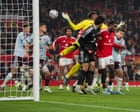
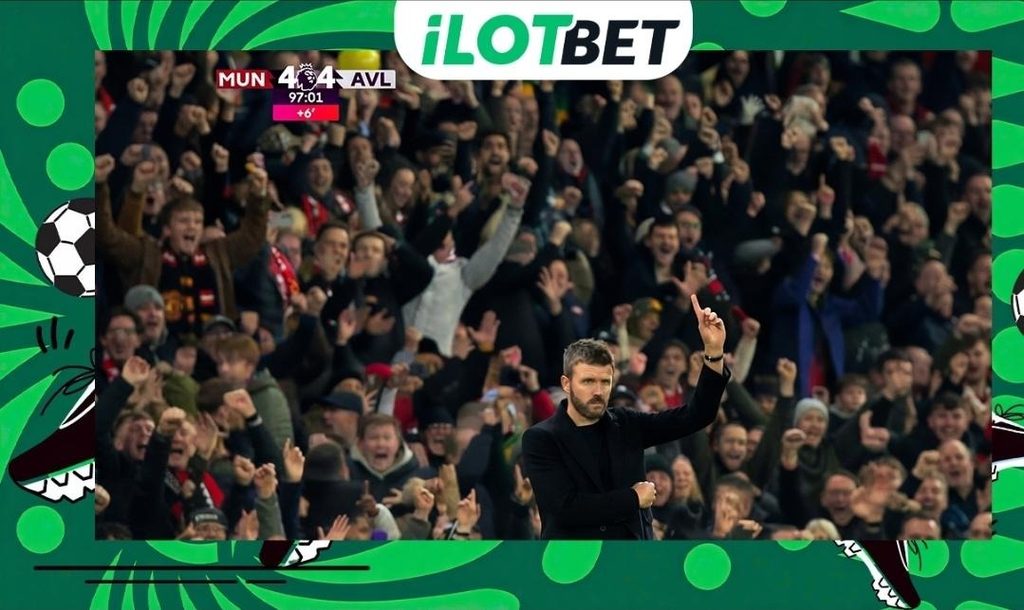
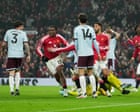
By the final whistle that wild 4‑4 draw at Old Trafford felt like a fitting endpoint to the opening quarter of the Premier League season. As we head into a 12‑day international break it is customary at this point to take a set of readings, to anatomise the season to date, to offer up a state of the Premier League address.
Five games since the last time we did this, not a great deal has changed. Brighton have maintained their luminous insurgent energy. The headline chart-breakers are Tottenham, up from second‑bottom to 11th. The official Home Office Spurs In Crisis threat level has been downgraded from Definitely In Crisis to Probably In Crisis A Bit Later On. Roberto De Zerbi no longer looks like a doomed and haunted cartoon caterpillar. Instead he looks like a feisty and fun haunted cartoon caterpillar.
Otherwise there has been only one story in town across that autumn segment. And that story is Manchester, and the extraordinary contortions of two contrasting, but deeply conjoined mega-clubs.
Manchester City’s run from October to November kicked off with the guilty verdict on almost all of their financial charges, followed by an adrenal victory at Anfield, and finally a run of three problematic league defeats. United have basically fallen through the floor in the same period: played eight in all comps, won one, and a point off the bottom of the Premier League table.
At the same time both Manchester clubs have dominated the news cycle, inexhaustible content machines, and the source of football-adjacent stories so strange and so vast they threaten to surge up over the seawall and consume the rest of the league.
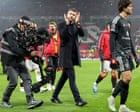
It is necessary at this point to talk about Michael Carrick and whether he has been sacked yet (current answer: no). It seems likely that this will happen in the current break, once the designated replacement has been lined up. Another Manchester United paradox: only here, in the realm of the mid-season panic-sacking do we suddenly feel ourselves in the hands of a slick and well-practised machine. Stand aside. We’re old hands at this. Leave it to the experts.
But Carrick is of course essentially another bystander to the ongoing reactor core meltdown. He didn’t appoint Michael Carrick. He has done nothing surprising in his role as head coach, simply been the best Michael Carrick he can be, which is a Michael Carrick unqualified for this level of management.
Even the club executives captured by the TV pictures in insinuating close-up every week are essentially bit-part players, useful idiots for the regime: the director of football, Jason Wilcox, who looks every week a bit more like an office clerk trapped inside a hijacked foreign embassy trying to signal desperately with his eyes that he’s close to the edge and can someone in a flak jacket please appear at the fire escape window pretty soon. And the chief executive, Omar Berrada, who personally oversaw the Manchester City commercial sponsorship regime, and surely can’t be allowed to stay in his role at a listed company if the appeal against City’s charges is dismissed.
These are just the visible symptoms, not the cause. This is what happens when you run an institution where it is necessary to appoint people at significant levels who are willing to exist at a compromised level, who feel delighted to have the chance to run this organisation, even badly.
And by now it feels too easy to say the obvious thing. Manchester United have one competent but entirely self-motivated majority owner, for whom this has been a wonderful financial opportunity; and another owner whose only addition to the spectacle is to demonstrate the non‑transferable skills of the average billionaire.
We know this now. United are trapped in a cycle of self‑consumption. It is an ingrained, self-cannibalising decline, like a depressed post‑industrialised city in miniature. All that remains is rust, people and unspent heritage.
But it has also created something extraordinary in the past few weeks. Right now the Old Trafford match‑day atmosphere feels entirely unlike anything else, not just in sport but any other human activity at which you care to point.
The periphery is now enshrined definitively as The Event. Here is a man in sodden navy woollen menswear haunted by strange noises, striding the touchline like King Lear on his way to a golfing weekend. Here is the United crowd clamped together inside a clanky and leaking stadium, gripped by macro‑forces, shouting at the tides of power, a drama of alienation taking place just beyond the white lights around the lip of the stand.
The currents of energy are so mixed and nuanced. Who is cheering what? Where exactly is the love, the fear, the rage directed at this moment? Like all the best human dramas it is both sweeping and bathetic, thousands of human souls in that same shared space, all focused on an abstract idea, the act of faith and memory they identify collectively as Manchester United, while in front of them Harry Maguire trots about like an ageing police horse and Diogo Dalot attempts to play football with his legs on the wrong way round.
To the unconverted, football can seem like a distraction, a silly thing, the society of the spectacle with the society part aggressively deleted. But there is still something noble about howling into this physical space, about expressing dissent, protest, rage, which is the opposite of so many things that are unsatisfying about the wider world: fakery, remote emotion, remote experience.
Take a look at the world that surrounds the team on the pitch: asset-stripping owners, branding overload, a club that is entirely committed to monetising your emotions. To rage at this thing is not just rational and human but an appropriate act of resistance.
This is where the autumn 2026 version of Manchester City also enters the picture. On the pitch City were muddled and unusually open in midfield during the 3-1 defeat by an excellent Nottingham Forest on Saturday. But something has changed around the club in this period, expressed most powerfully in that travelling support.
The urge to defy the independent tribunal verdict, to lean into being “villains”, has been a little baffling from the outside. It is hard to understand how truth, freedom, sunlight, the little man kicking against the pricks is compatible with swallowing the party line of an autocratic propaganda project.
But the space is more complex than that, the tension less linear. The City fans in Cheetos shirts waving inflatable mnemonic bananas, raising their fists to the world, have also become strangely captivating, persuasive, unexpectedly likeable.
Because this is also at bottom a protest against a world that feels beyond your reach. Forget the accounting regulation stuff and it isn’t hard to find plenty that is cheerless in the Premier League model, in the complete prostration of elite football at the altar of money. Whatever its source, no matter how muddled the logic, there is a base‑level majesty in this spectacle of defiance and collectivism.
If it feels addictive, moreish, impossible to look away from, then maybe this is because something authentic is happening in a world of fakery and illusions. The Manchester clubs feel in their separate ways like a version of their own city’s modern form, of the way post‑post‑imperial Britain has tried to create energy from inward investment or stripping its parts, selling its soul for some glass and steel high-rises and a tramline. It is a process that also includes turning supporters of a football club into product, a piece of staging, the trees on an architects drawing.
There is no obvious solution to this, no way of reversing that process given the selling off of land, control, intellectual property, just as it can seem like there is no obvious practical route towards the soft, comforting, previously attainable things Andy Burnham conjures up in his speeches about the future.
But it is interesting to see football directly confronting this alienation, expressing, however incoherently, that the only sensible response is a refusal to be silent. The Premier League is in its own way a perfect reflection of the nation, with its ailing but wealthy boomer generation, its lightweight pop-up entities filling the vacant spaces in the high street.
The other key story of the autumn period is of course Arsenal, who are basically London in the form of a football club, economically functional, geographically privileged, ticking along under its carefully curated restrictions. Is this the story of the season from here? Even with 28 games still to play it is hard to see Arsenal’s five‑point lead as anything other than a steady progression towards another league title.
At the same time every metric, from social media spikes to estimated TV figures, suggests that the event of the weekend was by some distance a theatrical but essentially meaningless 4-4 draw in the rain on Sunday night. Drink it in. Raise a fist to the world. Manchester has been the capital of English football for so long. It remains, even in a state of football‑adjacent crisis, its most potent spectacle, still able to provide a sense of something real in a post-real world.
- manchester
- soulless
- content
- machine
- football
- britain
- united
- event