healthUnder review

Country diary: Could this be the most beautiful fungus in the UK?
Country diary: Could this be the most beautiful fungus in the UK?

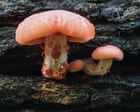
Raveley Wood is one of a chain of small, elm-rich woods along the Cambridgeshire fen edge. I’m here searching for wrinkled peach, a contender for Britain’s most beautiful mushroom: it has a salmon-pink cap, delicately wrinkled, and gills of the same shade.

Upwood, Cambridgeshire: This woodland is a stronghold for elm trees – and that brings the prospect of finding a stunning rarity, the wrinkled peach

Above me, a lively breeze moves through the tall elms, branches creaking between gusts. Most of the crowns look healthy, but a few stand skeletal against the sky, suggesting Dutch elm disease. Below them, the woodland floor is scattered with fallen trunks. I find pale bonnet fungi rising from the mossy bark and the frilled fans of tripe fungus. Where older logs have shed their bark, the exposed wood is marked by elm bark beetle etchings (or “galleries”) and the emergence holes of deadwood beetles.

Raveley Wood is one of a chain of small, elm-rich woods along the Cambridgeshire fen edge. I’m here searching for wrinkled peach, a contender for Britain’s most beautiful mushroom: it has a salmon-pink cap, delicately wrinkled, and gills of the same shade. Ruddy-orange, jewel-like droplets often gather on its stem, a process known as guttation.

Its fortunes follow the elm’s. Usually found on decaying, often barkless trunks, it was rare in Britain before Dutch elm disease struck in the late 1960s. For a decade or two it flourished among the dead trees. Now, with fewer mature elms remaining across Britain and Europe, it’s classified as “vulnerable”. But here, in Cambridgeshire’s elm woods, it persists.

Off the trampled path, I pick my way between fallen branches and low bramble, searching trunk after trunk. Underfoot, the clay still bears scars from the summer drought: fissures wide enough to turn an ankle. After the extreme summer weather, the fungus season seems reluctant to begin; many species are less abundant than usual. An hour passes. No wrinkled peach. I’m losing heart.

As I turn to leave, my heart leaps as the low afternoon sun catches a pink speck on an elm log. Less than a centimetre across, it’s the tiniest wrinkled peach I’ve ever seen. Its cap is barely wrinkled, but its slightly grubby stem holds a small cluster of sparkling droplets. I kneel in the leaf mould and lean close. Accounts describe a scent of peach or apricot, or no distinctive odour. I detect nothing.

Later in the season I may find a finer specimen. For now, this pink speck is beauty enough.

  • fungus
  • elm
  • bark
  • wood
  • country
  • diary
  • cambridgeshire
  • woodland

Summaries and tags are generated automatically. Stay informed with VidiaNews.

Related news

Cholera killed more than 3,000 this year – WHO
health

Cholera killed more than 3,000 this year – WHO

“The 2030 goal is achievable because the work is already under way,” Pezzoli added, pointing to the International Coordinating Group (ICG) on Vaccine Provision, which last year approved the supply of 71 million doses, funded by Gavi. Seven countries — Angola, Bangladesh, the DR Congo, Nigeria, South Sudan, Sudan and Yemen — accounted for about 90 percent of global cases and deaths last year.

Read →
WHO warns poor health data systems could delay lifesaving interventions across Africa
health

WHO warns poor health data systems could delay lifesaving interventions across Africa

NAIROBI, Kenya, Nov 10 – More than half of African countries assessed by the World Health Organization (WHO) are failing to adequately record deaths, raising concerns that preventable health risks could go undetected and delay interventions that could save lives. Conducted in 2024 across 40 of the WHO African Region’s 47 Member States, the assessment gave the region an overall health information system maturity score of 59 out of 100.

Read →
Africa’s health data must serve its people, not just technology providers – WHO
health

Africa’s health data must serve its people, not just technology providers – WHO

Every day, health facilities across Africa generate information about patients, diseases, medicines, births, deaths and the delivery of healthcare services. For Dr Benson Droti, Team Lead for Health Information, Knowledge Management, Digital Health and Artificial Intelligence at the World Health Organisation’s Regional Office for Africa, health data must serve the interests of the people and countries from which it is generated.

Read →
Climate change is becoming a matter of life and death for health systems – UN Climate Chief
health

Climate change is becoming a matter of life and death for health systems – UN Climate Chief

UN Climate Change Executive Secretary Simon Stiell has warned that climate change is increasingly threatening healthcare delivery, with extreme heat, flooding, power outages and disrupted transport putting patients and health workers at risk. Speaking during the Health Day Ministerial Roundtable Meeting at COP31 in Antalya, Türkiye, on November 9, 2026, Mr Stiell said climate-related pressures were exposing weaknesses in health systems, particularly in vulnerable communities.

Read →
Developing countries in limbo as rich nations delay new climate finance plans
science

Developing countries in limbo as rich nations delay new climate finance plans

Many governments are yet to set targets, leaving recipient countries struggling to plan and attract private investment Developing countries have been left in limbo by the failure of some of the world’s biggest economies to flesh out their plans for new climate finance. Poor countries are supposed to receive $300bn a year from the governments of industrialised nations by 2035, along with about $1tn from other sources, to help them cope with the effects of extreme weather and shift to a low-carbon future.

Read →