Richard Lloyd obituary
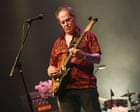
American guitarist and songwriter who was a founding member of the punk band Television When the New York band Television released their debut album Marquee Moon in February 1977, it provoked euphoria among critics, even if they were not quite sure how to describe it – punk, art-rock, new wave, post-punk, progressive or just rock were all terms flung in its direction.
American guitarist and songwriter who was a founding member of the punk band Television
When the New York band Television released their debut album Marquee Moon in February 1977, it provoked euphoria among critics, even if they were not quite sure how to describe it – punk, art-rock, new wave, post-punk, progressive or just rock were all terms flung in its direction.
It would frequently be described as an “influence” on countless acts who came after them, but Television’s music was too rare and sophisticated to be easily imitated, made as it was by a unique blend of musical personalities and instrumental skills.
Above all, it was the extraordinary twin-guitar interplay between the band’s frontman, Tom Verlaine, and Richard Lloyd, who has died aged 75 of cancer, that gave the band its inimitable character, along with a collection of songs that seemed both familiar yet mysteriously alien. It was rock’n’roll, but not as we know it.
Nonetheless, it could claim some familiar historical roots. Lloyd would recall how he had been inspired by seeing the Rolling Stones on TV’s Ed Sullivan Show, and the Stones remained a subliminal influence on Television.
“When the band was first formed I was a lead player, and it took a great deal of coaxing from Tom [Verlaine] to get me to play rhythm at all. He’d say stuff like, ‘Well, look at the Stones – Keith [Richards] just plays rhythm, and he’s the backbone of it, and there has to be a backbone.’” Learning how to integrate their contrasting guitar styles and musical roles effortlessly was key to the Lloyd-Verlaine partnership, illustrated perfectly in the title track of Marquee Moon.
The album failed to reach the US Billboard 200 chart, though it peaked at 28 in the UK. But its reputation has far outstripped its initial commercial performance, and it has subsequently appeared in countless “greatest albums of all time” lists.
Television’s second album, Adventure, appeared in 1978, and made the UK Top 10, though still failed to register on the US chart. It was a perfectly decent effort judged by normal standards, but Marquee Moon was the kind of lightning that could not strike twice. The group subsequently disbanded and Lloyd battled a heroin addiction that he eventually overcame in 1984.
In his memoir Everything Is Combustible (2018), the Pittsburgh-born Lloyd revealed that he was the son of John Alt and his wife, Virginia (nee Ewing). John made a living selling wristwatches in a strip club, while Virginia was a “soda jerk”, serving drinks in a restaurant. His parents separated when Richard was young, and Virginia moved to New York with her son. When his mother remarried, Richard adopted the surname of his stepfather, David Lloyd.
He would recall how he first became fascinated with the guitar aged seven. Attending a sleepover at a cousin’s house, he picked one up for the first time, and was so absorbed by the instrument that he shut himself in the bathroom and spent all night experimenting with it. In his teens he dabbled with playing the drums, before experiencing an epiphany-like moment when “an inner voice said, ‘You need to play a melody instrument.’ This was when I switched to electric guitar.”
Soon afterwards, he became good friends with a young musician named Velvert Turner, who was taking guitar lessons with Jimi Hendrix. He would teach Lloyd some of the technical tricks he had learned from Hendrix, and Lloyd met Hendrix a couple of times. When Led Zeppelin were in New York, Lloyd picked up further tips from Jimmy Page’s guitar technician. He expanded his musical education further by seeing concerts by leading bands of the era including the Doors, the Allman Brothers and the Grateful Dead, and he attended the 1969 Woodstock festival in upstate New York.
Determined to become a professional guitarist, he paid less attention to academic achievements, leaving Stuyvesant high school before graduation, then doing the same again at a school in New Jersey after his parents had moved there. Then, as he told ZigZag magazine in 1978, “I went to Boston, I went to Los Angeles, I did the usual sort of vagabond 20-year-old trip around America, and got to New York where I played guitar.”
He initially played a sunburst-coloured Fender Telecaster guitar, then subsequently settled on the Fender Stratocaster as his favoured instrument, the one that he would play on Marquee Moon and subsequently throughout his solo career. As he explained to Guitar Player magazine: “A Strat asks you to play a certain way; it demands a certain grasp. It’s just the way the neck is shaped, I guess. That kind of neck is really conducive to a certain kind of string-bending that you can’t get on most guitars.”
Lloyd had been lured back to the Big Apple by a developing new music scene featuring groups including the New York Dolls and Suicide. He met Tom Verlaine (real name Thomas Miller) and Richard Hell (originally Richard Meyers), who were in a band called the Neon Boys with the drummer Billy Ficca; they invited Lloyd to join and in 1973 the band became Television, achieving its definitive lineup when Hell was replaced on bass by Fred Smith (formerly with Blondie) in 1975.
Regular gigs at CBGB, a club that had previously only hosted bands playing in the country, bluegrass and blues styles that had given it its name, helped to build the band – and the venue – a cult following.
They released the single Little Johnny Jewel in 1975, on their own Ork Records label (named after Terry Ork, who had managed the group and helped support them financially in their early days). Then, after flirtations with Island Records, for whom they recorded demos with the producer Brian Eno, and Arista, Television were signed to Elektra Records in 1976.
After Television, Lloyd pursued a solo career that saw him release nine albums, from Alchemy (1979) to The Countdown (2108). He participated in Television’s reunions in 1992 (which produced their third album, Television) and 2001, but opted out of the 2007 tour marking the 30th anniversary of Marquee Moon.
He also featured as a session musician on albums by Matthew Sweet and John Doe (from the band X), and produced recordings by artists including Rocket from the Tombs and Jim Neversink.
He is survived by his wife, Sheila (nee O’Keefe), his son, Dylan, and brother, Eric.
- television
- richard
- lloyd
- obituary
- punk
- band
- rock
- guitarist