Netanyahu’s legacy: Personality politics reshapes Israeli democracy
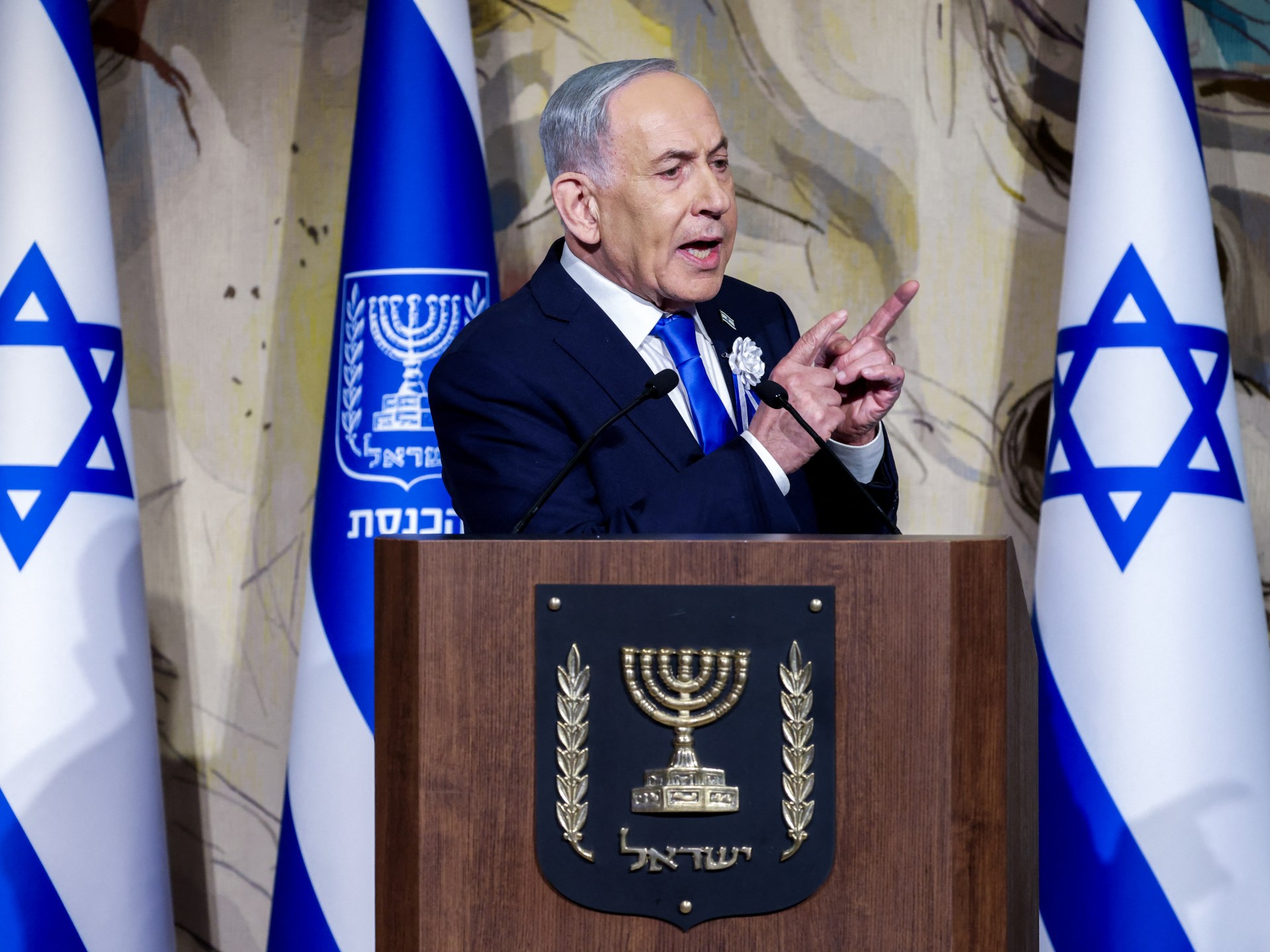
Netanyahu's fight for political survival turns the parliament's opening into a scene of insults and acrimony.
Prime Minister Benjamin Netanyahu called for a national unity government – at least among Jewish Israelis – during the swearing-in of Israel’s new parliament, or Knesset, on Tuesday, hoping to cling to power. The opposition to him, which now has a majority of seats but has yet to form a government, reacted with heckles, catcalls, and walkouts.
Citing supposed internal and external threats, Netanyahu called for unity with the opposition bloc that has been tasked with forming a government to replace him. Netanyahu pointed to the threat posed by Iran and the increased number of democratically elected lawmakers who are Palestinian citizens of Israel, whom he accused, without evidence, of seeking Israel’s destruction.
“We must do one thing – set aside every other consideration and form a national unity government. Only such a government will be able to meet challenges of this magnitude. It is impossible to handle them with a narrow government,” he said of the potential for a minority government that many analysts consider likely after coalition negotiations are complete.
“I say this because here in this parliament they are seriously talking about forming a narrow government like this, a government that includes within it terror supporters, haters of Israel, or that would be dependent on them,” he said, referring to the parties representing Palestinian citizens of Israel.
Even by the standards of Israeli politics, where analysts say personality has long overshadowed party and policy, Tuesday’s session was unusually contentious.
Former Prime Minister Naftali Bennett heckled Netanyahu while trading barbs with the latter’s wife, Sara, and his hard-right ally Itamar Ben-Gvir, while many of the Palestinian lawmakers attacked by the prime minister during his speech walked out in protest.
Gadi Eisenkot, who has been given the first chance to form a new government, subsequently cancelled previously scheduled coalition talks with Netanyahu and declared him “unfit for office”.
Netanyahu has long played an outsized role in Israeli politics, helping transform the political system into one that is highly based on personalities, with voters typically identifying a leader they like first, and then focusing on policy discussions. Nevertheless, despite having contributed more to that change than any other politician, Netanyahu now finds himself fighting for his political life.
If Eisenkot is able to form a viable new government – which still hangs in the balance – Netanyahu faces being frozen out of power, and a future in which his corruption trial continues without the protection of the prime minister’s office. There will also likely be an inquiry into his and his government’s failings in the run-up to the Hamas-led attack of October 7, 2023.
His potential downfall, however, does not mean an end to personality politics in Israel. Instead, it may be one of the most lasting parts of his legacy, said Roi Zur, an Israeli specialist in voting behaviour and election strategies at the University of Essex.
“Netanyahu Americanised the party system in Israel and made Likud a populist party,” he said of the influences the country’s longest-serving prime minister has had on Israel and his own party.
“It is a clear case in Israel that the person at the head of the list or the head of the party is very important, and politics evolve around the head of the party,” Zur said. “We see it in how people think about political parties or voting in general in Israel. When you ask people, ‘Who are you voting for?’, they say, ‘I vote for Netanyahu, I vote for Bennett, I vote for Eisenkot,’ whilst in the past it was ‘I vote for Likud, I vote for Labor,’ and so on.”
Dahlia Schneidlin, an American-Israeli pollster, noted that Israeli political campaigns had become more personalised in the past few decades even though elections in the country are almost all based on voting for a party slate, and not individuals.
That had led to many cases where voters focus on the personality rather than the party, and vote accordingly.
However, the Israeli electoral system almost always leads to coalition governments. And bringing other parties into a coalition often needs leaders to demonstrate “political neogitiating and bargaining skills”, Schneidlin said, as they try to encourage others to join them.
Eisenkot, Schneidlin said, will have to demonstrate those skills if he is to form a government, rather than simply being focused on his own personality.
But the emphasis on differences in political personality over policy positions has fuelled a culture where personal differences, such as those between Netanyahu and opposition stalwart Avigdor Lieberman – whose shared animosity is well known but whose right-wing political positions are in some ways very close – contribute to a populist politics easily understood by a public eager to see itself as politically engaged.
“The stress on the personal makes everything so much worse,” Yossi Mekelberg, a senior fellow at Chatham House, said. “With party structures so centralised, leaders can become almost dictatorial and get to act without constraint. This is how it becomes possible for a prime minister to accuse 19 elected members of the Knesset of being terrorist sympathisers and nobody thinks it’s extraordinary. It’s become toxic,” he said.
- netanyahu
- legacy
- personality
- democracy
- politic
- fight
- survival
- parliament