Oil: Nigeria cautions Namibia against host community neglect
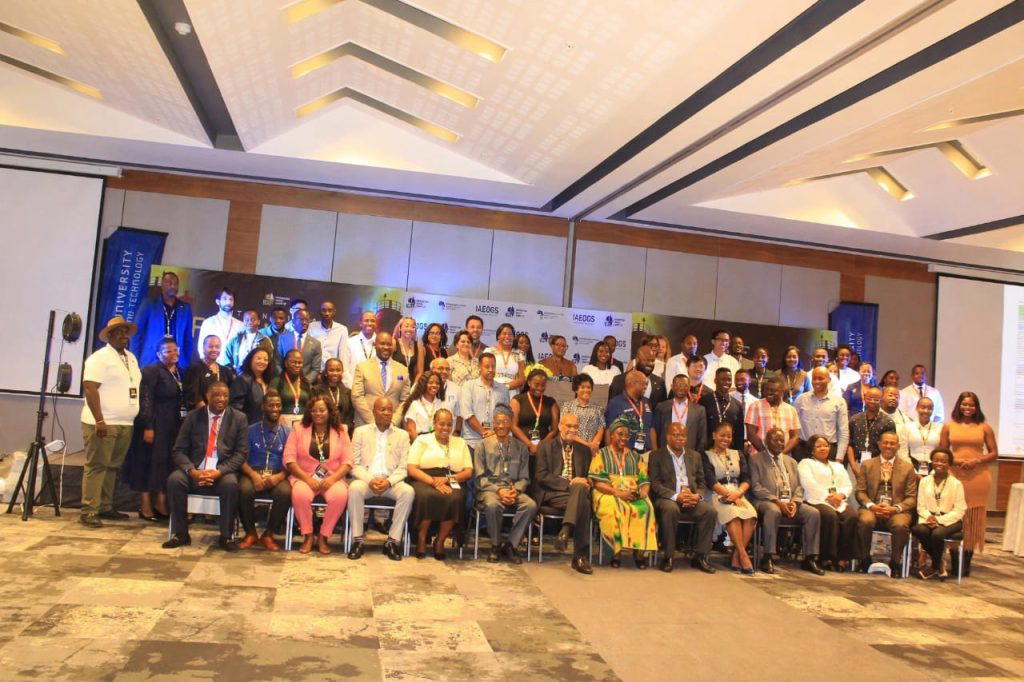
By Folarin Kehinde Nigeria has urged Namibia to establish clear policies on host community benefits, local content development and environmental protection before commencing commercial oil production, warning the emerging oil-producing country against repeating the challenges that have characterised Nigeria’s petroleum industry. Nigeria’s High Commissioner to Namibia, Ambassador Esther Adebola Arewa, gave the advice while delivering the keynote address titled: Nigeria-Namibia at the 5th International African Energy, Oil and Gas Summit in Windhoek, Namibia.
By Folarin Kehinde Nigeria has urged Namibia to establish clear policies on host community benefits, local content development and environmental protection before commencing commercial oil production, warning the emerging oil-producing country against repeating the challenges that have characterised Nigeria’s petroleum industry. Nigeria’s High Commissioner to Namibia, Ambassador Esther Adebola Arewa, gave the advice while delivering the keynote address titled: Nigeria-Namibia at the 5th International African Energy, Oil and Gas Summit in Windhoek, Namibia.
Arewa said Namibia could draw important lessons from Nigeria’s nearly seven decades of oil exploration, particularly its experiences with gas flaring, community grievances, regulatory uncertainty and inadequate local participation. She urged the Namibian government to make adequate provisions for communities in oil-producing areas before the first barrel of crude oil is produced.
“Decide now, before the first barrel, how the people of ǁKaras and the coastal towns will share in this, and write it down,” she said. The envoy stressed that establishing trust with host communities before production begins would help prevent conflicts and costly disputes in the future. “It is far cheaper to build trust before production than to buy back peace afterwards,” she added.
Her warning comes as Namibia advances petroleum exploration in the Orange Basin, which has attracted significant international interest. Arewa identified gas utilisation, regulatory certainty, local content development and host community participation as four major lessons Namibia should draw from Nigeria’s experience. On gas utilisation, she said Nigeria had wasted substantial quantities of associated gas through flaring for decades but had made progress in reducing the practice.
She disclosed that nearly 93 per cent of the gas produced in Nigeria in the first half of 2026 was put to use, while the country’s gas reserves stood at about 215 trillion cubic feet. She said Nigeria was willing to share its technical expertise with Namibia, particularly in managing associated gas from offshore petroleum operations. On regulatory reforms, Arewa recalled that Nigeria spent more than a decade debating comprehensive petroleum legislation before the Petroleum Industry Act was enacted in August 2021.
According to her, the prolonged uncertainty affected investor confidence and drove some investors away. “Investors waited. Some of them left. Certainty, even imperfect certainty, is worth a great deal,” she said. The High Commissioner also cited Nigeria’s local content policy as an example of how deliberate government intervention could increase domestic participation in the oil and gas industry.
She said Nigerian content in the petroleum sector rose from about 26 per cent in 2016 to 61 per cent in 2026, with a target of 70 per cent. She attributed the growth to regulatory enforcement, dedicated funding, industrial parks and investment in technical training. On host community relations, Arewa recalled the experience of Oloibiri, where commercial oil production began in Nigeria, noting that the community had received little benefit despite its contribution to the country’s oil wealth.
She said the Petroleum Industry Act introduced a requirement for oil companies to contribute three per cent of their annual operating expenditure to host community development trusts. “We should have done it fifty years earlier,” she said. Arewa further advised Namibia to protect critical infrastructure, including pipelines, electricity installations, railways and telecommunications facilities, from vandalism and sabotage.
She said pipeline theft and vandalism contributed to Nigeria’s oil production decline to about 1.1 million barrels per day in 2022 before output recovered to above 1.7 million barrels per day. She stressed that host communities should be involved in protecting such facilities rather than treated merely as beneficiaries of government interventions. Beyond the petroleum sector, the envoy called for stronger economic cooperation between Nigeria and Namibia, lamenting the low level of trade between the two countries despite their longstanding diplomatic relations.
She disclosed that Namibia exported goods worth about $11 million to Nigeria in 2023, while Nigeria’s exports to Namibia were below $2 million. “That is not yet a trading relationship. It is a courtesy,” she said. Arewa proposed the revival of Nigeria’s Technical Aid Corps programme to facilitate the exchange of petroleum engineers, geoscientists, metallurgists, environmental specialists and other professionals between both countries.
Meanwhile, Vice-Chancellor of the Namibia University of Science and Technology, Professor Frednard Gideon, said Africa’s problem was not a shortage of energy resources, land or expertise, but inadequate governance, financing and public trust. He warned that energy development without secure land rights could lead to displacement
- nigeria
- oil
- namibia
- community
- host
- gas
- petroleum
- arewa