Gadi Eisenkot campaigns on Moroccan roots in challenge to Netanyahu
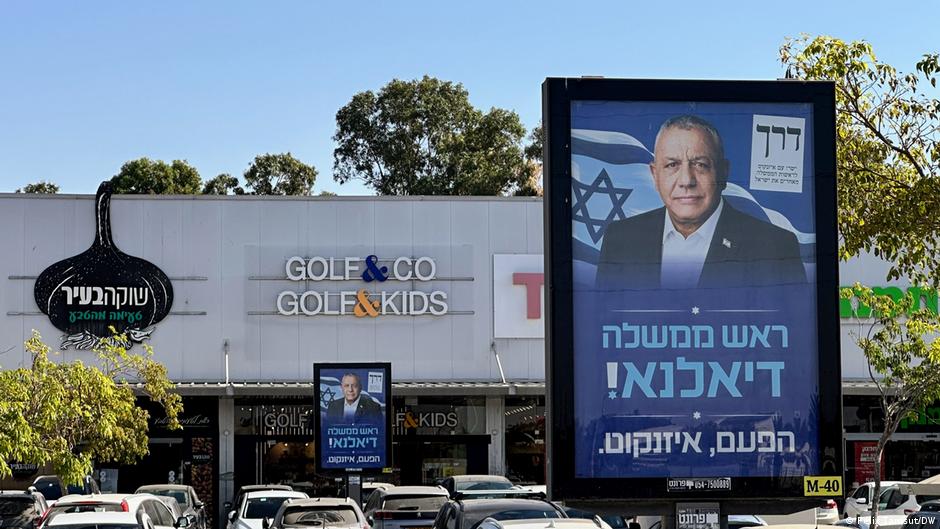
As Israel prepares to vote, Gadi Eisenkot is leveraging his Moroccan heritage in Likud strongholds such as Sderot. From historical divides to October 7, identity and trauma are redefining the city's political loyalties.
Ahead of Tuesday's elections, party advertisements greet people arriving by train to the outskirts of the western Israeli city of Sderot.
Campaign posters with various slogans promote the right-wing Likud and the far-right Otzma Yehudit parties. However, one poster is seen more than any others: that of's liberal Yashar party.
Its slogan, "Rosh Memshala Dialna," combines the terms "prime minister" in Hebrew and the words "of our own" in Moroccan Arabic.
And there is a good reason why Eisenkot's campaign in Sderot and other cities on Israel's sociopolitical periphery focuses on his Moroccan roots.
Sderot — located in the Negev desert, about 75 kilometers (45 miles) to Tel Aviv's south and just a kilometer away from the Gaza border — is a city with a large Moroccan Jewish community. In recent decades, the city has become symbolic of Moroccan-Jewish culture in Israel, finding its expression in music, cinema and state politics.
Historically, Sderot is considered a bastion of the Israeli right, and especially a stronghold of Prime MinisterBenjamin Netanyahu's Likud. In 2022, Likud received more than 40% of the votes in Sderot, compared with 23% nationwide. Other members of Israel's far-right coalition received a lot of support there in the last election.
This pattern reflects deeper historical divisions in Israel between Ashkenazim, or Jews of European origin, and Mizrahim, or Jews mostly from Middle Eastern and North African backgrounds. According to estimates, half of Israel's Jewish population is of Mizrahi origin, amounting to about 4 million people.
Mizrahi Jews have faced discrimination and neglect since the early days of the Israeli state. This inequality still shapes the economic and social reality in Israel ― and its political discourse.
The issue has received special attention in the 2026 campaign. Eisenkot, Netanyahu's major challenger, is of Moroccan origin and grew up in Eilat, a city with a large North African Jewish population. Eisenkot's Yashar party accused Likud of sidelining its Mizrahi politicians. The campaign slogan, "Netanyahu: Let the Mizrahim give interviews,” mocked that omission.
On live television, the right-wing journalist Yinon Magal — one of Netanyahu's most vocal supporters — claimed that Eisenkot was being controlled by elitist Ashkenazim and called him a "monkey."
Netanyahu, who is of European origin, condemned the remark.
Morocco-born Daniel Ben-Simon, an award-winning Israeli journalist and a former member of parliament, told DW that Eisenkot's embrace of his roots might have been forced upon him by Magal's comments — but it has historical value nevertheless.
"People don't use terms like 'Dialna' with pride," Ben-Simon said, referring to Eisenkot's embrace of the Arabic term "of our own" in campaign posters. He said Israeli society had long tried to erase the Arab identities of North African Jews.
Eisenkot's embrace of his identity serves as a way of "leaving the frame" set by society. "By using such a term, you're creating a new identity: an Israeli-Moroccan identity," Ben-Simon said. "Eisenkot is the first to allow this double identity to be expressed and still feel at home."
After Israel's founding, the ruling socialist party, Mapai, whose leadership was largely Ashkenazi, pursued discriminatory policies against Mizrahim. Mizrahim were often expected to "Europeanize” rather than preserve their own culture, heritage, or Arabic language.
These inequalities also took a material form. In the state's early decades, while European immigrants often received better housing and jobs, many Jews from Arab-speaking countries were sent to Ma'abarot, or temporary transit camps, often in remote areas with little infrastructure. Many later became "development towns,” which remained underfunded compared with Israel's central regions. That in turn resulted in poverty. Sderot, in the south, is one of the best-known development towns.
For many Mizrahim, limited access to jobs, education and infrastructure symbolized long-standing exclusion by the Mapai establishment. Likud, founded as a right-wing alliance in 1973, used this frustration effectively under Menachem Begin. Mizrahi support for Begin helped produce the Mahapach, or upheaval, when Likud first defeated the socialist camp and took power. Since then, Mizrahim have often been associated with Likud, even though the party has never had a Mizrahi leader.
Over the past two decades, Sderot's proximity to Gaza has made the city a frequent target of rocket attacks launched by the militant group Hamas. During the Hamas-led terrorist attacks on October 7, 2023, the city of Sderot was hit especially hard. More than 50 people were killed. In the three years since the attack, the city's population has grown by about 5,000 people, bringing it to 40,000, with many young families making the town their home, both as a result of idealism and government benefits.
Walking around the town, it's hard not to notice that the so-called national-religious community is becoming increasingly dominant. This community tends to vote for Bezalel Smotrich's far-right Religious Zionism party, a main member of Netanyahu's coalition. Though votes for Smotrich and his party are de facto votes for Netanyahu's bloc, the prime minister's Likud party itself could suffer losses in Sderot.
Regardless of the election's results, the perception of Sderot as a city of Moroccan Jews is not bound to change anytime soon. Ben-Simon said Eisenkot's election could serve as an opportunity for reshaping Moroccan Jews' future identity in Israel.
"The connection cities like Sderot have to their Moroccan roots would grow stronger as a result of an Eisenkot win," Ben-Simon said.
- gadi
- eisenkot
- challenge
- netanyahu
- root
- israel
- heritage
- likud