Pork fat, a heating pad and a five-storey jump: how a 74-year-old escaped house arrest in Argentina

Leonardo Bertulazzi, ex-member of Italy’s radical far-left Red Brigades, fled in dramatic fashion, ‘like something out of a movie’ As dozens of police and sniffer dogs poured into San Telmo, a traditional Buenos Aires neighbourhood with cobblestone streets, on Tuesday morning, one of the clerks at a shop selling dulce de leche asked them why. “An Italian mafioso, right?”
Leonardo Bertulazzi, ex-member of Italy’s radical far-left Red Brigades, fled in dramatic fashion, ‘like something out of a movie’
As dozens of police and sniffer dogs poured into San Telmo, a traditional Buenos Aires neighbourhood with cobblestone streets, on Tuesday morning, one of the clerks at a shop selling dulce de leche asked them why. He said they were “looking for a bomb”.
It was only later that she found out there was no danger of being blown up after all, and that authorities were, in fact, hunting for a fugitive. “An Italian mafioso, right?” she asked.
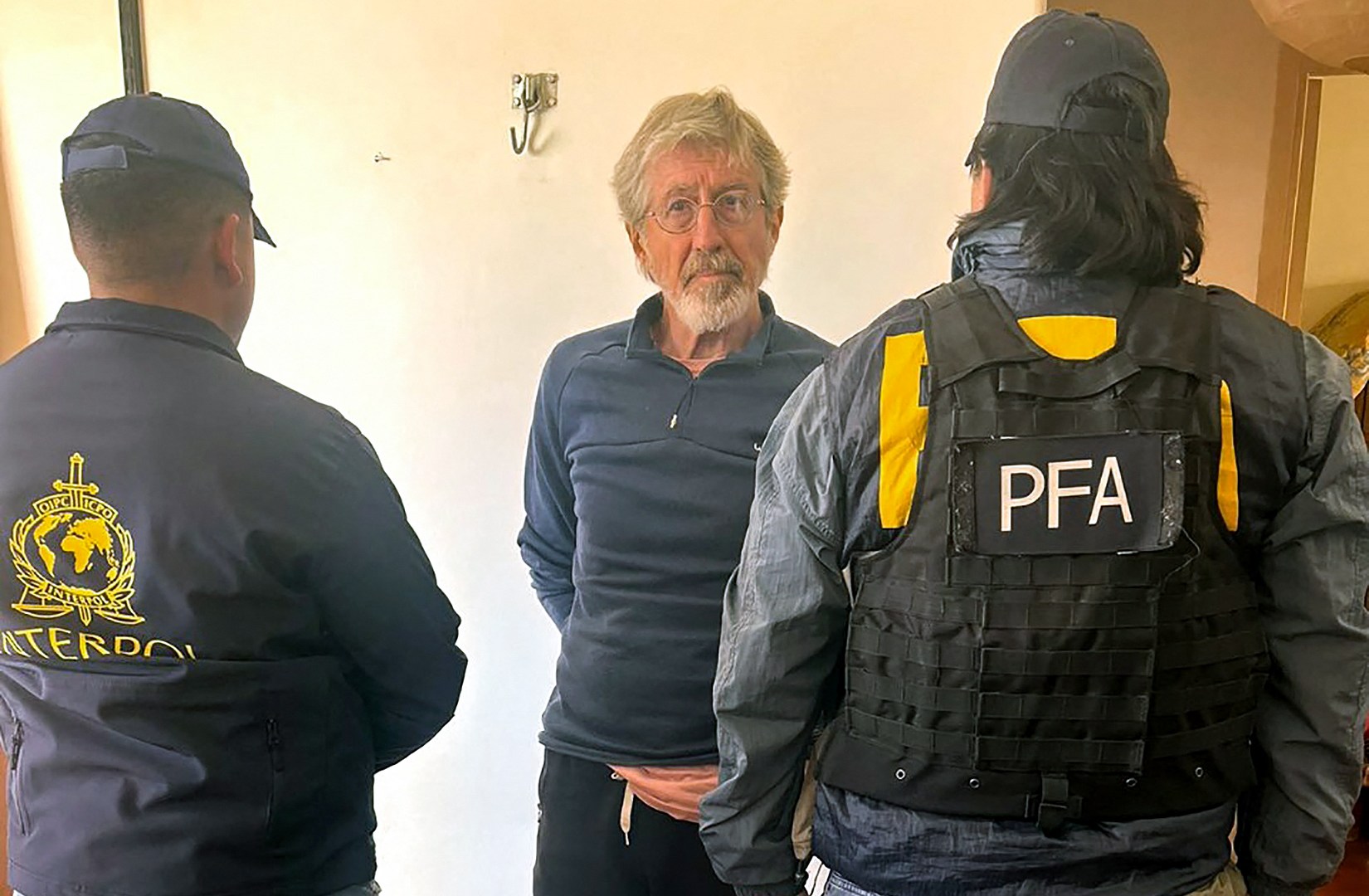
The escapee was no mobster, exactly: he was Leonardo Bertulazzi, 74, a former member of Italy’s radical far-left militant group the Red Brigades, who had been living under house arrest in Argentina after his arrest in 2024, awaiting extradition to Italy to serve a 27-year sentence.
On Tuesday, however, the 74-year-old escaped from house arrest in dramatic fashion.
“It was like something out of a movie,” said a person with knowledge of the investigation who asked to remain anonymous.
At around 6am, when most security forces “were focused on the Pope’s security” as the pontiff was visiting Argentina, Bertulazzi cut off his ankle monitor, the source said. In order to bypass its temperature and pressure sensors, Bertulazzi apparently wrapped it in a tube with pork fat and left it next to a heating pad.
He then rappelled down from his apartment’s fifth floor, jumped in to a vacant lot behind the building, and then scaled a metal gate to reach the street.
Two weeks prior, an alert in the ankle monitor’s system had gone off, indicating that he might have been tinkering with the machine. On Tuesday, police noticed his ankle monitor had stopped transmitting movement data entirely, and headed to the house – only to find him missing.
“He knew exactly what he was doing”, said the source. “After all, he’s a guy who worked in logistics for the Italian brigade.”
Indeed, Bertulazzi once held a senior position in the Red Brigades, an organization responsible for a series of attacks throughout the 1970s, dubbed Italy’s “Years of Lead”. The group most notoriously kidnapped and assassinated former prime minister Aldo Moro in 1978.
He had been sentenced in absentia on terrorism charges in Italy in 1985 and 1997 and was living in Argentina in 2002 when, after years on the run, Bertulazzi was first arrested by Argentine authorities. He was freed a few months later, and in 2004 he secured refugee status. But it was revoked two years ago, and he was arrested again and put under house arrest, for health concerns. Italy’s rightwing prime minister, Giorgia Meloni, framed the move as a significant political win made possible by her government’s close relations with Argentina’s president, Javier Milei.
After he fled, Italy’s interior ministry undersecretary, Wanda Ferro, said Argentinian police were responsible because they were “supposed to ensure surveillance and the handover [of Bertulazzi] to the Italian authorities”, and urged his swift reapprehension. On Wednesday, Argentina’s security ministry offered a $13,000 reward for information leading to Bertulazzi’s recapture.
The Italian press has reacted to the escape with bemusement, noting his ability to abseil from a fifth-floor balcony despite the 74-year-old’s supposedly poor health – which his lawyer, Rodolfo Yanzon, had used as a reason to argue he couldn’t board a plane back to Italy. Bertulazzi, Yanzon said, suffered three strokes during his two years in detention, and had difficulty walking. He said he told his client on Monday that the judge would not authorise medical testing, however – which he suspects inspired Bertulazzi to flee before he could be extradited. “That was the last thing I said to Bertulazzi,” he added. “He undoubtedly made the decision to prioritise his freedom over his health.”
In an interview with La Repubblica, Bertulazzi’s daughter, Claudia, said he “had no choice” but to flee after an Argentinian court on 3 November rejected his appeal to keep his refugee status, and that he feared spending “the rest of his life in prison” in Italy.
Bertulazzi fled the country in 1980 after being found guilty in the kidnapping of shipowner Pietro Costa, generating a ransom that was allegedly used to fund the Red Brigades’ terrorist activities and to buy a flat in Rome where Moro was held captive. A court in Genoa sentenced him to 27 years in prison.
For years, a complex legal situation meant Bertulazzi could live as a free man in Argentina despite being wanted in Italy. He was arrested in 2002 in Buenos Aires after a joint investigation with Interpol, but was released eight months later because his Italian trials had been held in absentia, preventing his extradition.
Claudi said her father doesn’t fear a retrial: “Partly because, under current laws, we are convinced the only charge that would remain is of participating in an armed group, a charge he has never denied and for which he would accept responsibility.”
She also said she last spoke to her father two days previously and only learned of his escape through the media. “He removed his electronic ankle monitor and lowered himself from the fifth floor using a harness. It’s plausible: he was a mountaineer.”
- pork
- fat
- heating
- pad
- jump
- house
- arrest
- argentina