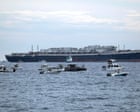
From ocean legend to undersea reef: Why has the SS United States been sunk?

The ship had been inactive for years despite various owners attempting to save and restore it.
The historic SS United States ocean liner has taken its final trip, this time to the bottom of the ocean, as it becomes part of an artificial underwater reef.
The nearly 1,000-foot (302m)-long vessel, the fastest ocean liner in the world, was sunk on Wednesday after its hull was hollowed out to ensure it remains on the ocean floor, in a process also known as scuttling.
Over five hours, the ship gradually filled with water and, in its final moments, tilted to its side and sank to the bottom of the Gulf of Mexico off the coast of Destin, Florida.
The vessel will now feature as part of the world’s largest artificial reef, which is expected to become a popular diving destination.
Built between 1950 and 1951, the ship was larger than the Titanic, which was 882 feet nine inches (269.1 meters) long. The SS United States was known for its speed, strength and luxury.
Officially launched in 1952, the vessel made history by setting a transatlantic speed record during its first trip, crossing the Atlantic in three days, 10 hours, and 40 minutes at an average speed of 35.59 knots (almost 66km/h). The ocean liner’s record has yet to be broken by another passenger liner.
During 17 years of operation, the SS US carried thousands of passengers, including former Presidents John F Kennedy, Bill Clinton, Harry Truman and Dwight Eisenhower.
Hollywood stars Marilyn Monroe, Elizabeth Taylor and Marlon Brando also graced the ship, as did surrealist painter Salvador Dali and jazz musician Duke Ellington.
With the advent of air travel, the ship’s career came to an end in 1969.
The ship had been inactive for years and remained docked in Philadelphia as various owners attempted to save and restore it.
However, the costs of maintaining the vessel mounted. In 2021, Philadelphia port authorities raised the daily dockage fee to $1,700, which the nonprofit SS United States Conservatory could no longer afford.
In 2024, Florida’s Okaloosa County bought the ship for $1m, with plans to transform it into the world’s largest artificial reef.
According to the county’s website, the ship underwent a yearlong process to ensure it would be environmentally safe to sink as an artificial reef, and the county said it followed all standards set by regulatory agencies.
“Artificial reefs prepared in this way are a benefit to the marine ecosystem, not the other way around. They create habitat that did not previously exist and foster the development of a diverse environment that can thrive for the overall health of the environment that benefits marine life, our fishing industry and tourism as a whole,” a statement from the county says.
The forming of the world’s largest artificial reef is expected to attract wreck divers to the site, creating more tourism opportunities for Florida.
There are an estimated three million shipwrecks lying on sea and ocean floors around the world, according to a 2007 report from the United Nations Educational, Scientific and Cultural Organisation.
Many are reclaimed naturally by marine life and are used by coral, eels and snappers as homes.
While some ships are sunk through disaster, others are deliberately sunk to begin reef deployment and attract fish.
Preparation for the sinking of ships is extensive, as harmful substances including paint, wiring and fuel must be removed before they can safely become part of marine life.
Eventually, a sunken ship’s facade will be unrecognisable, with marine life such as fish, barnacles, and crustaceans all inhabiting or using the vessel.
Besides other decommissioned ships which have been deliberately sunk, oil rigs, radio towers and train boxcars have also been used to make artificial reefs on which fish and other marine life can thrive.
More than 600 oil rigs and gas platforms previously installed on the US outer continental shelf were used as part of a 1984 US programme called “Rigs to Reefs” in the Gulf of Mexico.
Other materials have also been used to make artificial reefs, including log huts, household goods such as fridges and shopping trolleys, and even retired New York City subway cars.
Last year, one of the world’s largest artificial reefs was installed around the base of a single wind turbine off the Sussex coast in England. It is made up of 75,000 specifically designed, low-carbon, concrete reef cubes, each with a central chamber and an outer honeycomb texture to encourage marine life to use them.
The cubes were also designed to help the wind farm withstand erosion by acting as a barrier against sea currents and wave energy, slowing sediment that could scour the base.
In Australia, the Queensland Government established its eighth artificial reef in Moreton Bay Marine Park in 2018, using concrete blocks.
Under the official government programme, the first of these reefs expanded the existing Harry Atkison artificial reef, established in 1975 using old car tyres, in 2008 by deploying granite boulders to create new habitats for small fish.
In 2011, the East Coochie Artificial Reef was established using “reef balls” made of hollow concrete; the Wild Banks Artificial Reef was formed by deploying “fish caves”, which are structures made from steel designed to attract more fish species.
In 2011, the South Stradbroke Artificial Reef was also established, and 20 “fish boxes” – cubes with a cross brace made from reinforced concrete – were deployed.
In 2015, the North Moreton Artificial Reef was established in Australia, also using fish boxes. The same year, the Turner Artificial Reef was established, and concrete clusters were deployed.
In 2010, the West Peel Artificial Reef was formed using reef balls.
In 2000, the Mexican government sank two World War II-era decommissioned minesweepers – small warships – and established an artificial reef in the Caribbean marine area.
- ocean
- legend
- reef
- united
- states
- ship
- owner