Meet Ilaro Poly graduate Tunji Adaramola leading power system rebuild on US self-driving car project
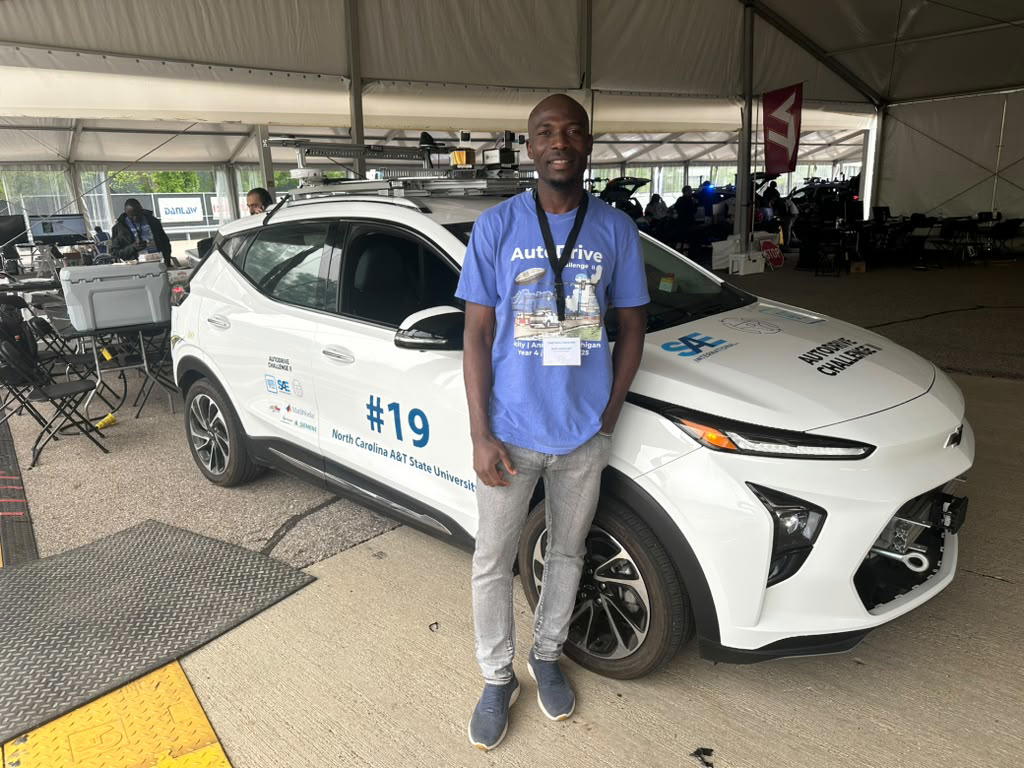
By Ayo Taiwo A Nigerian electrical engineer, Tunji Semiu Adaramola, has led the rebuild of a critical power panel on the autonomous electric vehicle developed by North Carolina A&T State University for the SAE International AutoDrive Challenge II, a competition in which university teams convert a production electric car into a self-driving vehicle. Tunji, a graduate of The Federal Polytechnic, Ilaro, Ogun State, serves as Electrical Engineer for Electric Vehicle Integration on the university’s team in Greensboro, North Carolina.
By Ayo Taiwo A Nigerian electrical engineer, Tunji Semiu Adaramola, has led the rebuild of a critical power panel on the autonomous electric vehicle developed by North Carolina A&T State University for the SAE International AutoDrive Challenge II, a competition in which university teams convert a production electric car into a self-driving vehicle.
Tunji, a graduate of The Federal Polytechnic, Ilaro, Ogun State, serves as Electrical Engineer for Electric Vehicle Integration on the university’s team in Greensboro, North Carolina. The role covers the electrical systems on which the vehicle’s self-driving equipment depends. The power panel had been overheating, a fault that undermined the reliability of the vehicle’s electrical system.
Tunji, it was gathered, led the reconstruction of the panel and coordinated the work with the team’s mechanical engineers. The rebuild eliminated the overheating and restored the reliability of the electrical system. “The repair carries more weight on a self-driving vehicle than on a conventional one. An autonomous car relies on sensors and onboard computers that need stable power for as long as the vehicle is in motion, so a fault in power distribution is a safety matter as well as a maintenance one,” Tunji said.
The AutoDrive Challenge II is sponsored by SAE International, the engineering standards body, and General Motors. Ten universities in the United States and Canada were selected when the competition was announced in 2021. General Motors supplied each team with a Chevrolet Bolt EUV, an electric vehicle, as the base platform. The teams were asked to design and integrate their own autonomous driving systems, with the aim of navigating an urban driving course at Level 4 automation under the SAE J3016 standard.
At that level, a vehicle is expected to drive itself within defined operating conditions without a human taking over. The teams meet for annual competitive events at vehicle test facilities in the United States. North Carolina A&T entered the second edition with a record from the first. Its team, Aggie Autonomous Auto, completed the original four-year AutoDrive Challenge in June 2021, and the university reported that the result earned it a place in the follow-on competition.
Beyond the power panel, Tunji directed the design and implementation of a real-time blue-light safety alert for the vehicle. The system was built with the Python programming language and embedded systems, and was designed to improve the operational safety of the autonomous vehicle. He also produced the wiring diagrams and electrical subsystem documentation for the vehicle, prepared in line with SAE requirements so that the integration is safe and can be maintained.
Such records matter on university teams, where members graduate and their successors must service systems they did not build. Taken together, his assignments on the vehicle span power hardware, safety software and engineering documentation. Tunji completed his studies in Electrical and Electronic Engineering at The Federal Polytechnic, Ilaro, in October 2016.
He is currently pursuing a Master of Science in Electrical and Computer Engineering at North Carolina A&T State University.
- system
- tunji
- power
- vehicle
- team
- university
- ilaro
- car


