What's going on with the polar vortex?
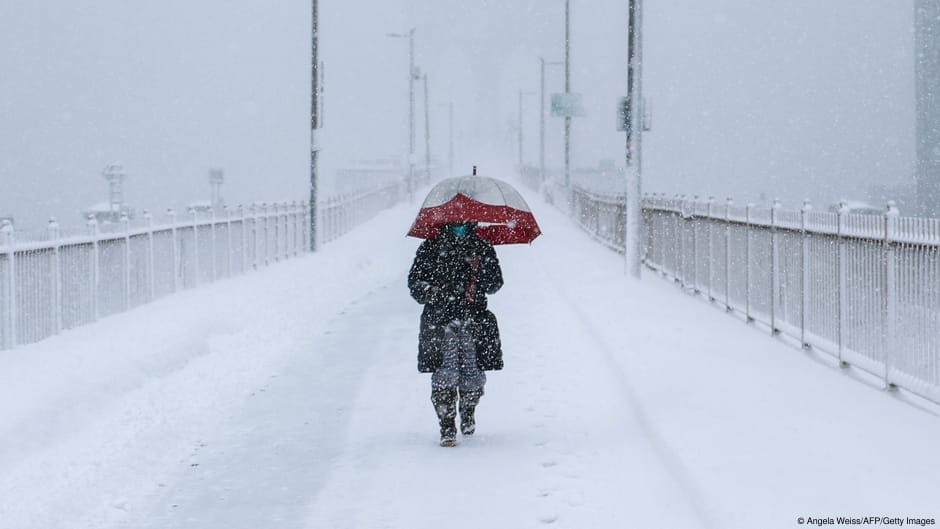
Observations show the ring of fierce winds that rotate at the Earth's North Pole has changed direction. What could it mean for the weather?
High up in the atmosphere, there's a ring of cold air swirling over the Arctic that can intensify, weaken, and shapeshift through the seasons. This is the polar vortex.
If it gets disrupted, this twisting pool of chilly air can influence the weather we experience, increasing the risk of a cold snap in the Northern Hemisphere.
Current observations show the vortex has weakened unprecedentedly early this year, with its winds reversing directions.
It's not yet clear how the current disruption to the polar vortex will affect the Northern Hemisphere winter, but scientists agree it is a record-breaking event.
"As far as we know, this is the earliest stratospheric vortex disruption that has been observed," European Centre for Medium-Range Weather Forecast (ECMWF) principal scientists Tim Stockdale and Frederic Vitart told the AFP news agency.
The French meteorological agency Meteo-France, meanwhile, called it "an unprecedented event."
The early breakdown of the vortex "really increases the chance of cold air outbreaks across the latitudes where most of the densely populated population centers are across the Northern Hemisphere, US, Europe and East Asia," Judah Cohen, a climatologist at the Massachusetts Institute of Technology told AFP.
The polar vortex is an enormous band of cold, low-pressure air that spins counterclockwise around the North Pole, about 10 to 50 kilometers (around 6 to 30 miles) above the surface.
It's closely connected to the jet stream, another band of powerful winds just below the vortex. The jet stream forms a boundary where the cold Arctic air meets warmer air from the tropics and subtropics.
The vortex can sometimes be a tight circle, keeping the coldest air locked around the North Pole over winter. It can also form uneven waves that dip southwards. And as it changes in strength and shape, that can influence the atmosphere below and alter the position of the jet stream, which drives the weather on the ground.
So, if the jet stream is more "wavy," and plunges south, it may also allow freezing Arctic air to spill southward.
One of the biggest influences that can provoke this kind of disruption is known as "sudden stratospheric warming." This is when temperatures in the polar stratosphere rise dramatically within a few days, causing the vortex's strong westerly winds to weaken.
This can push the vortex off its spot at the North Pole, make it split apart into multiple rings, or — as is happening now — cause the westerly winds to change direction.
It can take several weeks for the vortex to recover.
A previous polar vortex disruption contributed to the deadly Great Texas Freeze in February 2021, which caused more than a week of freezing temperatures that sparked power outages and killed hundreds of people.
But bone-chilling cold isn't a foregone conclusion. The Met Office, which is the UK's national weather and climate service, stresses that what's happening with the polar vortex can nudge odds in that direction, but it's not a switch that turns cold weather on and off.
Other weather patterns can also influence the outcome.
For example, there's a possibility El Nino, which is associated with milder winters, could "moderate or modify" the impacts, Cohen told AFP. But he added this was not certain.
The El Nino weather phenomenon, caused by the warming of surface temperatures in the central and eastern equatorial Pacific, is currently intensifying and is expected to peak at the end of the year. The ongoing event has been classified as exceptionally strong and is disrupting weather around the globe.
Some research has also linked the rapid warming of the Arctic driven by climate change to increasing disruptions to the polar vortex. That means that, even as the planet warms, some areas may still experience more severe cold spells. But this connection is not conclusive and is still debated by scientists.
- vortex
- observation
- ring
- wind
- earth
- north
- pole
- direction