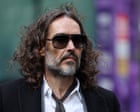
I saw how brightly stars like Russell Brand could shine, but there is darkness in the shadows

We never really know them – we know what they want us to know As I sat in Southwark crown court, listening to the final day of Russell Brand’s trial, there was one subject that came up repeatedly, invoked as often by his defence as the prosecution. So it was doubly strange to sit in court and feel somehow complicit in it - in how this media culture had encouraged Russell Brand.
After years of celebrity interviews, I have learned not to be fooled by the allure of fame. We never really know them – we know what they want us to know
As I sat in Southwark crown court, listening to the final day of Russell Brand’s trial, there was one subject that came up repeatedly, invoked as often by his defence as the prosecution. I don’t mean sex or coercion, but fame. It ran through every victim impact statement and loomed so large in the courtroom that it felt as if it was almost on trial itself.
I’m an entertainment journalist who has been covering celebrities for more than 20 years – as long as Brand has been one – and I have written about him at various stages of his career. But I went to Southwark crown court as a member of the public who wanted to see justice done. For the women he had hurt, for the ones who couldn’t get as far as the courtroom, and for all of us who came of age at a time when rape culture was so fast and furious that young women mistook it for a joke that we were in on. In the age of lads’ mags, sex felt cheapened, yet somehow we were the ones who ended up paying for this. So it was doubly strange to sit in court and feel somehow complicit in it - in how this media culture had encouraged Russell Brand.
I interviewed Brand in 2011 for a glossy magazine when he was promoting his remake of the film Arthur, with Helen Mirren. They were to be interviewed together, and an editor told me that if I accepted this freelance commission I would need to “muck about a bit and basically be into Russell Brand’s humour”.
When I played back the tape this week, I heard the me of 15 years ago asking Mirren if she had read his book (“No,” she hadn’t). Brand and I both pressed her. Had she really not read the chapter in Booky Wook 2 in which he outlines what he would like to do to her with her Oscar. “You have, I read it to you, the chapter’s called ‘Mummy Helen’,” he insisted. On the tape, he and I are both laughing while she is not. She was too dignified to play the game, saying she hadn’t been sure about joining his film project “because Russell is intimidating”. Yet we both ploughed on at her. I struggle now with how inappropriate this behaviour was – it’s mortifying. But it was what the job entailed.
Fast forward to Brand’s sentencing in court, where I listened intently to the victim impact statements from the women he was found guilty of attacking, each one stressing that recovering from his attacks had been rendered almost impossible by seeing him doing things such as joking about his sex drive every time they turned on the television or picked up a paper. I shuddered again. No, I’d had no idea what darkness he was capable of.
By 2014, when he turned to politics, I did at least write a piece about him in which I said he had, by now, “grabbed a thousand women as if they were lifeboats made of tits” and was trying to overthrow democracy “with a revolution fashioned from leftover bits of the internet and some string”, so at least my judgment had improved somewhat.
But he’s not the only interviewee whose darkness has been right there in front of me, hiding in plain sight. In 2007, I spent the day with Jared Leto, an actor who would go on to win an Oscar but who was then playing with his emo-rock band, 30 Seconds to Mars. I spent the day with him, his bandmates and various young women, some of them teenagers, who had flown into London from across Europe to see their hero play live. The girls who got to meet him seemed unworldly, wildly overexcited and close to fainting in his presence, and while I found his vibe intense to the point of weirdness, I never imagined he’d have any interest in these geeky fans. In 2026, he was accused by four women of criminal sexual conduct, with the alleged offences taking place when the women were teenagers. These are allegations he vigorously denies.
And now the spotlight is on David Walliams (who I’m relieved never to have worked with), after this week’s accounts from the women who had relationships with him as teenagers and now consider it grooming. He, too, denies any wrongdoing, beyond hurting their feelings. Walliams had sold £156m-worth of books in the UK alone, which is presumably why his industry protected him for so long.
Celebrities are surrounded by layers of people. When you interview one, people often imagine that you would have their phone number, but this is rarely the case, as that meeting will have been set up by a whole paper chain of intermediaries, which often include the star’s publicist, agent, manager and assistant. If there’s a photoshoot, you’ll be given a callsheet with numbers of the hair and makeup people, the styling department – and even drivers. Basically everyone apart from “the talent”, as their number is kept private every time. No wonder impressionable young fans were made to feel special by stars such as Walliams getting in touch directly from their own number.
I once interviewed a deeply charming celebrity at her home in West Hollywood, where we shared jokes about us both being chocoholics. As soon as I left, she called her agent to say I should be fired. I thought we’d got on well – but she was, as my editor subsequently reminded me, “a trained actress”. This is why the first rule of interviewing is to remember the maxim: “Why is this lying bastard lying to me?”, and that the star is never your friend. You are their conduit. And sometimes you are their cover.
Sophie Heawood is a feature writer and commentator
Information and support for anyone affected by rape or sexual abuse issues is available from the following organisations. In the UK, Rape Crisis offers support on 0808 500 2222 in England and Wales, 0808 801 0302 in Scotland, or 0800 0246 991 in Northern Ireland. In the US, Rainn offers support on 800-656-4673. In Australia, support is available at 1800Respect (1800 737 732). Other international helplines can be found at ibiblio.org/rcip/internl.html
- brand
- russell
- court
- darkness
- celebrity
- fame
- southwark
- crown