Wolf Biermann at 90: The singer who defied East Germany
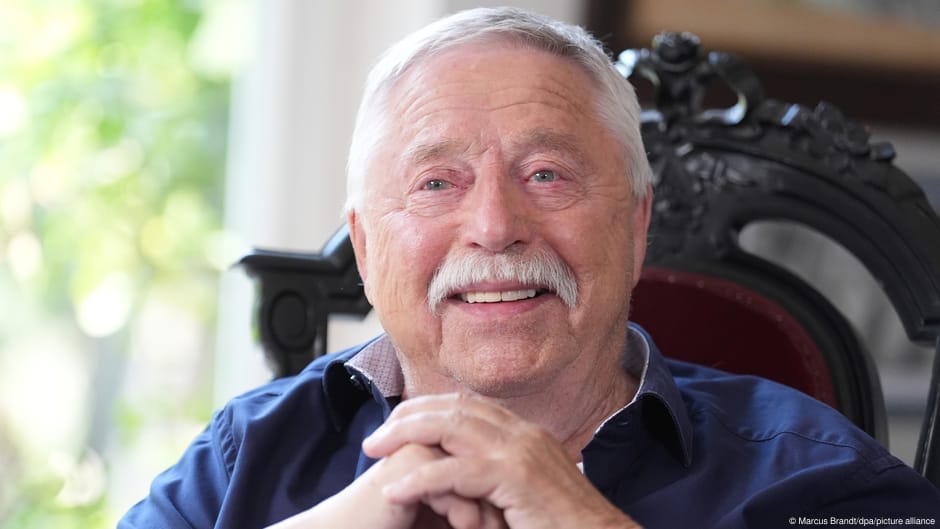
His life is a reflection of contemporary German history, which Biermann has addressed via his songs and sharp wit. Turning 90, he’s as feisty as ever.
He mocks Trump and Putin's political love affair, criticizes the "endless war of brotherhood" over Israel, and makes constant calls for freedom. It was freedom he so sorely missed while living in the former East Germany.
Such themes converge on his latest German album, "Unterm Haar nur Himmel," scheduled for release in conjunction with his birthday on November 15, 2026.
The album's German title is a poetic line coined by Bierman, which translates to "Under the hair, only sky." It generally captures the idea that no matter how restrictive external circumstances become, a person's inner world and spirit can remain boundless and free.
Wolf Biermann is one of Germany's most influential singer-songwriters, and he has no plans to hang up his guitar anytime soon. Sometimes referred to as Germany's own Bob Dylan, the outspoken troubadour still has much to say about current world affairs. His recent track "Moritat von den Liebespaaren" — or "A Ballad of Lovers" — contains the message that while no one person can save the world, everyone could help make it a better place. And he exhorts everyone to get actively involved in their own lives.
This outspokenness was instilled in Wolf Biermann early on. When he was born in Hamburg in 1936, Adolf Hitler was already in power. His father was a dockworker, a committed communist, a resistance fighter against the Nazis — and Jewish. Wolf was just three months old when the Gestapo, Hitler's secret police, arrested his father. He initially served time in prison before he was murdered by the Nazis at Auschwitz in early 1943.
Just a few months later, British and American bombers attacked Hamburg, unleashing a devastating firestorm. "Nothing in my life has shaped me more," Biermann has repeatedly said in interviews. When the air raid sirens sounded, his mother took him into an air raid shelter. The house above them was burning.
Yet Biermann says his memories of that time are rooted in a profound sense of trust in life. In an interview with the German magazine Chrismon, he recalled: "I pressed my face into my mother's soft coat so I could breathe. A sense of security in the midst of the end of the world. We stumbled out over the neighboring house and into the open. The firestorm lifted a burning roof into the air. Roaring corrugated metal, smoke everywhere. We searched for a way out. (...) Death was everywhere. 40,000 people died. They had no chance. But I did. My strong mama."
His mother instilled communist and anti-fascist ideas in him with almost religious fervor. "My mother had only one goal after those dark years," Biermann recalls. "I was supposed to survive so that I could, as she put it rather grandly, one day take revenge for my father's death. I was supposed to build communism."
In 1953, while countless people were fleeing from East Germany, Biermann moved there of his own free will — after all, communism was the official state ideology. He was just 16 at the time. In East Berlin, he studied political economy, mathematics and philosophy. His role models were writers Bertolt Brecht and Heinrich Heine. He began working as an assistant director at the Berliner Ensemble. He also began writing and performing his political songs.
He soon realized that life in East Germany was far from the communist paradise he had imagined and he wrote about this openly in his songs. "The party bosses were torn," Biermann recalls. "They were delighted by this young poet who could play the guitar so beautifully and sing such cheeky songs. They thought they just needed to bring me into line. Even today, I'm amazed that I wound up cast in the role of the heroic dragon slayer."
In 1965, East Germany's ruling Socialist Unity Party, the SED, imposed a blanket ban on Biermann performing or publishing his work. His East Berlin apartment, which was under constant surveillance, soon became a gathering place for dissidents and critical thinkers.
Yet, to his great surprise, the East German authorities allowed him to travel to Cologne, West Germany in 1976. There, around 7,000 people flocked to see him. For four and a half hours, he strummed and sang, mocking the East German regime. His songs were so popular that bootleg copies found their way back to East Germany.
On November 16, while still on tour in West Germany, Biermann heard the news on his car radio that he had been stripped of his right to continue residing in the German Democratic Republic. The regime accused him of betraying and slandering East Germany. "I felt like the ground had opened up beneath me. I was overcome with fear, everything went dark," Biermann wrote in his memoirs.
In a petition, leading East German intellectuals spoke out against the decision. In response, the regime stepped up surveillance of dissidents, imposed professional bans and jailed its critics. Several prominent public figures left the country.
"The SED leadership expected an angry media response from the West. What they hadn't reckoned with was that, for the very first time, a group of respected East German writers and artists would make their protest public, disguising it as a humble petition," Biermann writes.
Biermann sank into a deep depression. "Not just because I had been torn away from the friends I knew and loved in East Berlin, but also because I had lost my familiar mortal enemies," he says. He became involved in the peace and anti-nuclear movements and continued singing about the injustices of the world. "The world's conflicts take different forms in each generation," he says. "But it's always the same struggle for freedom."
The singer-songwriter plans to spend his 90th birthday at home in Hamburg with his wife and manager, Pamela. For the first time in his life, he says, he's skipping the birthday party, even with his 10 children. "I'm so old and I can feel my strength fading. And I know that the next day I have a major concert at the Berliner Ensemble," he told the German Press Agency (dpa).
And should he ever die, he says, he wants to be buried at Berlin's cemetery where some renowned German writers and intellectuals have been laid to rest, among them Bertolt Brecht, Anna Seghers and Georg Wilhelm Friedrich Hegel. Quite a crowd, Biermann says. He still has a thing or two to discuss with them.
- biermann
- wolf
- singer
- east
- germany
- life
- reflection
- history