Werner Holzer Prize awarded to Katja Gloger and DW's Jaafar Abdul Karim
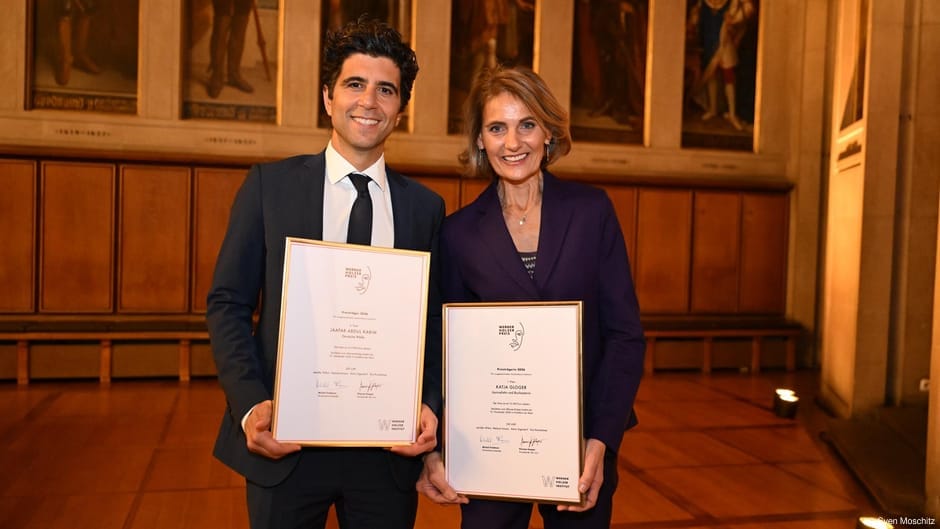
DW journalist Jaafar Abdul Karim and Russia correspondent Katja Gloger have been awarded the prestigious Werner Holzer Prize for international journalism.
At a time when press freedom is under pressure and international newsrooms are shrinking, the Werner Holzer Prize celebrates a profession that many consider indispensable to democracy: foreign correspondence.
Presented in honor of Werner Holzer, the veteran reporter and former editor-in-chief of the German daily newspaper Frankfurter Rundschau, this year's award coincided with what would have been his 100th birthday. Holzer spent decades reporting from some of the world's most important hot spots and championing international journalism.
At the award ceremony in Frankfurt's Römer, the city's historic town hall, Mayor Mike Josef recalled that fundamental rights such as freedom of speech and freedom of the press were first enshrined for all Germans by the Frankfurt Parliament in the nearby Paulskirche in 1848.
The 2026 winners reflect the breadth and ambition of the award. First prize went to Katja Gloger, a veteran Russia correspondent who moved to Moscow in 1989 and accompanied Vladimir Putin during the early years of his presidency.
In her recent nonfiction book, "The Failure: An Investigative Report of Germany's Russia Policy," Gloger and co-author Georg Mascolo offer a searing critique of the misjudgments and illusions that shaped German policy toward Russia for decades.
Second prize was awarded to DW journalist and presenter Jaafar Abdul Karim. His talk show JaafarTalk reaches millions of viewers across the Arab world and in Germany. Whether in Tunis, Beirut or Cairo, Abdul Karim tackles subjects that are often considered taboo.
A research grant went to freelance journalist Luise Land, whose current project explores why her German-Namibian family still owns extensive landholdings in Namibia today. By tracing that history, she examines the enduring legacy of the genocide against the Herero and Nama peoples by German colonial forces in the early 20th century.
"Katja Gloger is one of the leading foreign policy reporters. For decades, she has been among the foremost experts on Russia and speaks out on uncomfortable truths," the jury stated on Friday, explaining its decision to honor Gloger. "Like almost no one else, she has gained access to the very heart of the Kremlin's power elite — from Mikhail Gorbachev to Vladimir Putin."
At the prize-giving ceremony, Gloger delivered a passionate plea for more journalism — and more international coverage — in the German press. "We must defend trustworthy, reliable and fact-based journalism with everything in our power," she said.
Gloger worked for Reporters Without Borders for 12 years. "The latest rankings show that only one in 100 people can get their information from free, independent journalism and a free, independent press. That shows what's at stake," she said.
The prize winner also said she would dedicate the award to journalists in exile and to her colleagues at Novaya Gazeta, the independent Russian newspaper long known for its critical reporting on the Kremlin. Earlier this week, the paper was forced to shut down its operations in Russia and leave its Moscow newsroom.
In his acceptance speech, Jaafar Abdul Karim said journalism has become more challenging and exhausting than ever. The DW host spoke of hatred and incitement, attacks and threats, both online and offline, in the regions he reports on as well as in Germany.
Such pressure, he said, takes a personal toll — yet giving up is not an option. "When I listen to my heart, I know I have to keep going," he said. The answer, he argued, is a form of journalism that fosters dialogue, embraces multiple perspectives and helps bridge divides rather than deepen them.
"I firmly believe in the power of dialogue, today more than ever. That's why we must talk to one another. Even when it gets difficult. Even when we disagree. Or perhaps precisely because of that," he said.
Listening doesn't mean agreeing, and understanding doesn't mean being in agreement. "Especially now, in times of polarization, when those who believe they're always right are often the loudest, we as journalists have a special responsibility. When everyone is just shouting into their own bubbles or communities, we need journalists who connect these bubbles with one another," he said.
The jury praised Abdul Karim for creating programs at DW that reach millions of young people across the Arab world and in Germany. "His journalism fosters dialogue between countries, between generations, and between religions. He has set new standards," the jury stated.
So far in 2026, JaafarTalk has already garnered more than 1.1 billion views across all platforms, and its community has grown to more than 9 million followers. Its motto: "Diversity fosters dialogue."
"We need fact-based journalism that promotes dialogue and reflects the diversity of our society," Abdul Karim stressed. "By that, I mean an honest and open dialogue in which we do not look away or remain silent. On the contrary, we must take a clear stand against racism, antisemitism, Islamophobia, discrimination, sexism, and hate speech — no matter which side they come from."
- werner
- holzer
- prize
- katja
- gloger
- jaafar
- abdul
- karim