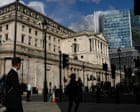
A rapid interest rate rise seems inevitable – and households are expected to pick up the tab
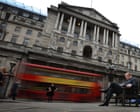
Raising borrowing costs too far risks laying waste to whatever growth there is in the economy A head of steam is building up behind the Bank of England raising interest rates again. A growing number of analysts predict the Bank’s policymakers will don Scrooge masks when they meet on 17 December to deliver a message of austerity and sacrifice.
Raising borrowing costs too far risks laying waste to whatever growth there is in the economy
A head of steam is building up behind the Bank of England raising interest rates again. With the latest forecasts by the central bank showing inflation rising to 5% next spring, another increase in the cost of borrowing seems inevitable, and may come as soon as next month.
A growing number of analysts predict the Bank’s policymakers will don Scrooge masks when they meet on 17 December to deliver a message of austerity and sacrifice.
So sclerotic is the economy, so lacking in flexibility or productive spare capacity, that even the burst of growth experienced by the UK over the last year, defying most forecasters, must be calmed down with higher interest rates or else inflation will rip.
Huw Pill, the Bank’s chief economist, told the Financial Times on Saturday that more than one rate rise was almost certain.
This is not a message anyone who borrows money will want to hear, especially when the festive season is in full swing. If interest rates edge up from 4% to 4.25%, mortgage deals will rise and business loans will become more expensive.
The central bank expects businesses to react to the higher costs of doing business by hitting their customers with price hikes. It is an argument that presumes consumers have money available to pay higher prices, despite plenty of evidence to the contrary. Only households in the top half of the income scale have spent more this year and that has depended on running down their savings.
Consumers are also battle-hardened after the greedflation period following the pandemic that morphed into its evil cousin, shrinkflation. They know about grifting retailers and consumer product suppliers that try to build a narrative about the inevitability of surging inflation to disguise their own price hikes.
The Bank says its business surveys have failed to detect efforts by the corporate sector to increase prices. It’s just that a majority of policymakers are convinced pressure is building and inflation will be more than double their 2% target in a few months.
But if consumers don’t have any spare cash, or have become more savvy about how they spend it, there is still a weak link – a special kind of consumer who could aid corporates in pushing up prices.
The weak link is the state, or government in all its forms. The NHS is a big purchaser, so is local government and the many agencies that are funded by government, from Homes England to National Highways. Government expenditure on goods and services accounts for 25% of overall consumption in the economy.
Everything from concrete and medical supplies to food and furniture will cost more, and sellers will be prepared to justify the rise with a wide range of excuses.
Corporates will blame the war in the Middle East for an increase in transport costs and the impact of climate change that makes growing stuff harder. They will even accuse the government of raising costs by introducing new worker protection rules.
Let’s add another one: contractors will say they can’t get the skilled staff and so must pass on the cost of higher wages.
After 15 years of austerity and job cuts, there is a question mark over whether the public sector has the nous and resolve to push back to keep costs in check.
Budgets on the London to Birmingham high-speed rail line (HS2) have spiralled out of control. The costs of the next largest infrastructure project in England, the 14.5-mile (23km) lower Thames crossing linking Essex and Kent via two tunnels, have more than doubled to £11bn.
Government spending on consultants reached £3.7bn in 2024-25 from £2.9bn in 2022-23 and there seems to be no end to their uses, from advisers on artificial intelligence to strategies for reaching net zero.
The public sector is also notorious for commissioning plans for new town or city developments for which there is no funding, except for the inflationary bill from consultants.
These public sector organisations have huge clout, and should use it. If they do, there will be knock-on effects to inflation deals struck within the business community, which in many cases can only ramp up prices knowing the public sector is the ultimate buyer.
Inside Threadneedle Street, policymakers expect everyone – consumers, government and business – to cave in to sellers’ demands. And that many of the UK’s 33 million workers will subsequently demand big pay rises to compensate.
Yet it must be possible that all three consumer groups will adopt the slogan Can’t Pay, Won’t Pay, limiting the rise in inflation and eliminating the need for elevated pay rises.
Even if the poor, financially bombed-out household consumer is the only one to take a stand against greedy corporates, inflation will not hit the heights forecast by the Bank of England. In the meantime, it might have raised interest rates too far, laying waste to whatever growth there is in the economy.
- interest
- rate
- bank
- rise
- tab
- borrowing
- cost
- household